
Join Our JEE Preparation Group
Prep with like-minded aspirants; Get access to free daily tests and study material.
Sign in
Please select an account to continue using cracku.in
↓ →
Join Our JEE Preparation Group
Prep with like-minded aspirants; Get access to free daily tests and study material.
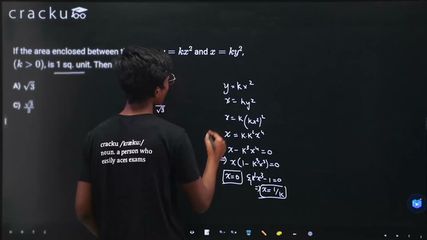
If the area enclosed between the curves $$y = kx^2$$ and $$x = ky^2$$, $$(k \gt 0)$$, is 1 sq. unit. Then $$k$$ is:
We have to find the area that lies between the two curves $$y = kx^{2}$$ and $$x = ky^{2}$$, where $$k \gt 0$$, and equate it to the given value 1 sq. unit in order to determine $$k$$.
First, we locate the points of intersection of the curves. Putting $$y = kx^{2}$$ into $$x = ky^{2}$$ gives
$$x = k\left(kx^{2}\right)^{2} = k\bigl(k^{2}x^{4}\bigr) = k^{3}x^{4}.$$
Re-arranging,
$$k^{3}x^{4} - x = 0 \quad\Longrightarrow\quad x\bigl(k^{3}x^{3} - 1\bigr)=0.$$
Therefore $$x = 0$$ or $$k^{3}x^{3}=1$$. Since $$k\gt 0$$, the second equation gives
$$x = \dfrac{1}{k}.$$
Substituting $$x = \dfrac{1}{k}$$ into $$y = kx^{2}$$, we get
$$y = k\left(\dfrac{1}{k}\right)^{2}=k\cdot\dfrac{1}{k^{2}}=\dfrac{1}{k}.$$
So the two curves meet at the points $$(0,0)$$ and $$\left(\dfrac{1}{k},\dfrac{1}{k}\right).$$
To set up the integral, we need the explicit form of each curve as $$y$$ in terms of $$x$$. We already have $$y_{1}=kx^{2}$$. From $$x = ky^{2}$$ we solve for $$y$$ (taking the positive square root because we are in the first quadrant):
$$y_{2} = \sqrt{\dfrac{x}{k}} = \dfrac{1}{\sqrt{k}}\;x^{1/2}.$$
Next we decide which curve is above the other between $$x=0$$ and $$x=\dfrac{1}{k}$$. For a typical $$x$$ in this interval we compare:
$$y_{1}=kx^{2}, \qquad y_{2}=\sqrt{\dfrac{x}{k}}.$$ Squaring both sides of $$kx^{2} \lt \sqrt{\dfrac{x}{k}}$$ gives $$k^{2}x^{4} \lt \dfrac{x}{k}\;\;\Longleftrightarrow\;\;k^{3}x^{3} \lt 1,$$ which is true for all $$0\le x \lt \dfrac{1}{k}$$. Hence $$y_{2}$$ lies above $$y_{1}$$ everywhere in the required strip.
Thus, the required area $$A$$ is obtained by integrating the vertical difference $$y_{2}-y_{1}$$ from $$x=0$$ to $$x=\dfrac{1}{k}$$:
$$ A=\int_{0}^{1/k}\Bigl(\sqrt{\dfrac{x}{k}}-kx^{2}\Bigr)\,dx. $$
We now evaluate the integral term by term. First rewrite the integrand in powers of $$x$$:
$$\sqrt{\dfrac{x}{k}} = \dfrac{1}{\sqrt{k}}\;x^{1/2},\qquad kx^{2}=k\,x^{2}.$$
Therefore,
$$ A=\int_{0}^{1/k}\left(\dfrac{1}{\sqrt{k}}\,x^{1/2}-k\,x^{2}\right)\!dx =\dfrac{1}{\sqrt{k}}\int_{0}^{1/k}x^{1/2}\,dx -k\int_{0}^{1/k}x^{2}\,dx. $$
We now recall the basic power-integration formula: $$\displaystyle\int x^{n}\,dx = \dfrac{x^{n+1}}{n+1}+C$$ for any real $$n\neq -1$$. Using this:
$$ \int x^{1/2}\,dx=\dfrac{x^{3/2}}{3/2}=\dfrac{2}{3}\,x^{3/2},\qquad \int x^{2}\,dx=\dfrac{x^{3}}{3}. $$
Substituting the limits $$0$$ and $$\dfrac{1}{k}$$, we get
$$ A=\dfrac{1}{\sqrt{k}}\left[\dfrac{2}{3}x^{3/2}\right]_{0}^{1/k} -k\left[\dfrac{x^{3}}{3}\right]_{0}^{1/k}. $$
Evaluating the first bracket at $$x=\dfrac{1}{k}$$ gives $$\dfrac{2}{3}\left(\dfrac{1}{k}\right)^{3/2} =\dfrac{2}{3}\cdot\dfrac{1}{k^{3/2}}.$$ Multiplying by $$\dfrac{1}{\sqrt{k}}$$ yields $$\dfrac{2}{3}\cdot\dfrac{1}{\sqrt{k}}\cdot\dfrac{1}{k^{3/2}} =\dfrac{2}{3}\cdot\dfrac{1}{k^{2}}.$$ (The lower limit contributes 0.)
For the second bracket, at $$x=\dfrac{1}{k}$$ we obtain $$\dfrac{1}{3}\left(\dfrac{1}{k}\right)^{3} =\dfrac{1}{3k^{3}},$$ and multiplying by the outer $$k$$ gives $$k\cdot\dfrac{1}{3k^{3}}=\dfrac{1}{3k^{2}}.$$ (The lower limit again contributes 0.)
Collecting the two results,
$$ A=\dfrac{2}{3k^{2}}-\dfrac{1}{3k^{2}} =\dfrac{1}{3k^{2}}. $$
The problem states that this area equals 1 sq. unit, so
$$ \dfrac{1}{3k^{2}}=1 \quad\Longrightarrow\quad k^{2}=\dfrac{1}{3} \quad\Longrightarrow\quad k=\dfrac{1}{\sqrt{3}},\;\;\text{because }k\gt 0. $$
Hence, the correct answer is Option B.
Was this solution helpful?
Click on the Email ☝️ to Watch the Video Solution
Create a FREE account and get:
_1.webp)

Educational materials for JEE preparation

Ask our AI anything

AI can make mistakes. Please verify important information.
AI can make mistakes. Please verify important information.
