
Join Our JEE Preparation Group
Prep with like-minded aspirants; Get access to free daily tests and study material.
Sign in
Please select an account to continue using cracku.in
↓ →
Join Our JEE Preparation Group
Prep with like-minded aspirants; Get access to free daily tests and study material.
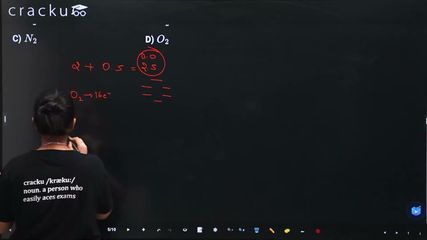
We first translate the verbal condition. “Two $$\pi$$ bonds and half a $$\sigma$$ bond” means that in the molecular-orbital picture the total bond order is
$$\;2\;(\text{from }\pi\text{ orbitals}) \;+\;0.5\;(\text{from a }\sigma\text{ orbital}) \;=\;2.5.$$
The bond order of any homonuclear di-atomic species is found with the well-known formula
$$\text{Bond order}\;=\;\dfrac{N_b-N_a}{2},$$
where $$N_b$$ is the total number of electrons in bonding molecular orbitals and $$N_a$$ is the total number in antibonding molecular orbitals.
For second-period molecules the sequence of valence MOs depends on the atomic number. For $$B_{2},C_{2},N_{2}$$ and their ions (that is, for $$Z\le 7$$) the order is
$$\sigma(2s),\,\sigma^{*}(2s),\,\pi(2p_x)=\pi(2p_y),\,\sigma(2p_z),\,\pi^{*}(2p_x)=\pi^{*}(2p_y),\,\sigma^{*}(2p_z).$$
For $$O_{2},F_{2}$$ and their ions ($$Z\ge 8$$) the two $$\pi(2p)$$ bonding orbitals lie below $$\sigma(2p_z).$$ That change in order does not affect the total count of bonding and antibonding electrons, so the bond order calculation remains straightforward.
We now examine each option in turn.
(A) $$O_{2}^-$$
Each O contributes 6 valence electrons, the extra negative charge adds one more, so we have $$6+6+1=13$$ valence electrons (core 1s electrons cancel out). Filling the MOs for oxygen-type ordering gives
$$\sigma 2s^2,\;\sigma^{*}2s^2,\;\sigma 2p_z^2,\;\pi 2p_x^2,\;\pi 2p_y^2,\;\pi^{*}2p_x^2,\;\pi^{*}2p_y^{\,1}.$$
Thus $$N_b=8$$ (the first five orbitals) and $$N_a=5$$ (the last three antibonding electrons), so
$$\text{Bond order}=\dfrac{8-5}{2}=1.5.$$
This is smaller than the required $$2.5,$$ so option A is discarded.
(B) $$N_{2}^+$$
Here each N supplies 5 valence electrons; the positive charge removes one electron, leaving $$5+5-1=9$$ valence electrons. Because $$Z\le 7,$$ the MO order with $$\pi(2p)$$ below $$\sigma(2p_z)$$ is used. Filling proceeds as
$$\sigma 2s^2,\;\sigma^{*}2s^2,\;\pi 2p_x^2,\;\pi 2p_y^2,\;\sigma 2p_z^{\,1}.$$
Counting electrons,
$$N_b=7\quad(2+0+2+2+1),\qquad N_a=2\quad(\text{from }\sigma^{*}2s).$$
Hence
$$\text{Bond order}=\dfrac{7-2}{2}=2.5.$$
To see the nature of those 2.5 bonds, we compare bonding and antibonding occupancy orbital by orbital:
• The two degenerate $$\pi(2p)$$ bonding orbitals contain four electrons, while their antibonding counterparts contain none, so the net contribution from the $$\pi$$ set is
$$\dfrac{4-0}{2}=2\text{ (two }\pi\text{ bonds)}.$$
• The $$\sigma(2p_z)$$ bonding orbital holds only one electron, with no electron in $$\sigma^{*}(2p_z).$$ That single extra bonding electron gives
$$\dfrac{1-0}{2}=0.5\text{ (half a }\sigma\text{ bond)}.$$
All other $$\sigma$$ contributions (from $$\sigma 2s$$ versus $$\sigma^{*}2s$$) cancel. Therefore $$N_{2}^+$$ indeed possesses “two $$\pi$$ and half a $$\sigma$$ bond,” exactly matching the statement.
(C) $$N_{2}$$
With ten valence electrons the filling is
$$\sigma 2s^2,\;\sigma^{*}2s^2,\;\pi 2p_x^2,\;\pi 2p_y^2,\;\sigma 2p_z^2.$$
This gives $$N_b=8,\;N_a=2,$$ so
$$\text{Bond order}=\dfrac{8-2}{2}=3.0,$$
corresponding to two $$\pi$$ bonds and one full $$\sigma$$ bond, not the required pattern. Option C is ruled out.
(D) $$O_{2}$$
Twelve valence electrons produce the configuration
$$\sigma 2s^2,\;\sigma^{*}2s^2,\;\sigma 2p_z^2,\;\pi 2p_x^2,\;\pi 2p_y^2,\;\pi^{*}2p_x^{\,1},\;\pi^{*}2p_y^{\,1}.$$
Here $$N_b=8,\;N_a=4,$$ giving a bond order of $$2.0.$$ The breakup is one $$\sigma$$ bond and one $$\pi$$ bond (because each $$\pi$$-$$\pi^{*}$$ pair contributes only half a bond). This is again not what we need.
The only species whose molecular orbital analysis yields exactly two $$\pi$$ bonds and half a $$\sigma$$ bond is $$N_{2}^+.$$ Hence, the correct answer is Option B.
Was this solution helpful?
Click on the Email ☝️ to Watch the Video Solution
Create a FREE account and get:
_1.webp)

Educational materials for JEE preparation

Ask our AI anything

AI can make mistakes. Please verify important information.
AI can make mistakes. Please verify important information.
