
Join Our JEE Preparation Group
Prep with like-minded aspirants; Get access to free daily tests and study material.
Sign in
Please select an account to continue using cracku.in
↓ →
Join Our JEE Preparation Group
Prep with like-minded aspirants; Get access to free daily tests and study material.
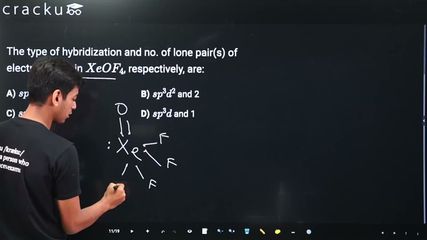
The type of hybridization and no. of lone pair(s) of electron of Xe in $$XeOF_4$$, respectively, are:
First, we note that xenon has the electronic configuration $$[Kr]\,4d^{10}\,5s^{2}\,5p^{6}$$, so the number of valence electrons on $$\text{Xe}$$ is $$8$$.
In the molecule $$XeOF_{4}$$ the central atom is xenon, which is bonded to one oxygen atom and four fluorine atoms. We must count all the electrons of xenon that participate in these bonds.
The Xe-O bond is a double bond. A double bond consists of one $$\sigma$$-bond and one $$\pi$$-bond. Each $$\sigma$$-bond requires one electron from xenon, and each $$\pi$$-bond also requires one electron from xenon. Thus, for the Xe-O linkage xenon contributes
$$1 \,(\sigma\text{-electron}) + 1 \,(\pi\text{-electron}) = 2 \text{ electrons}.$$
Every Xe-F bond is a single bond and therefore contains only one $$\sigma$$-bond. Xenon must contribute one electron to each of the four Xe-F $$\sigma$$-bonds, hence
$$4 \times 1 = 4 \text{ electrons}.$$
Adding together the electrons of xenon used in all the bonds, we have
$$2 \text{(for Xe-O)} + 4 \text{(for four Xe-F)} = 6 \text{ electrons}.$$
Xenon started with $$8$$ valence electrons, so the electrons that remain unshared (and therefore form lone pairs) are
$$8 - 6 = 2 \text{ electrons}.$$
Two electrons constitute one lone pair. Thus xenon possesses exactly one lone pair in $$XeOF_{4}$$.
Now we determine the hybridization. We employ the concept of the steric number, which is defined as
$$\text{Steric number} = \text{number of } \sigma\text{-bonds} + \text{number of lone pairs}.$$
In $$XeOF_{4}$$ xenon forms
$$1 \,(\sigma\text{-bond with }O) + 4 \,(\sigma\text{-bonds with }F) = 5 \,\sigma\text{-bonds}.$$
Including the one lone pair, we get
$$\text{Steric number} = 5 + 1 = 6.$$
A steric number of $$6$$ corresponds to $$sp^{3}d^{2}$$ hybridization (since six hybrid orbitals are required: one $$s$$, three $$p$$, and two $$d$$ orbitals).
Therefore, the xenon atom in $$XeOF_{4}$$ is $$sp^{3}d^{2}$$ hybridised and carries one lone pair of electrons.
Hence, the correct answer is Option A.
Click on the Email ☝️ to Watch the Video Solution
Create a FREE account and get:
_1.webp)

Educational materials for JEE preparation

Ask our AI anything

AI can make mistakes. Please verify important information.
AI can make mistakes. Please verify important information.


