
Join Our JEE Preparation Group
Prep with like-minded aspirants; Get access to free daily tests and study material.
Sign in
Please select an account to continue using cracku.in
↓ →
Join Our JEE Preparation Group
Prep with like-minded aspirants; Get access to free daily tests and study material.
We begin by recalling that the oxidation number of oxygen in hydrogen peroxide $$\mathrm{H_2O_2}$$ is $$-1$$(because the total oxidation number of the neutral molecule must be zero and hydrogen is $$+1$$, so $$2(+1)+2(x)=0\Longrightarrow x=-1$$). The value $$-1$$ lies midway between the usual oxidation numbers of oxygen in $$\mathrm{O_2^{2-}}$$ (which is $$-2$$ as in $$\mathrm{H_2O}$$, $$\mathrm{O^{2-}}$$, etc.) and in molecular oxygen $$\mathrm{O_2}$$ (which is $$0$$), as well as between $$-1$$ and $$+2$$ found in $$\mathrm{OF_2}$$. Because of this intermediate oxidation state, $$\mathrm{H_2O_2}$$ can either:
• lose electrons (be oxidised) and act as a reducing agent, or
• gain electrons (be reduced) and act as an oxidising agent.
Now we verify its dual behaviour in both acidic and basic media by writing the standard redox half-reactions.
In acidic medium
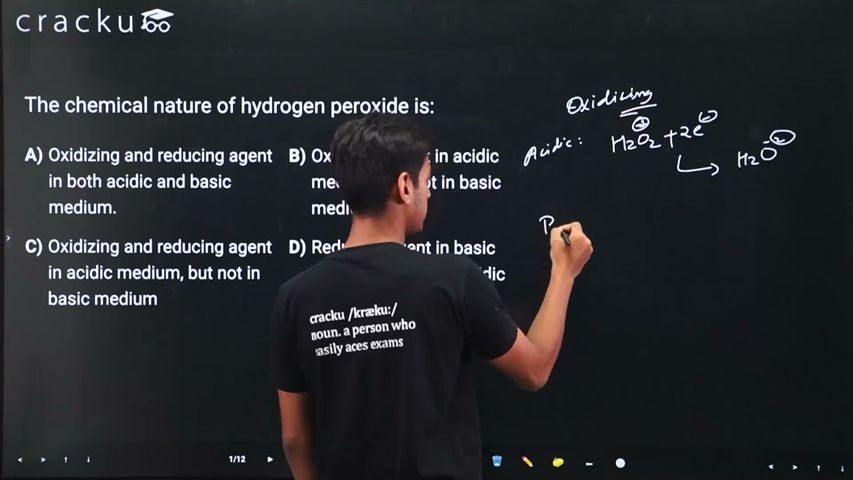
Oxidising action (hydrogen peroxide gets reduced):
$$\mathrm{H_2O_2 + 2H^+ + 2e^- \;\longrightarrow\; 2H_2O} \quad -(1)$$
Reducing action (hydrogen peroxide gets oxidised):
$$\mathrm{H_2O_2 \;\longrightarrow\; O_2 + 2H^+ + 2e^-} \quad -(2)$$
Because both half-reactions are feasible, $$\mathrm{H_2O_2}$$ acts as both an oxidising and a reducing agent in acidic solution.
In basic medium
Oxidising action (hydrogen peroxide gets reduced):
$$\mathrm{H_2O_2 + 2e^- \;\longrightarrow\; 2OH^-} \quad -(3)$$
Reducing action (hydrogen peroxide gets oxidised):
$$\mathrm{H_2O_2 + 2OH^- \;\longrightarrow\; O_2 + 2H_2O + 2e^-} \quad -(4)$$
Again, both processes are allowed, so in alkaline solution also it behaves as both oxidising and reducing agent.
Because hydrogen peroxide exhibits both oxidising and reducing properties in both acidic and basic media, we match this description with the options provided.
Option A states: “Oxidizing and reducing agent in both acidic and basic medium.” This is precisely what we have demonstrated.
Hence, the correct answer is Option A.
Was this solution helpful?
Click on the Email ☝️ to Watch the Video Solution
Create a FREE account and get:
_1.webp)

Educational materials for JEE preparation

Ask our AI anything

AI can make mistakes. Please verify important information.
AI can make mistakes. Please verify important information.
