
Join Our JEE Preparation Group
Prep with like-minded aspirants; Get access to free daily tests and study material.
Sign in
Please select an account to continue using cracku.in
↓ →
Join Our JEE Preparation Group
Prep with like-minded aspirants; Get access to free daily tests and study material.
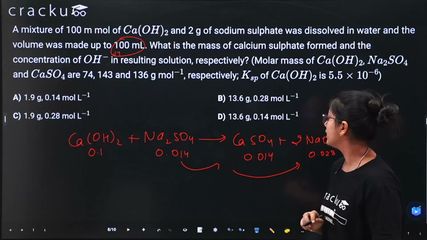
A mixture of 100 m mol of $$Ca(OH)_2$$ and 2 g of sodium sulphate was dissolved in water and the volume was made up to 100 mL. What is the mass of calcium sulphate formed and the concentration of $$OH^-$$ in resulting solution, respectively? (Molar mass of $$Ca(OH)_2$$, $$Na_2SO_4$$ and $$CaSO_4$$ are 74, 143 and 136 g mol$$^{-1}$$, respectively; $$K_{sp}$$ of $$Ca(OH)_2$$ is $$5.5 \times 10^{-6}$$)
We need to determine the mass of calcium sulphate ($$\text{CaSO}_4$$) formed and the final concentration of hydroxide ions ($$\text{OH}^-$$) when $$100\text{ mmol}$$ of $$\text{Ca(OH)}_2$$ reacts with $$2\text{ g}$$ of sodium sulphate ($$\text{Na}_2\text{SO}_4$$) in a $$100\text{ mL}$$ solution.
The chemical reaction between calcium hydroxide and sodium sulphate is a double displacement reaction:
$$\text{Ca(OH)}_2(aq) + \text{Na}_2\text{SO}_4(aq) \rightarrow \text{CaSO}_4(s) + 2\text{NaOH}(aq)$$
Initial moles of $$\text{Ca(OH)}_2$$:
$$\text{Moles of Ca(OH)}_2 = 100\text{ mmol} = 0.1\text{ mol}$$Initial moles of $$\text{Na}_2\text{SO}_4$$:
$$\text{Moles of Na}_2\text{SO}_4 = \frac{\text{Mass}}{\text{Molar Mass}} = \frac{2\text{ g}}{143\text{ g mol}^{-1}} \approx 0.014\text{ mol} = 14\text{ mmol}$$Since $$1\text{ mol}$$ of $$\text{Ca(OH)}_2$$ reacts with $$1\text{ mol}$$ of $$\text{Na}_2\text{SO}_4$$, and we have significantly fewer moles of $$\text{Na}_2\text{SO}_4$$, $$\text{Na}_2\text{SO}_4$$ is the limiting reagent.
According to the stoichiometry, $$1\text{ mol}$$ of $$\text{Na}_2\text{SO}_4$$ produces $$1\text{ mol}$$ of $$\text{CaSO}_4$$:
$$\text{Moles of CaSO}_4 \text{ formed} = 0.014\text{ mol}$$
$$\text{Mass of CaSO}_4 = 0.014\text{ mol} \times 136\text{ g mol}^{-1} \approx 1.9\text{ g}$$
From the balanced equation, $$1\text{ mol}$$ of $$\text{Na}_2\text{SO}_4$$ generates $$2\text{ mol}$$ of $$\text{NaOH}$$ (which completely dissociates to provide $$2\text{ mol}$$ of $$\text{OH}^-$$):
$$\text{Moles of OH}^- \text{ produced} = 2 \times 0.014\text{ mol} = 0.028\text{ mol}$$
The total volume of the resulting solution is made up to $$100\text{ mL} = 0.1\text{ L}$$. The molarity of $$\text{OH}^-$$ is:
$$\text{Concentration of OH}^- = \frac{\text{Moles of OH}^-}{\text{Volume of solution in L}} = \frac{0.028\text{ mol}}{0.1\text{ L}} = 0.28\text{ mol L}^{-1}$$
The calculation yields a precipitated mass of $$1.9\text{ g}$$ for calcium sulphate and a final hydroxide ion concentration of $$0.28\text{ mol L}^{-1}$$.
Answer: Option C — 1.9 g, 0.28 mol L$$^{-1}$$
Click on the Email ☝️ to Watch the Video Solution
Create a FREE account and get:
_1.webp)

Educational materials for JEE preparation

Ask our AI anything

AI can make mistakes. Please verify important information.
AI can make mistakes. Please verify important information.


