
Join Our JEE Preparation Group
Prep with like-minded aspirants; Get access to free daily tests and study material.
Sign in
Please select an account to continue using cracku.in
↓ →
Join Our JEE Preparation Group
Prep with like-minded aspirants; Get access to free daily tests and study material.
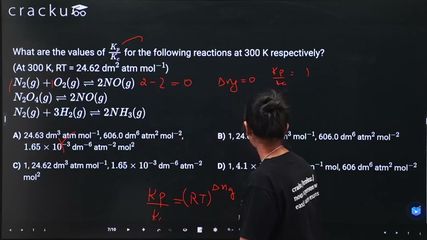
What are the values of $$\frac{K_p}{K_c}$$ for the following reactions at 300 K respectively?
(At 300 K, RT = 24.62 dm$$^2$$ atm mol$$^{-1}$$)
$$N_2(g) + O_2(g) \rightleftharpoons 2NO(g)$$
$$N_2O_4(g) \rightleftharpoons 2NO(g)$$
$$N_2(g) + 3H_2(g) \rightleftharpoons 2NH_3(g)$$
For gaseous reactions we have the relation between the two equilibrium constants
$$K_p = K_c\,(RT)^{\Delta n}$$
where $$\Delta n =(\text{total gaseous moles of products})-(\text{total gaseous moles of reactants})$$ and $$RT$$ has the value given in the question, $$RT = 24.62\ \text{dm}^3\ \text{atm mol}^{-1}$$ at 300 K.
Re-writing the relation to isolate the required ratio,
$$\frac{K_p}{K_c}=(RT)^{\Delta n}$$
Now we evaluate this ratio for each reaction one by one, carefully calculating $$\Delta n$$ each time.
First reaction : $$N_2(g)+O_2(g)\rightleftharpoons 2NO(g)$$
The number of gaseous moles on the left is $$1+1=2$$ while on the right it is $$2$$. Hence $$\Delta n = 2-2 = 0$$.
Substituting $$\Delta n=0$$ gives
$$\frac{K_p}{K_c}=(RT)^0 = 1$$
Second reaction : $$N_2O_4(g)\rightleftharpoons 2NO(g)$$
Moles on the left = $$1$$; moles on the right = $$2$$. Therefore $$\Delta n = 2-1 = 1$$.
So
$$\frac{K_p}{K_c}=(RT)^1 = RT = 24.62\ \text{dm}^3\ \text{atm mol}^{-1}$$
Third reaction : $$N_2(g)+3H_2(g)\rightleftharpoons 2NH_3(g)$$
Moles on the left = $$1+3 = 4$$; moles on the right = $$2$$, giving $$\Delta n = 2-4 = -2$$.
Hence
$$\frac{K_p}{K_c}=(RT)^{-2}=\frac{1}{(RT)^2}$$
We now square the given numerical value of $$RT$$:
$$RT = 24.62$$ gives $$ (RT)^2 = (24.62)^2 = 606.1\ \text{dm}^6\ \text{atm}^2\ \text{mol}^{-2}$$ (multiplying 24.62 by 24.62 step-by-step yields 606.1444, which we may round to 606.1).
Therefore
$$\frac{K_p}{K_c}= \frac{1}{606.1}=1.65\times10^{-3}\ \text{dm}^{-6}\ \text{atm}^{-2}\ \text{mol}^2$$
Collecting the three results in the order asked, we have
$$1,\; 24.62\ \text{dm}^3\ \text{atm mol}^{-1},\; 1.65\times10^{-3}\ \text{dm}^{-6}\ \text{atm}^{-2}\ \text{mol}^2$$
These values exactly match the figures presented in Option C.
Hence, the correct answer is Option C.
Click on the Email ☝️ to Watch the Video Solution
Create a FREE account and get:
_1.webp)

Educational materials for JEE preparation

Ask our AI anything

AI can make mistakes. Please verify important information.
AI can make mistakes. Please verify important information.


