
Join Our JEE Preparation Group
Prep with like-minded aspirants; Get access to free daily tests and study material.
Sign in
Please select an account to continue using cracku.in
↓ →
Join Our JEE Preparation Group
Prep with like-minded aspirants; Get access to free daily tests and study material.
The shortest distance between the point $$\left(\frac{3}{2}, 0\right)$$ and the curve $$y = \sqrt{x}$$, $$(x > 0)$$, is:
We have to find the shortest distance between the fixed point $$A\left(\dfrac{3}{2},\,0\right)$$ and a variable point $$P(x,\;y)$$ that lies on the curve $$y=\sqrt{x}$$ with $$x>0$$.
Because every point on the curve satisfies $$y=\sqrt{x}$$, we can rewrite the coordinates of the variable point simply as $$P\bigl(x,\;\sqrt{x}\bigr)$$.
The distance $$D$$ between two points $$\bigl(x_1,y_1\bigr)$$ and $$\bigl(x_2,y_2\bigr)$$ in the plane is given by the distance formula
$$D=\sqrt{(x_2-x_1)^2+(y_2-y_1)^2}.$$
Substituting $$A\left(\dfrac{3}{2},0\right)$$ for $$\bigl(x_1,y_1\bigr)$$ and $$P\bigl(x,\sqrt{x}\bigr)$$ for $$\bigl(x_2,y_2\bigr)$$, we obtain
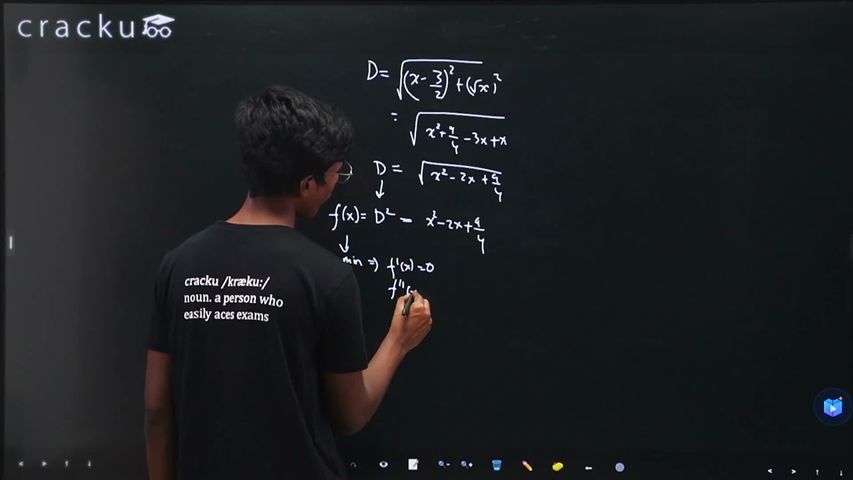
$$D=\sqrt{\left(x-\dfrac{3}{2}\right)^2+\left(\sqrt{x}-0\right)^2}.$$
In problems of minimisation it is easier to work with the square of the distance, because the square-root function is strictly increasing. Thus the value of $$x$$ that minimises $$D$$ also minimises $$D^2$$.
Define
$$f(x)=D^2=\left(x-\dfrac{3}{2}\right)^2+\left(\sqrt{x}\right)^2.$$
We now expand and simplify:
$$\left(x-\dfrac{3}{2}\right)^2=x^2-3x+\dfrac{9}{4},$$
and
$$\left(\sqrt{x}\right)^2=x.$$
Adding these results, we get
$$f(x)=\left[x^2-3x+\dfrac{9}{4}\right]+x=x^2-2x+\dfrac{9}{4}.$$
To locate the minimum of $$f(x)$$ on $$x>0$$ we differentiate and set the derivative to zero. The differentiation rule used is: if $$g(x)=x^n$$ then $$g'(x)=n\,x^{n-1}.$$
Computing the derivative,
$$f'(x)=\dfrac{d}{dx}\Bigl(x^2\Bigr)-\dfrac{d}{dx}\Bigl(2x\Bigr)+\dfrac{d}{dx}\left(\dfrac{9}{4}\right)=2x-2+0=2x-2.$$
Setting $$f'(x)=0$$ for a stationary point,
$$2x-2=0\quad\Longrightarrow\quad x=1.$$
Because $$x=1>0$$, it is acceptable for the domain. We also check the nature of this stationary point by the second derivative. Differentiating once more,
$$f''(x)=\dfrac{d}{dx}(2x-2)=2.$$
Since $$f''(x)=2>0$$ for all $$x$$, the function $$f(x)$$ is convex everywhere; hence the stationary point at $$x=1$$ indeed gives the minimum value of $$f(x)$$ and therefore of the distance.
Now we substitute $$x=1$$ back into the curve equation to obtain the corresponding $$y$$-coordinate:
$$y=\sqrt{x}=\sqrt{1}=1.$$
So the closest point on the curve to $$A$$ is $$P(1,1).$$
We now evaluate the minimum squared distance:
$$f(1)=1^2-2\cdot1+\dfrac{9}{4}=1-2+\dfrac{9}{4}=-1+\dfrac{9}{4}=\dfrac{-4+9}{4}=\dfrac{5}{4}.$$
Taking the square root to revert to the actual distance, we find
$$D_{\text{min}}=\sqrt{\dfrac{5}{4}}=\dfrac{\sqrt{5}}{2}.$$
Hence, the correct answer is Option D.
Was this solution helpful?
Click on the Email ☝️ to Watch the Video Solution
Create a FREE account and get:
_1.webp)

Educational materials for JEE preparation

Ask our AI anything

AI can make mistakes. Please verify important information.
AI can make mistakes. Please verify important information.
