
Join Our JEE Preparation Group
Prep with like-minded aspirants; Get access to free daily tests and study material.
Sign in
Please select an account to continue using cracku.in
↓ →
Join Our JEE Preparation Group
Prep with like-minded aspirants; Get access to free daily tests and study material.
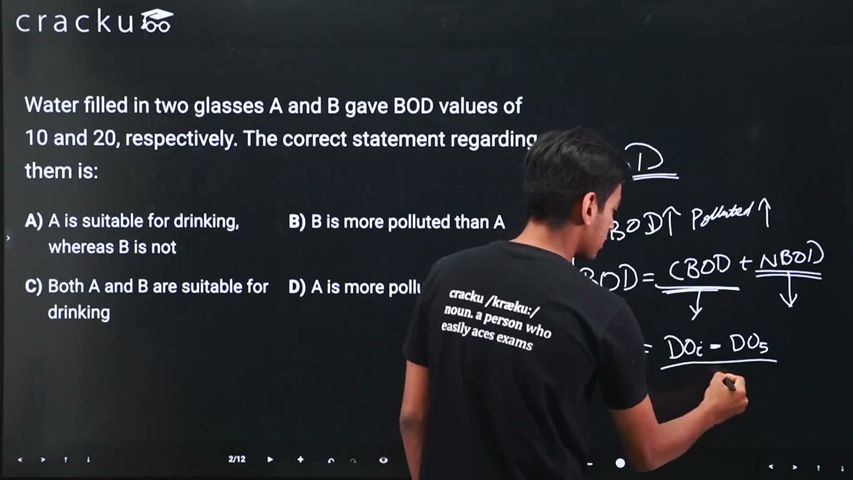
Water filled in two glasses A and B gave BOD values of 10 and 20, respectively. The correct statement regarding them is:
First, recall the definition: the Biological Oxygen Demand (BOD) of a water sample is the mass of dissolved oxygen (in milligrams per litre) that aerobic microorganisms need to oxidise the organic matter present in the water over a standard period (usually 5 days at 20 °C). In simple words, higher BOD means more biodegradable organic pollutants are present, so more oxygen is consumed and the water quality is poorer.
Mathematically we can write the direct proportionality
$$\text{Pollution level} \;\propto\; \text{BOD}$$
and the usual drinking-water guideline is
$$\text{BOD}_{\text{permissible}} < 5 \;\text{mg\,L}^{-1}.$$
Now, for the two glasses we have the numerical data
$$\text{BOD}_A = 10\;\text{mg\,L}^{-1}, \qquad \text{BOD}_B = 20\;\text{mg\,L}^{-1}.$$
Both of these individual values clearly violate the $$<5\;\text{mg\,L}^{-1}$$ criterion, so neither sample qualifies as potable (drinking) water. To compare their relative pollution levels, simply look at the difference:
$$\text{BOD}_B - \text{BOD}_A = 20 - 10 = 10\;\text{mg\,L}^{-1} > 0,$$
which shows $$\text{BOD}_B > \text{BOD}_A.$$ Because BOD is directly proportional to the concentration of organic pollutants, the larger value corresponds to the more polluted sample. Thus glass B, with the higher BOD of $$20\;\text{mg\,L}^{-1},$$ is more polluted than glass A.
Among the given options, the only statement that matches this conclusion is “B is more polluted than A.”
Hence, the correct answer is Option B.
Was this solution helpful?
Click on the Email ☝️ to Watch the Video Solution
Create a FREE account and get:
_1.webp)

Educational materials for JEE preparation

Ask our AI anything

AI can make mistakes. Please verify important information.
AI can make mistakes. Please verify important information.
