
Join Our JEE Preparation Group
Prep with like-minded aspirants; Get access to free daily tests and study material.
Sign in
Please select an account to continue using cracku.in
↓ →
Join Our JEE Preparation Group
Prep with like-minded aspirants; Get access to free daily tests and study material.
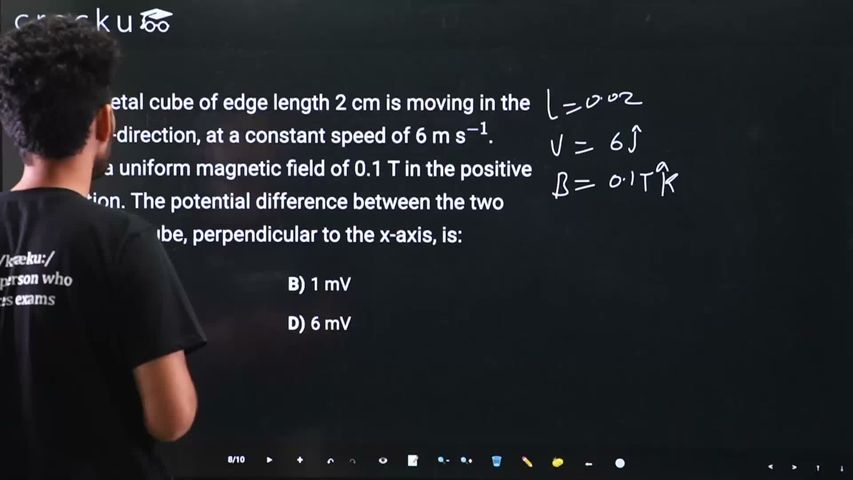
A solid metal cube of edge length 2 cm is moving in the positive y-direction, at a constant speed of 6 m s$$^{-1}$$. There is a uniform magnetic field of 0.1 T in the positive z-direction. The potential difference between the two faces of the cube, perpendicular to the x-axis, is:
We have a solid metallic cube whose edge length is given as 2 cm. In electromagnetism, it is always safer to change every length into the SI unit metre, because the Tesla (T) and the metre-second system go together neatly. So we convert
$$2\ \text{cm}=2\times 10^{-2}\ \text{m}=0.02\ \text{m}.$$
This cube is moving with a constant speed of 6 m s$$^{-1}$$ along the positive $$y$$-axis, that is
$$v=6\ \text{m s}^{-1},\qquad \vec v=6\hat{\mathbf y}\ \text{m s}^{-1}.$$
The region contains a uniform magnetic field whose magnitude is 0.1 T and whose direction is the positive $$z$$-axis, so
$$B=0.1\ \text{T},\qquad \vec B=0.1\hat{\mathbf z}\ \text{T}.$$
We are asked for the potential difference between the two faces that are perpendicular to the $$x$$-axis. Those faces are the left and right faces of the cube; they are separated from each other by a distance equal to the edge length $$\ell=0.02\ \text{m}$$ along the $$x$$-direction.
For a solid conductor moving in a magnetic field, the free charges experience the magnetic Lorentz force $$\vec F=q(\vec v\times\vec B).$$ Inside the conductor, this force causes charge separation until an electric field is set up that balances the magnetic force, leading to a motional emf. The magnitude of that induced potential difference (emf) between two points a distance $$\ell$$ apart in the direction of $$\vec v\times\vec B$$ is given by the standard formula
$$\mathcal E = B\,\ell\,v,$$
provided $$\vec v$$, $$\vec B$$, and the line joining the two points are mutually perpendicular, which is the case here because
$$\vec v\parallel\hat{\mathbf y},\quad \vec B\parallel\hat{\mathbf z},\quad (\vec v\times\vec B)\parallel\hat{\mathbf x}.$$
Now we substitute the known numerical values step by step:
$$\mathcal E = B\,\ell\,v = (0.1\ \text{T})(0.02\ \text{m})(6\ \text{m s}^{-1}).$$
First multiply the last two factors:
$$0.02\ \text{m}\times 6\ \text{m s}^{-1}=0.12\ \text{m}^{2}\text{s}^{-1}.$$
Next multiply by the magnetic field:
$$0.1\ \text{T}\times 0.12\ \text{m}^{2}\text{s}^{-1}=0.012\ \text{V}.$$
Finally convert the result into millivolts, remembering that $$1\ \text{V}=1000\ \text{mV}$$:
$$0.012\ \text{V}=0.012\times 1000\ \text{mV}=12\ \text{mV}.$$
So the induced potential difference between the two faces of the cube that are perpendicular to the $$x$$-axis is $$12\ \text{mV}$$.
Hence, the correct answer is Option A.
Was this solution helpful?
Click on the Email ☝️ to Watch the Video Solution
Create a FREE account and get:
_1.webp)

Educational materials for JEE preparation

Ask our AI anything

AI can make mistakes. Please verify important information.
AI can make mistakes. Please verify important information.
