Join WhatsApp Icon JEE WhatsApp Group
Question 57

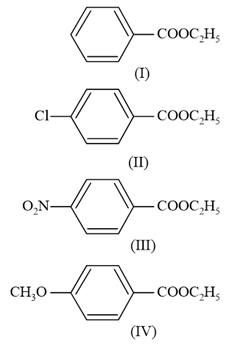
The decreasing order of ease of alkaline hydrolysis for the following esters is:

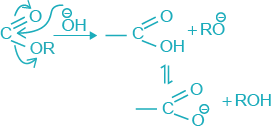
Alkaline hydrolysis of ester follow $$SN_2$$ mechanism.
image

Alkaline hydrolysis of an ester proceeds via a nucleophilic acyl substitution ($$\text{B}_{\text{Ac}}2$$) mechanism. The rate-determining step involves the attack of the hydroxide nucleophile ($$\text{OH}^\ominus$$) on the electrophilic carbonyl carbon:

$$\text{Rate of Hydrolysis} \propto \text{Electrophilicity of the Carbonyl Carbon}$$

  • Electron-Withdrawing Groups (EWGs) increase the positive charge density on the carbonyl carbon, making it more electrophilic and accelerating the rate of hydrolysis.
  • Electron-Donating Groups (EDGs) decrease the positive charge density on the carbonyl carbon, stabilizing the ester starting material and slowing down the reaction.

Substituent Breakdown and Comparison:

  1. Compound III ($$\text{--NO}_2$$ at para position):

    The nitro group is a very strong electron-withdrawing group via both resonance ($$\text{--R}$$) and inductive ($$\text{--I}$$) effects. This creates the highest positive charge on the carbonyl carbon, making III the most reactive.

  2. Compound II ($$\text{--Cl}$$ at para position):

    The chlorine atom acts as an electron-withdrawing group primarily through its inductive ($$\text{--I}$$) effect, which outweighs its weak resonance donation. It increases the reactivity compared to the unsubstituted ester, but less than the nitro group.

  3. Compound I (Unsubstituted Benzene Ring, $$\text{--H}$$):

    The unsubstituted ester serves as the standard baseline reference with no additional electronic enhancement or attenuation.

  4. Compound IV ($$\text{--OCH}_3$$ at para position):

    The methoxy group is a powerful electron-donating group due to resonance ($$\text{+R}$$) from the lone pairs on the oxygen atom. This severely reduces the electrophilicity of the carbonyl carbon, making IV the least reactive.


Why Other Arrangements Are Incorrect:

  • Any order placing IV anywhere but the last position is incorrect because strong resonance electron-donation ($$\text{+R}$$) always exhibits the lowest rate of nucleophilic attack.
  • Any choice ranking II above III is incorrect because inductive withdrawal ($$\text{--I}$$) from a halogen is significantly weaker than the combined resonance ($$\text{--R}$$) and inductive withdrawal of a nitro group.

Conclusion:

Combining these trends gives the clear decreasing sequence of reactivity: III > II > I > IV.

Answer: Option B — III > II > I > IV
Get AI Help

Video Solution

video

Create a FREE account and get:

  • Free JEE Mains Previous Papers PDF
  • Take JEE Mains paper tests

JEE Quant Questions | JEE Quantitative Ability

JEE DILR Questions | LRDI Questions For JEE

JEE Verbal Ability Questions | VARC Questions For JEE

Free JEE Topicwise Questions

JEE Rotational MotionJEE Units & MeasurementsJEE Atomic StructureJEE GravitationJEE Periodic Table & PeriodicityJEE StatisticsJEE Inverse Trigonometric FunctionsJEE Magnetism & Magnetic MaterialsJEE Sequences & SeriesJEE MatricesJEE Alternating CurrentsJEE Carboxylic AcidsJEE Permutations & CombinationsJEE Work, Energy & PowerJEE Electromagnetic InductionJEE Electronic DevicesJEE d and f-Block ElementsJEE Chemical KineticsJEE Heat TransferJEE Three Dimensional GeometryJEE Magnetic Effects of CurrentJEE Hydrocarbons - AromaticJEE Electromagnetic WavesJEE Aldehydes & KetonesJEE Hydrocarbons - AlkanesJEE Applications of DerivativesJEE EquilibriumJEE Indefinite IntegrationJEE Chemical ThermodynamicsJEE ElectrochemistryJEE ProbabilityJEE BiomoleculesJEE Continuity & DifferentiabilityJEE Kinetic Theory of GasesJEE Vector AlgebraJEE Hydrocarbons - AlkynesJEE Differential EquationsJEE Current & ResistanceJEE Straight LinesJEE WavesJEE Redox ReactionsJEE Hydrocarbons - AlkenesJEE DeterminantsJEE SolutionsJEE Ray OpticsJEE Dual Nature of Matter & RadiationJEE Chemical Bonding & Molecular StructureJEE Complex NumbersJEE Sets, Relations & FunctionsJEE Electric Charges & FieldsJEE Laws of MotionJEE Fluid MechanicsJEE Basic Concepts in ChemistryJEE Trigonometric FunctionsJEE LimitsJEE Laws of ThermodynamicsJEE Kinematics - 2D MotionJEE p-Block Elements (Groups 13-18)JEE Simple Harmonic MotionJEE Electric Potential & CapacitanceJEE Coordination CompoundsJEE JEE 2D GeometryJEE CirclesJEE Definite IntegrationJEE EMF & Circuit AnalysisJEE Surface TensionJEE Atoms & NucleiJEE Laboratory Experiments - XIJEE Number SystemJEE Basic Principles of Organic ChemistryJEE Wave OpticsJEE Quadratic EquationsJEE Alcohols, Phenols & EthersJEE Organic Compounds with HalogensJEE DifferentiationJEE Conic SectionsJEE Nitrogen-Containing CompoundsJEE ElasticityJEE Practical Organic ChemistryJEE Kinematics - 1D MotionJEE Purification & CharacterisationJEE Binomial Theorem
Ask AI