
Join Our JEE Preparation Group
Prep with like-minded aspirants; Get access to free daily tests and study material.
Sign in
Please select an account to continue using cracku.in
↓ →
Join Our JEE Preparation Group
Prep with like-minded aspirants; Get access to free daily tests and study material.
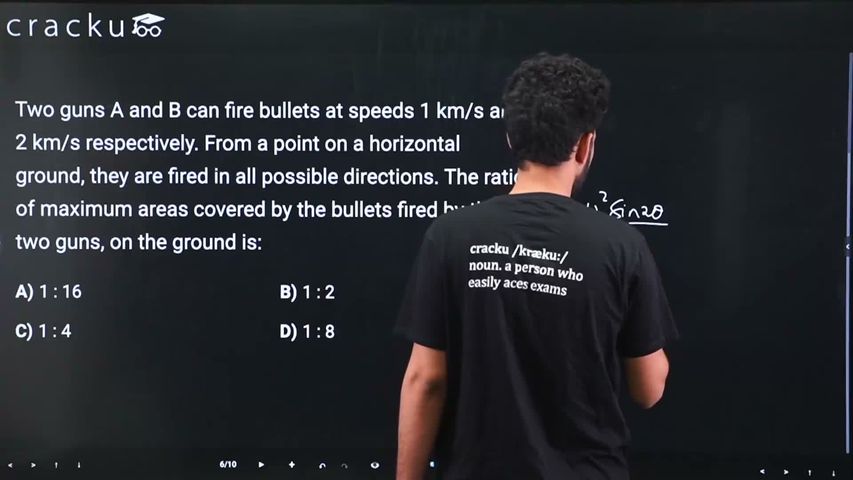
Two guns A and B can fire bullets at speeds 1 km/s and 2 km/s respectively. From a point on a horizontal ground, they are fired in all possible directions. The ratio of maximum areas covered by the bullets fired by the two guns, on the ground is:
Let us consider one of the guns first. A bullet is projected from ground level with an initial speed $$v$$ and makes an angle $$\theta$$ with the horizontal.
For a projectile that starts and finishes at the same height, the horizontal range is given by the well-known kinematic result
$$R \;=\; \frac{v^{2}\sin 2\theta}{g},$$
where $$g$$ denotes the magnitude of gravitational acceleration.
We are asked for the maximum horizontal distance the bullet can reach. The factor $$\sin 2\theta$$ attains its greatest value, namely $$1$$, when $$2\theta = 90^{\circ}$$, i.e. $$\theta = 45^{\circ}$$. Hence the greatest possible range for speed $$v$$ is
$$R_{\max} \;=\; \frac{v^{2}}{g}.$$
The bullet can be fired in any azimuthal direction. Therefore every direction in the horizontal plane is available, and the set of all landing points forms a full circle centred on the firing point with radius $$R_{\max}$$.
The area of this circle is thus
$$A \;=\; \pi R_{\max}^{2} \;=\; \pi \left( \frac{v^{2}}{g} \right)^{2} \;=\; \pi \frac{v^{4}}{g^{2}}.$$
Observe that $$\pi$$ and $$g$$ are the same for both guns, so the area is proportional to the fourth power of the muzzle speed:
$$A \;\propto\; v^{4}.$$
Now compare the two specific guns.
For gun A we have $$v_{A}=1\ \text{km/s},$$ so $$A_{A}\propto (1)^{4}=1.$$
For gun B we have $$v_{B}=2\ \text{km/s},$$ so $$A_{B}\propto (2)^{4}=16.$$
Taking the ratio of the two areas,
$$\frac{A_{A}}{A_{B}} = \frac{1}{16}.$$
Therefore the required ratio is $$1 : 16.$$
Hence, the correct answer is Option A.
Was this solution helpful?
Click on the Email ☝️ to Watch the Video Solution
Create a FREE account and get:
_1.webp)

Educational materials for JEE preparation

Ask our AI anything

AI can make mistakes. Please verify important information.
AI can make mistakes. Please verify important information.
