Join Our JEE Preparation Group
Prep with like-minded aspirants; Get access to free daily tests and study material.
Sign in
Please select an account to continue using cracku.in
↓ →
Join Our JEE Preparation Group
Prep with like-minded aspirants; Get access to free daily tests and study material.
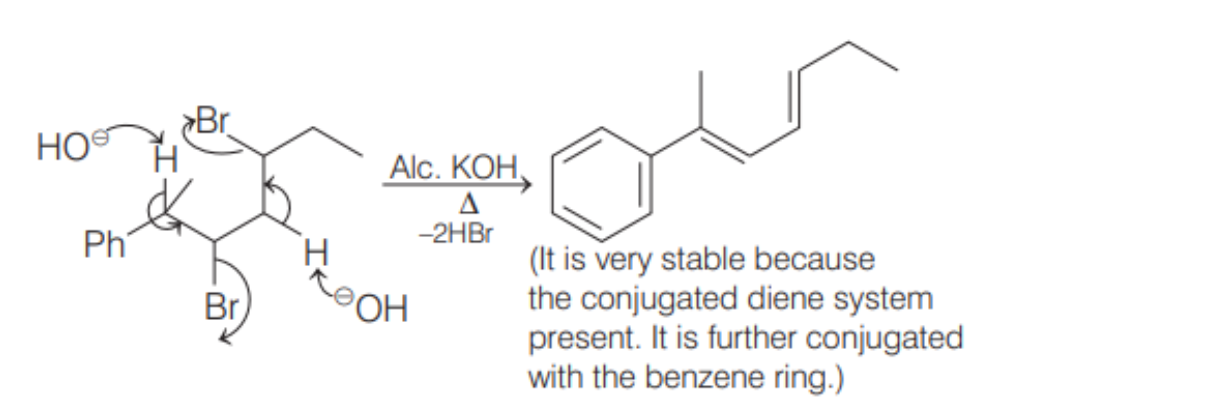
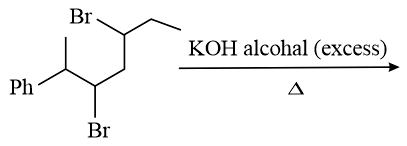
We need to determine the major product formed when the given dibromo compound undergoes dehydrohalogenation with alcoholic $$\text{KOH}$$ under heating ($$\Delta$$).
Double $$\text{E2}$$ Elimination ($$-2\text{HBr}$$):
Alcoholic $$\text{KOH}$$ is a strong base used to induce elimination reactions. Since the substrate contains two bromine leaving groups on adjacent carbons along with accessible $$\beta$$-hydrogens, it undergoes a double dehydrohalogenation process, losing two molecules of $$\text{HBr}$$.
Thermodynamic Driving Force (Conjugation):
The elimination is highly regioselective and follows Saytzeff's rule to produce the most thermodynamically stable alkene system possible. By eliminating both bromine atoms systematically, a highly extended conjugated diene system is formed.
$$\text{Dibromo Substrate} \xrightarrow{\text{Alc. KOH, }\Delta} \text{Highly Conjugated Diene Product} + 2\text{HBr}$$Resonance Stabilization with the Benzene Ring:
The newly formed pair of carbon-carbon double bonds ($$\text{C=C}$$) aligns perfectly with the adjacent phenyl ($$\text{Ph}$$) ring. This creates an uninterrupted, delocalized $$\pi$$-electron cloud spanning across the entire molecular framework, providing immense resonance stabilization energy.
The reaction yields a stable, extended conjugated diene system directly attached to the benzene ring due to the thermodynamic advantage of resonance delocalization.
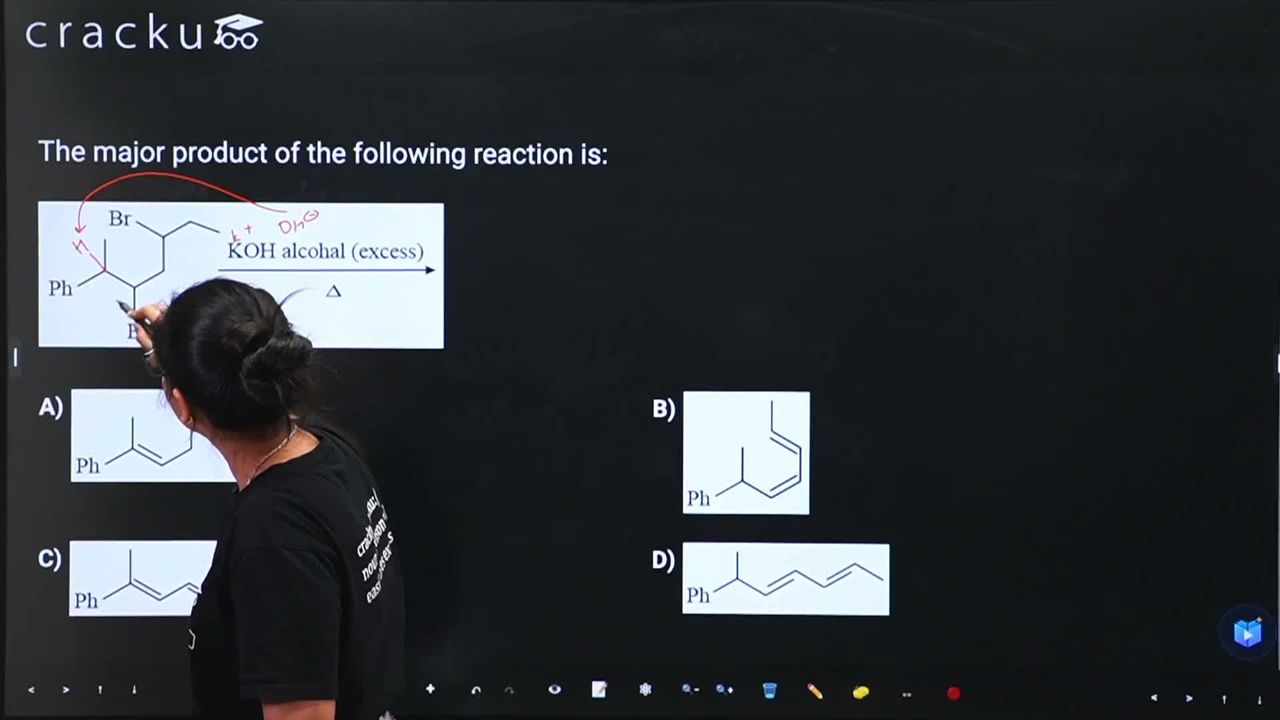
Answer: Option C
Click on the Email ☝️ to Watch the Video Solution
Create a FREE account and get:
_1.webp)

Educational materials for JEE preparation

Ask our AI anything

AI can make mistakes. Please verify important information.
AI can make mistakes. Please verify important information.