
Join Our JEE Preparation Group
Prep with like-minded aspirants; Get access to free daily tests and study material.
Sign in
Please select an account to continue using cracku.in
↓ →
Join Our JEE Preparation Group
Prep with like-minded aspirants; Get access to free daily tests and study material.
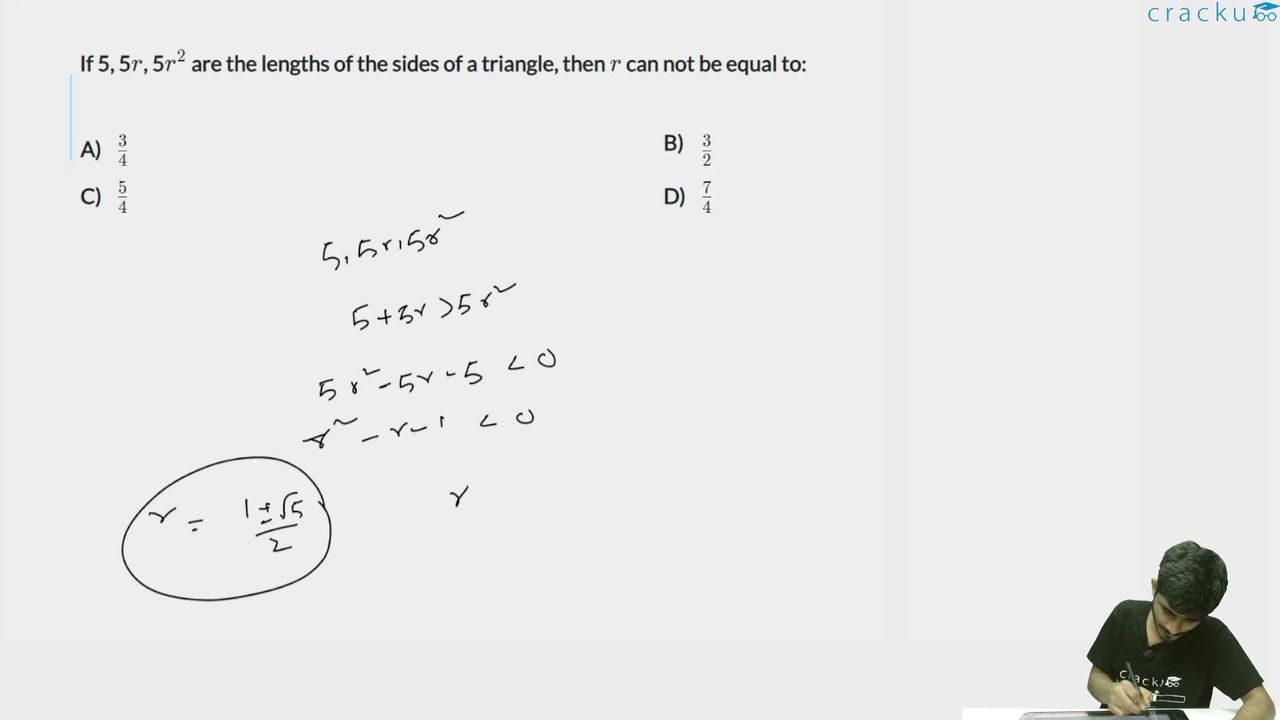
If 5, 5$$r$$, 5$$r^2$$ are the lengths of the sides of a triangle, then $$r$$ can not be equal to:
We are told that the three sides of a triangle have lengths $$5,\;5r,\;5r^{2}$$, where $$r\gt 0$$. For any three positive numbers to be the sides of a triangle, they must satisfy the triangle‐inequality theorem, which states:
Sum of any two sides > the remaining side.
Because the factor $$5$$ is common to all three expressions, it is convenient to divide each inequality by $$5$$. This leaves the simpler numbers $$1,\;r,\;r^{2}$$. Thus, the triangle inequalities become:
$$\begin{aligned} 1+r \gt r^{2},\\[4pt] r+r^{2} \gt 1,\\[4pt] 1+r^{2} \gt r. \end{aligned}$$
The third inequality $$1+r^{2}\gt r$$ is automatically true for every positive $$r,$$ so only the first two need detailed analysis. We examine them by separating the two natural cases $$r\ge 1$$ and $$0\lt r\le 1.$$
Case 1: $$r\ge 1.$$} In this range $$r^{2}\ge r\ge 1,$$ so $$r^{2}$$ is the largest of the three numbers $$1,\;r,\;r^{2}.$$ The pertinent inequality is therefore
$$1+r\gt r^{2}.$$
Rearranging gives
$$r^{2}-r-1\lt 0.$$
We solve the quadratic $$r^{2}-r-1=0$$ by the quadratic formula:
$$r=\frac{1\pm\sqrt{1+4}}{2}=\frac{1\pm\sqrt5}{2}.$$
Thus the two real roots are $$\dfrac{1-\sqrt5}{2}\;(\text{negative})$$ and $$\dfrac{1+\sqrt5}{2}\approx1.618.$$ A quadratic with positive leading coefficient is negative between its roots, so
$$-\,\frac{\sqrt5-1}{2}\lt r\lt \frac{1+\sqrt5}{2}.$$
Because we are in the subcase $$r\ge1,$$ the combined condition is
$$1\le r\lt \frac{1+\sqrt5}{2}\quad\Longrightarrow\quad1\le r\lt 1.618\ldots$$
Case 2: $$0\lt r\le1.$$} Here the largest of the three numbers $$1,\;r,\;r^{2}$$ is $$1.$$ Hence we must satisfy
$$r+r^{2}\gt 1.$$
Rewriting yields
$$r^{2}+r-1\gt 0.$$
We solve the quadratic $$r^{2}+r-1=0$$ in the same way:
$$r=\frac{-1\pm\sqrt{1+4}}{2}=\frac{-1\pm\sqrt5}{2}.$$
The positive root is $$\dfrac{\sqrt5-1}{2}\approx0.618.$$ Because the quadratic opens upward, it is positive outside the interval between its roots, giving
$$r\gt \frac{\sqrt5-1}{2}\quad\text{or}\quad r\lt -\frac{1+\sqrt5}{2}.$$
Only positive $$r$$ are relevant, so for this case
$$\frac{\sqrt5-1}{2}\lt r\le1\quad\Longrightarrow\quad0.618\ldots\lt r\le1.$$
Combining both cases we see that a valid $$r$$ must lie in the single continuous interval
$$0.618\ldots\lt r\lt 1.618\ldots$$
Now we test the four given choices:
$$\begin{aligned} \frac34 &=0.75 &\checkmark\\[4pt] \frac32 &=1.50 &\checkmark\\[4pt] \frac54 &=1.25 &\checkmark\\[4pt] \frac74 &=1.75 &\times \end{aligned}$$
The only option that lies outside the required range is $$\dfrac74.$$ Therefore $$r$$ cannot be equal to $$\dfrac74.$$ Hence, the correct answer is Option D.
Click on the Email ☝️ to Watch the Video Solution
Create a FREE account and get:
_1.webp)

Educational materials for JEE preparation

Ask our AI anything

AI can make mistakes. Please verify important information.
AI can make mistakes. Please verify important information.


