
Join Our JEE Preparation Group
Prep with like-minded aspirants; Get access to free daily tests and study material.
Sign in
Please select an account to continue using cracku.in
↓ →
Join Our JEE Preparation Group
Prep with like-minded aspirants; Get access to free daily tests and study material.
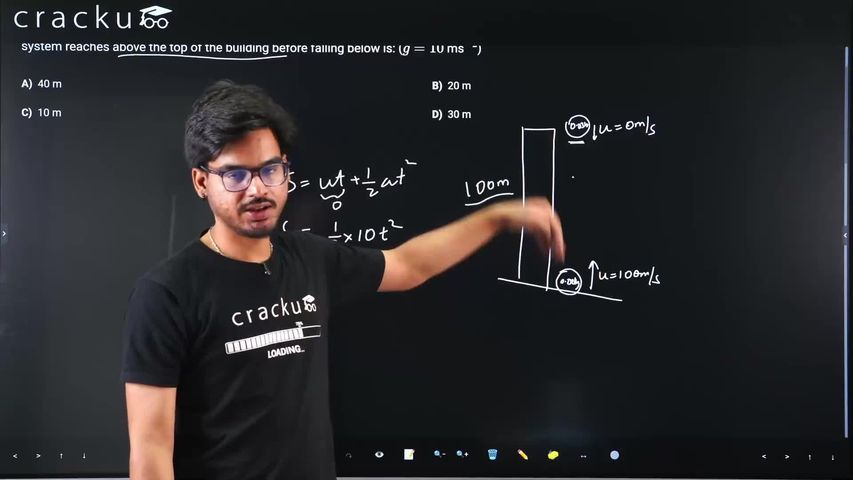
A piece of wood of mass 0.03 kg is dropped from the top of a 100 m height building. At the same time, a bullet of mass 0.02 kg is fired vertically upward, with a velocity 100 ms$$^{-1}$$, from the ground. The bullet gets embedded in the wood. Then the maximum height to which the combined system reaches above the top of the building before falling below is: ($$g = 10$$ ms$$^{-2}$$)
Let us choose the upward direction as positive and take the ground as the origin of coordinates.
At $$t = 0$$
• The wood (mass $$m_w = 0.03\ \text{kg}$$) is at a height $$y = 100\ \text{m}$$ with zero velocity.
• The bullet (mass $$m_b = 0.02\ \text{kg}$$) is at $$y = 0$$ with an upward velocity $$u_b = 100\ \text{m\,s}^{-1}$$.
For any body moving under gravity we have the kinematic formula
$$y = y_0 + u\,t - \tfrac{1}{2}g t^2,$$
where $$y_0$$ is the initial position, $$u$$ the initial velocity and $$g$$ the acceleration due to gravity.
Position of the wood after time $$t$$:
$$y_w = 100 + 0\cdot t - \tfrac{1}{2}g t^2 = 100 - 5t^2.$$
Position of the bullet after time $$t$$:
$$y_b = 0 + (100)t - \tfrac{1}{2}g t^2 = 100t - 5t^2.$$
The collision occurs when $$y_w = y_b$$, so
$$100 - 5t^2 = 100t - 5t^2.$$
The terms $$-5t^2$$ cancel, leaving
$$100 = 100t \;\;\Longrightarrow\;\; t = 1\ \text{s}.$$
Now find the velocities just before impact.
Velocity of the wood after $$t$$ seconds (using $$v = u - g t$$ with $$u=0$$):
$$v_w = 0 - g(1) = -10\ \text{m\,s}^{-1}.$$
Velocity of the bullet after $$t$$ seconds:
$$v_b = 100 - g(1) = 100 - 10 = 90\ \text{m\,s}^{-1}.$$
(A negative sign indicates downward motion; the bullet’s velocity is positive, i.e. upward.)
Height of the collision point above the ground:
$$y_c = y_w(1\ \text{s}) = 100 - 5(1)^2 = 95\ \text{m}.$$
Thus, the collision takes place $$5\ \text{m}$$ below the roof of the building.
Immediately after impact the bullet embeds in the wood, so we use conservation of linear momentum.
The law states: Total momentum before impact = Total momentum after impact.
Before impact:
$$p_{\text{before}} = m_b v_b + m_w v_w = (0.02)(90) + (0.03)(-10) = 1.8 - 0.3 = 1.5\ \text{kg\,m\,s}^{-1}\ (\text{upward}).$$
Total mass after impact:
$$M = m_b + m_w = 0.02 + 0.03 = 0.05\ \text{kg}.$$
Let $$V$$ be the common velocity just after impact. Then
$$M V = 1.5 \;\;\Longrightarrow\;\; V = \frac{1.5}{0.05} = 30\ \text{m\,s}^{-1}\ (\text{upward}).$$
The combined system now rises against gravity. For vertical motion under uniform acceleration, we have the formula
$$v_f^{\,2} = v_i^{\,2} - 2 g h,$$
where $$v_f$$ is the final velocity (zero at the highest point), $$v_i$$ the initial velocity and $$h$$ the rise.
Setting $$v_f = 0$$ and $$v_i = 30\ \text{m\,s}^{-1}$$, we get
$$0 = (30)^2 - 2(10)h \;\;\Longrightarrow\;\; h = \frac{(30)^2}{2 \times 10} = \frac{900}{20} = 45\ \text{m}.$$
Therefore the block-bullet system ascends $$45\ \text{m}$$ above the collision point. Because the collision point itself is $$5\ \text{m}$$ below the roof, the maximum height attained above the top of the building is
$$h_{\text{above roof}} = 45 - 5 = 40\ \text{m}.$$
Hence, the correct answer is Option A.
Click on the Email ☝️ to Watch the Video Solution
Create a FREE account and get:
_1.webp)

Educational materials for JEE preparation

Ask our AI anything

AI can make mistakes. Please verify important information.
AI can make mistakes. Please verify important information.


