
Join Our JEE Preparation Group
Prep with like-minded aspirants; Get access to free daily tests and study material.
Sign in
Please select an account to continue using cracku.in
↓ →
Join Our JEE Preparation Group
Prep with like-minded aspirants; Get access to free daily tests and study material.
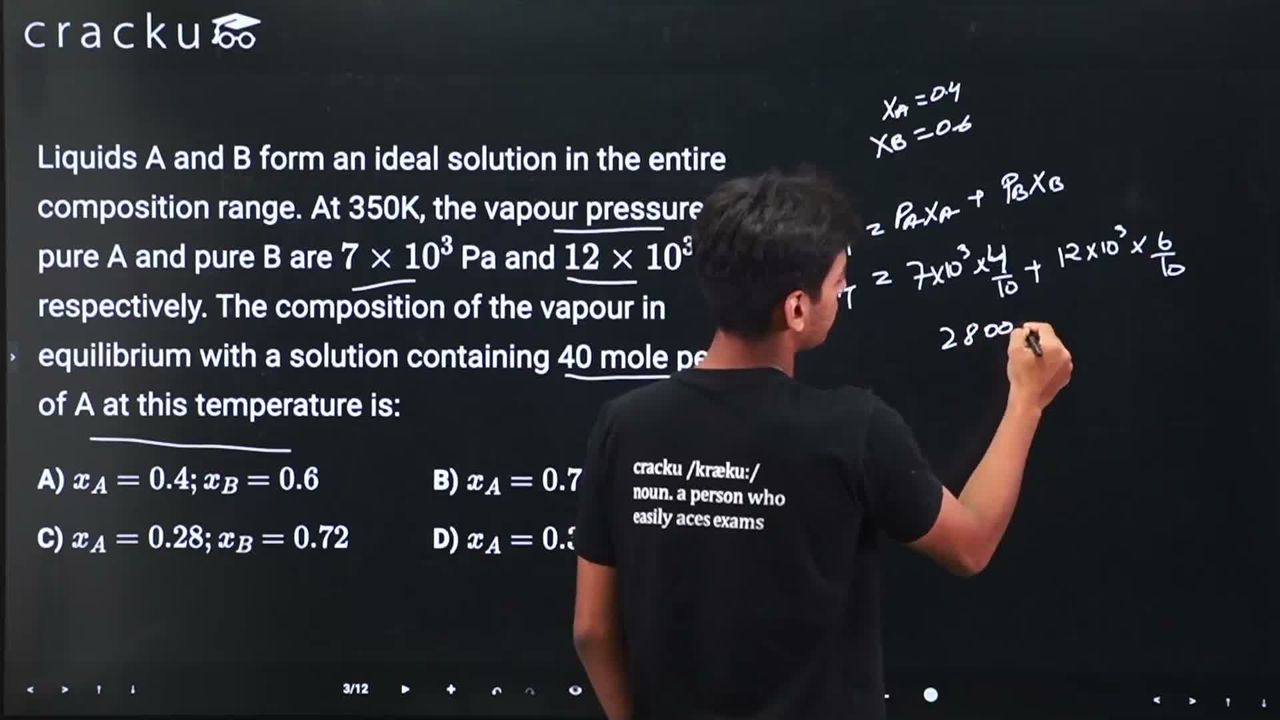
Liquids A and B form an ideal solution in the entire composition range. At 350K, the vapour pressure of pure A and pure B are $$7 \times 10^3$$ Pa and $$12 \times 10^3$$ Pa, respectively. The composition of the vapour in equilibrium with a solution containing 40 mole percent of A at this temperature is:
For an ideal binary solution Raoult’s law applies throughout the entire composition range. The law states that the partial vapour pressure of each component equals the product of its mole fraction in the liquid phase and its pure-component vapour pressure. Mathematically, for components A and B,
$$p_A = x_A P_A^{\circ}, \qquad p_B = x_B P_B^{\circ}.$$
The total pressure is the sum of the partial pressures,
$$P_{\text{total}} = p_A + p_B.$$
We are told that at 350\,K the vapour pressures of the pure liquids are $$P_A^{\circ}=7 \times 10^3\ \text{Pa}$$ and $$P_B^{\circ}=12 \times 10^3\ \text{Pa}.$$ The solution contains 40 mol % of A, so the liquid-phase mole fractions are
$$x_A = 0.40, \qquad x_B = 0.60.$$
Now we calculate each partial pressure:
$$\begin{aligned} p_A &= x_A P_A^{\circ} = 0.40 \times 7 \times 10^3\ \text{Pa} \\[4pt] &= 2.8 \times 10^3\ \text{Pa}, \\[6pt] p_B &= x_B P_B^{\circ} = 0.60 \times 12 \times 10^3\ \text{Pa} \\[4pt] &= 7.2 \times 10^3\ \text{Pa}. \end{aligned}$$
Adding these gives the total vapour pressure:
$$P_{\text{total}} = 2.8 \times 10^3\ \text{Pa} + 7.2 \times 10^3\ \text{Pa} = 10.0 \times 10^3\ \text{Pa}.$$
The mole fraction of each component in the vapour phase is obtained by dividing its partial pressure by the total pressure. Thus,
$$\begin{aligned} y_A &= \frac{p_A}{P_{\text{total}}} = \frac{2.8 \times 10^3}{10.0 \times 10^3} = 0.28, \\[6pt] y_B &= \frac{p_B}{P_{\text{total}}} = \frac{7.2 \times 10^3}{10.0 \times 10^3} = 0.72. \end{aligned}$$
Therefore, the vapour in equilibrium with the given liquid solution contains 28 mol % of A and 72 mol % of B.
Hence, the correct answer is Option C.
Was this solution helpful?
Click on the Email ☝️ to Watch the Video Solution
Create a FREE account and get:
_1.webp)

Educational materials for JEE preparation

Ask our AI anything

AI can make mistakes. Please verify important information.
AI can make mistakes. Please verify important information.
