
Join Our JEE Preparation Group
Prep with like-minded aspirants; Get access to free daily tests and study material.
Sign in
Please select an account to continue using cracku.in
↓ →
Join Our JEE Preparation Group
Prep with like-minded aspirants; Get access to free daily tests and study material.
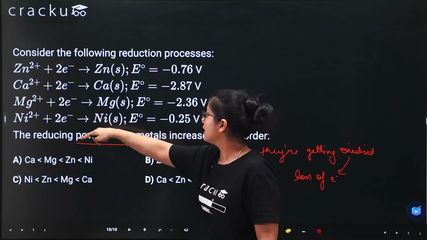
Consider the following reduction processes:
$$Zn^{2+} + 2e^- \rightarrow Zn(s); E^{\circ} = -0.76$$ V
$$Ca^{2+} + 2e^- \rightarrow Ca(s); E^{\circ} = -2.87$$ V
$$Mg^{2+} + 2e^- \rightarrow Mg(s); E^{\circ} = -2.36$$ V
$$Ni^{2+} + 2e^- \rightarrow Ni(s); E^{\circ} = -0.25$$ V
The reducing power of the metals increases in the order:
First, recall the electrochemical convention: a larger (more positive) standard reduction potential $$E^{\circ}$$ means a greater tendency of the species to undergo reduction. Conversely, a smaller (more negative) $$E^{\circ}$$ means the species prefers to undergo the reverse reaction, that is, it is more easily oxidised. A substance that is readily oxidised is a strong reducing agent because it donates electrons to other species.
Therefore, the rule we shall use is:
$$\text{More negative }E^{\circ} \;\;\Longrightarrow\;\; \text{greater tendency to be oxidised} \;\;\Longrightarrow\;\; \text{stronger reducing power}$$
Now we list the given half-reactions along with their standard reduction potentials in ascending order of the numerical value (from the least negative to the most negative) so that we can compare them easily:
$$Ni^{2+} + 2e^- \rightarrow Ni(s);\;E^{\circ} = -0.25\ \text{V}$$
$$Zn^{2+} + 2e^- \rightarrow Zn(s);\;E^{\circ} = -0.76\ \text{V}$$
$$Mg^{2+} + 2e^- \rightarrow Mg(s);\;E^{\circ} = -2.36\ \text{V}$$
$$Ca^{2+} + 2e^- \rightarrow Ca(s);\;E^{\circ} = -2.87\ \text{V}$$
We now compare their reducing powers step by step.
Between $$Ni$$ and $$Zn$$: $$E^{\circ}_{Ni} = -0.25\;\text{V}$$ is less negative than $$E^{\circ}_{Zn} = -0.76\;\text{V}$$. Hence $$Zn$$ is more negative, is oxidised more easily, and is therefore a stronger reducing agent than $$Ni$$. So we have
$$Ni < Zn\; \text{in reducing power}.$$
Next, compare $$Zn$$ and $$Mg$$: $$E^{\circ}_{Mg} = -2.36\;\text{V}$$ is more negative than $$E^{\circ}_{Zn} = -0.76\;\text{V}$$, so $$Mg$$ is oxidised even more readily than $$Zn$$. Thus,
$$Zn < Mg\; \text{in reducing power}.$$
Finally, compare $$Mg$$ and $$Ca$$: $$E^{\circ}_{Ca} = -2.87\;\text{V}$$ is still more negative than $$E^{\circ}_{Mg} = -2.36\;\text{V}$$, making $$Ca$$ the easiest to oxidise among all four metals. Therefore,
$$Mg < Ca\; \text{in reducing power}.$$
Combining all the individual comparisons in the same direction we obtain the overall ascending order of reducing strength:
$$Ni < Zn < Mg < Ca.$$
This sequence exactly matches Option C.
Hence, the correct answer is Option C.
Was this solution helpful?
Click on the Email ☝️ to Watch the Video Solution
Create a FREE account and get:
_1.webp)

Educational materials for JEE preparation

Ask our AI anything

AI can make mistakes. Please verify important information.
AI can make mistakes. Please verify important information.
