
Join Our JEE Preparation Group
Prep with like-minded aspirants; Get access to free daily tests and study material.
Sign in
Please select an account to continue using cracku.in
↓ →
Join Our JEE Preparation Group
Prep with like-minded aspirants; Get access to free daily tests and study material.
First, we recall the definition of catalysis. A catalyst is a substance that changes the rate of a chemical reaction but itself remains chemically unchanged at the end. When the catalyst and the reactants are present in different physical phases, the phenomenon is called heterogeneous catalysis. Thus, in heterogeneous catalysis we always have at least two phases: one for the catalyst and another for the reacting species.
Now, let us analyze each option and compare the physical phases involved.
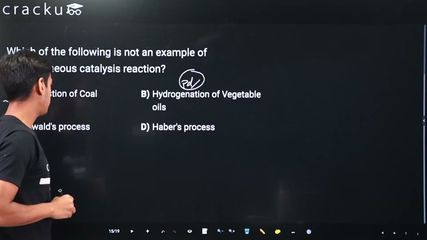
Option A - Combustion of Coal. Coal is a solid, and it reacts with oxygen gas to give products such as $$\text{CO}_2$$, $$\text{CO}$$, water vapour, etc. There is no catalyst employed in the ordinary burning of coal. The reaction proceeds simply because of high temperature once ignition has occurred. Since a catalyst is altogether absent, the question of heterogeneity or homogeneity of catalysis does not arise. Therefore this process is not an example of heterogeneous catalysis.
Option B - Hydrogenation of Vegetable Oils. The industrial hydrogenation of unsaturated vegetable oils is carried out in the presence of finely divided nickel, which is a solid. The reactants, hydrogen gas and liquid oil, together constitute different phases from the solid nickel catalyst. Hence we have a solid catalyst and fluid reactants, i.e. $$\text{solid} \;|\; \text{liquid+gas}$$, clearly satisfying the definition of heterogeneous catalysis. Therefore this is indeed an example of heterogeneous catalysis.
Option C - Ostwald’s Process. In the Ostwald process for the manufacture of nitric acid, ammonia gas, $$\text{NH}_3(g)$$, is oxidised in the presence of a platinum-rhodium gauze catalyst, which is a solid. So the catalyst phase is solid while the reactant phase is gaseous, written symbolically as $$\text{solid} \;|\; \text{gas}$$. Because the phases are different, this is a classic case of heterogeneous catalysis.
Option D - Haber’s Process. The Haber process for synthesising ammonia involves nitrogen gas and hydrogen gas reacting over a finely divided iron catalyst that is promoted by $$\text{K}_2\text{O}$$ and $$\text{Al}_2\text{O}_3$$. The iron catalyst is solid whereas both reactants are gaseous, again giving $$\text{solid} \;|\; \text{gas}$$ and fulfilling the criterion for heterogeneous catalysis.
Summarising the above discussion, we see that Options B, C, and D all employ a solid catalyst with reactants in gaseous or liquid phases, making them examples of heterogeneous catalysis. Option A, on the other hand, involves no catalyst at all and therefore cannot belong to the heterogeneous catalysis category.
Hence, the correct answer is Option A.
Click on the Email ☝️ to Watch the Video Solution
Create a FREE account and get:
_1.webp)

Educational materials for JEE preparation

Ask our AI anything

AI can make mistakes. Please verify important information.
AI can make mistakes. Please verify important information.


