A particle is moving with speed $$v = b\sqrt{x}$$ along positive x-axis. Calculate the speed of the particle at time $$t = \tau$$ (assume that the particle is at origin at t = 0)
 JEE WhatsApp Group
Sign in
Please select an account to continue using cracku.in
↓ →
JEE WhatsApp Group

Join Our JEE Preparation Group
Prep with like-minded aspirants; Get access to free daily tests and study material.
A particle is moving with speed $$v = b\sqrt{x}$$ along positive x-axis. Calculate the speed of the particle at time $$t = \tau$$ (assume that the particle is at origin at t = 0)
Login to view the detailed solution.
Two particles are projected from the same point with the same speed u such that they have the same range R, but different maximum heights, h$$_1$$ and h$$_2$$. Which of the following is correct?
Login to view the detailed solution.
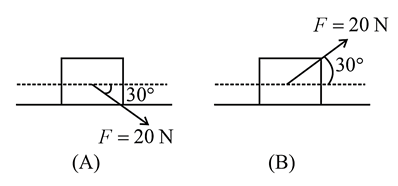
A block of mass 5 kg is (i) pushed in case (A) and (ii) pulled in case (B), by a force F = 20 N, making an angle of 30° with the horizontal, as shown in the figures. The coefficient of friction between the block and floor is $$\mu$$ = 0.2. The difference between the accelerations of the block, in case (B) and case (A) will be: (g = 10 m s$$^{-2}$$)
Login to view the detailed solution.
.webp)
A spring whose unstretched length is $$l$$ has a force constant k. The spring is cut into two pieces of unstretched lengths $$l_1$$ and $$l_2$$ where, $$l_1 = nl_2$$ and n is an integer. The ratio $$k_1/k_2$$ of the corresponding force constants, k$$_1$$ and k$$_2$$ will be:
Login to view the detailed solution.
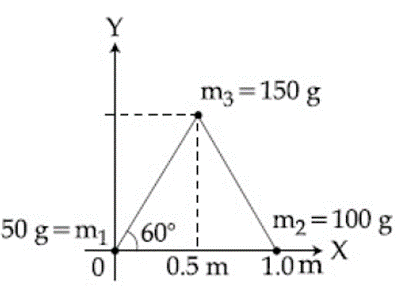
Three particles of masses 50 g, 100 g and 150 g are placed at the vertices of an equilateral triangle of side 1 m (as shown in the figure). The (x, y) coordinates of the centre of mass will be:
Login to view the detailed solution.
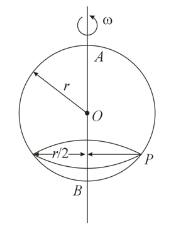
A smooth wire of length $$2\pi r$$ is bent into a circle and kept in a vertical plane. A bead can slide smoothly on the wire. When the circle is rotating with angular speed $$\omega$$ about the vertical diameter AB, as shown in figure, the bead is at rest with respect to the circular ring at position P as shown. Then the value of $$\omega^2$$ is equal to:
Login to view the detailed solution.
The ratio of the weights of a body on Earth's surface to that on the surface of a planet is 9:4. The mass of the planet is $$\frac{1}{9}$$th of that of the Earth. If R is the radius of the Earth, what is the radius of the planet? (Take the planets to have the same mass density)
Login to view the detailed solution.
A solid sphere, of radius R acquires a terminal velocity $$v_1$$ when falling (due to gravity) through a viscous fluid having a coefficient of viscosity $$\eta$$. The sphere is broken into 27 identical solid spheres. If each of these spheres acquires a terminal velocity, $$v_2$$, when falling through the same fluid, the ratio $$\left(\frac{v_1}{v_2}\right)$$ equals:
Login to view the detailed solution.
A uniform cylindrical rod of length L and radius r, is made from a material whose Young's modulus of Elasticity equals Y. When this rod is heated by temperature T and simultaneously subjected to a net longitudinal compressional force F, its length remains unchanged. The coefficient of volume expansion, of the material of the rod, is (nearly) equal to:
Login to view the detailed solution.
1 kg of water, at 20°C is heated in an electric kettle whose heating element has a mean (temperature averaged) resistance of 20 Ω. The rms voltage in the mains is 200 V. Ignoring heat loss from the kettle, time taken for water to evaporate fully is close to
[Specific heat of water = 4200 J kg$$^{-1}$$ °C$$^{-1}$$ Latent heat of water = 2260 kJ kg$$^{-1}$$]
Login to view the detailed solution.
A Carnot engine has an efficiency of $$\frac{1}{6}$$. When the temperature of the sink is reduced by 62°C, its efficiency is doubled. The temperatures of the source and the sink are, respectively,
Login to view the detailed solution.
A diatomic gas with rigid molecules does 10 J of work when expanded at constant pressure. What would be the heat energy absorbed by the gas, in this process?
Login to view the detailed solution.
The number density of molecules of a gas depends on their distance r from the origin as, $$n(r) = n_0 e^{-\alpha r^4}$$. Then the numer of molecules is proportional to:
Login to view the detailed solution.
A small speaker delivers 2 W of audio output. At what distance from the speaker will one detect 120 dB intensity sound? [Given reference intensity of sound as $$10^{-12}$$ W/m$$^2$$]
Login to view the detailed solution.
Two sources of sound S$$_1$$ and S$$_2$$ produce sound waves of same frequency 660 Hz. A listener is moving from source S$$_1$$ towards S$$_2$$ with a constant speed u$$_0$$ m/s and he hears 10 beats/s. The velocity of sound is 330 m/s. Then, u$$_0$$ equals:
Login to view the detailed solution.
Let a total charge 2Q be distributed in a sphere of radius R, with the charge density given by $$\rho(r) = kr$$, where r is the distance from the centre. Two charges A and B, of -Q each, are placed on diametrically opposite points, at equal distance, a, from the centre. If A and B do not experience any force, then:
Login to view the detailed solution.
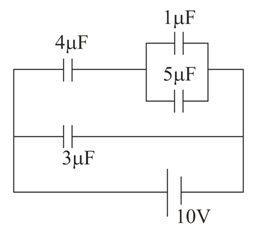
In the given circuit, the charge on 4 μF capacitor will be:
Login to view the detailed solution.
A moving coil galvanometer, having a resistance G, produces full scale deflection when a current I$$_G$$ flows through it. This galvanometer can be converted into (i) an ammeter of range 0 to I$$_0$$ (I$$_0$$ > I$$_g$$) by connecting a shunt resistance R$$_A$$ to it and (ii) into a voltmeter of range 0 to V (V = GI$$_0$$) by connecting a series resistance R$$_V$$ to it. Then,
Login to view the detailed solution.
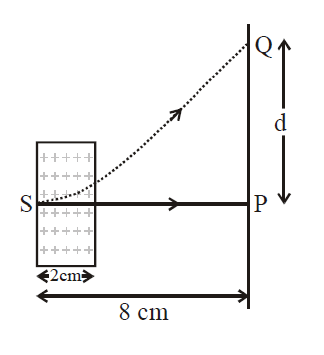
An electron, moving along the x-axis with an initial energy of 100 eV, enters a region of magnetic field $$\vec{B} = (1.5 \times 10^{-3}$$ T)$$\hat{k}$$ at S (see figure). The field extends between x = 0 and x = 2 cm. The electron is detected at the point Q on a screen placed 8 cm away from the point S. The distance d between P and Q (on the screen) is:
(electron’s charge $$1.6 ×10^{−19} C$$, mass of electron $$=9.1×10^{−31} kg$$)
Login to view the detailed solution.
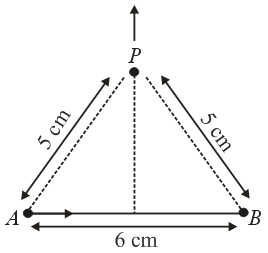
Find the magnetic field at point P due to a straight line segment AB of length 6 cm carrying a current of 5 A. (See figure) ($$\mu_0 = 4\pi \times 10^{-7}$$ NA$$^{-2}$$)
Login to view the detailed solution.
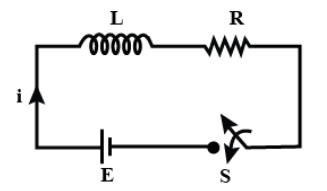
Consider the LR circuit shown in the figure. If the switch S is closed at t = 0 then the amount of charge that passes through the battery between t = 0 and t = $$\frac{L}{R}$$ is:
Login to view the detailed solution.
A plane electromagnetic wave having a frequency f = 23.9 GHz propagates along the positive z-direction in free space. The peak value of the Electric Field is 60 V/m. Which among the following is the acceptable magnetic field component in the electromagnetic wave?
Login to view the detailed solution.
A transparent cube of side d, made of a material of refractive index $$\mu_2$$, is immersed in a liquid of refractive index $$\mu_1$$ ($$\mu_1 < \mu_2$$). A ray is incident on the face AB at an angle $$\theta$$ (shown in the figure). Total internal reflection takes place at point E on the face BC.
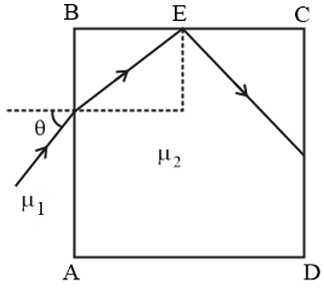
Then $$\theta$$ must satisfy
Login to view the detailed solution.
A system of three polarizers P$$_1$$, P$$_2$$, P$$_3$$ is set up such that the pass axis of P$$_3$$ is crossed with respect to that of P$$_1$$. The pass axis of P$$_2$$ is inclined at 60° to the pass axis of P$$_3$$. When a beam of unpolarized light of intensity I$$_0$$ is incident on P$$_1$$, the intensity of light transmitted by the three polarizers is I. The ratio (I$$_0$$/I) equals (nearly):
Login to view the detailed solution.
Consider an electron in a hydrogen atom, revolving in its second excited state (having radius 4.65 Å). The de-Broglie wavelength of this electron is:
Login to view the detailed solution.
The electron in a hydrogen atom first jumps from the third excited state to the second excited state and subsequently to the first excited state. The ratio of the respective wavelengths, $$\frac{\lambda_1}{\lambda_2}$$, of the photons emitted in this process is:
Login to view the detailed solution.
Half lives of two radioactive nuclei A and B are 10 minutes and 20 minutes, respectively. If, initially a sample has equal number of nuclei, then after 60 minutes, the ratio of decayed numbers of nuclei A and B will be:
Login to view the detailed solution.
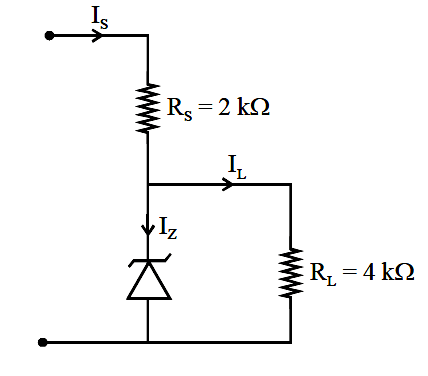
Figure shows a DC voltage regulator circuit, with a Zener diode of breakdown voltage = 6 V. If the unregulated input voltage varies between 10 V to 16 V, then what is the maximum Zener current?
Login to view the detailed solution.
In a CE transistor amplifier, the audio signal voltage across the collector resistance of 2 kΩ is 2 V, if the base resistance is 1 kΩ and the current amplification of the transistor is 100 then the input signal voltage is
Login to view the detailed solution.
A tuning fork of frequency 480 Hz is used in an experiment for measuring speed of sound (v) in air by resonance tube method. Resonance is observed to occur at two successive lengths of the air column, l$$_1$$ = 30 cm and l$$_2$$ = 70 cm. Then, v is equal to:
Login to view the detailed solution.
25 g of an unknown hydrocarbon upon burning produces 88 g of CO$$_2$$ and 9 g of H$$_2$$O. This unknown hydrocarbon contains:
Login to view the detailed solution.
Among the following, the energy of 2s orbital is lowest in:
Login to view the detailed solution.
In comparison to boron, beryllium has:
Login to view the detailed solution.
The incorrect match in the following is:
Login to view the detailed solution.
In which one of the following equilibria, K$$_p$$ ≠ K$$_c$$?
Login to view the detailed solution.
The molar solubility of Cd(OH)$$_2$$ is $$1.84 \times 10^{-5}$$ M in water. The expected solubility of Cd(OH)$$_2$$ in a buffer solution of pH = 12 is:
Login to view the detailed solution.
The temporary hardness of a water sample is due to compound X. Boiling this sample converts X to compound Y. X and Y, respectively, are:
Login to view the detailed solution.
The incorrect statement is:
Login to view the detailed solution.
The C - C bond length is maximum in:
Login to view the detailed solution.
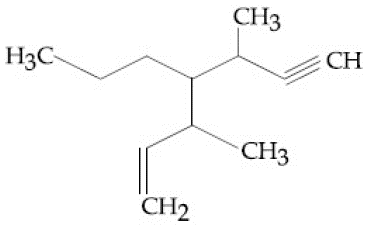
The IUPAC name for the following compound is:
Login to view the detailed solution.
Which one of the following is likely to give a precipitate with AgNO$$_3$$ solution?
Login to view the detailed solution.
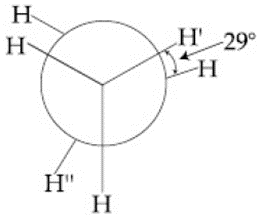
In the following skew conformation of ethane, H' - C - C - H'' dihedral angle is:
Login to view the detailed solution.
Heating of 2-chloro-1-phenylbutane with EtOK/EtOH gives X as the major product. Reaction X with Hg(OAc)$$_2$$/H$$_2$$O followed by NaBH$$_4$$ gives Y as the major product. Y is:
Login to view the detailed solution.
The primary pollutant that leads to photochemical smog is:
Login to view the detailed solution.
The ratio of number of atoms present in a simple cubic, body centered cubic and face centered cubic structure are, respectively:
Login to view the detailed solution.
A solution is prepared by dissolving 0.6 g of urea (molar mass = 60 g mol$$^{-1}$$) and 1.8 g of glucose (molar mass = 180 g mol$$^{-1}$$) in 100 mL of water at 27°C. The osmotic pressure of the solution is:
(R = 0.08206 L atm K$$^{-1}$$ mol$$^{-1}$$)
Login to view the detailed solution.
The decreasing order of electrical conductivity of the following aqueous solutions is:
(A) 0.1 M Formic acid,
(B) 0.1 M Acetic acid,
(C) 0.1 M Benzoic acid.
Login to view the detailed solution.
NO$$_2$$ required for a reaction is produced by the decomposition of N$$_2$$O$$_5$$ in CCl$$_4$$ as per the equation, 2N$$_2$$O$$_5$$(g) $$\to$$ 4NO$$_2$$(g) + O$$_2$$(g). The initial concentration of N$$_2$$O$$_5$$ is 3.00 mol L$$^{-1}$$ and it is 2.75 mol L$$^{-1}$$ after 30 minutes. The rate of formation of NO$$_2$$ is:
Login to view the detailed solution.
Among the following, the incorrect statement about colloids is:
Login to view the detailed solution.
The correct statement is:
Login to view the detailed solution.
The pair that has similar atomic radii is:
Login to view the detailed solution.
Thermal decomposition of a Mn compound (X) at 513 K results in compound Y, MnO$$_2$$ and a gaseous product. MnO$$_2$$ reacts with NaCl and concentrated H$$_2$$SO$$_4$$ to give a pungent gas Z. X, Y and Z, respectively, are:
Login to view the detailed solution.
The coordination numbers of Co and Al in [Co(Cl)(en)$$_2$$]Cl and K$$_3$$[Al(C$$_2$$O$$_4$$)$$_3$$], respectively are:
(en = ethane-1, 2-diamine)
Login to view the detailed solution.
The compound used in the treatment of lead poisoning is:
Login to view the detailed solution.
An 'Assertion' and a 'Reason' is given below. Choose the correct answer from the following options:
Assertion (A): Vinyl halides do not undergo nucleophilic substitution easily.
Reason (R): Even though the intermediate carbocation is stabilized by loosely held $$\pi$$-electrons, the cleavage is difficult because of the strong bonding.
Login to view the detailed solution.
Consider the following reactions:
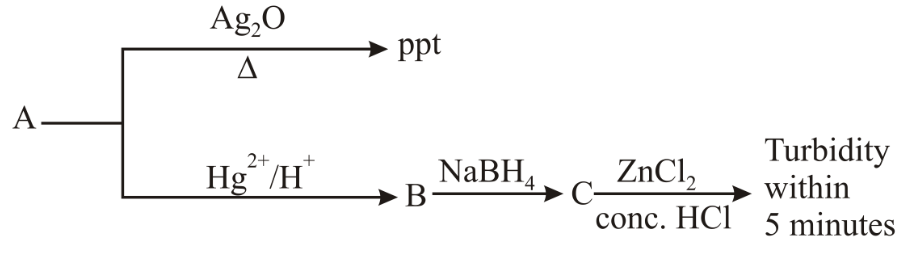
'A' is:
Login to view the detailed solution.
What will be the major product when m-cresol is reacted with propargyl bromide (HC ≡ C - CH$$_2$$Br) in presence of K$$_2$$CO$$_3$$ in acetone?
Login to view the detailed solution.
Benzene diazonium chloride on reaction with aniline in the presence of dilute hydrochloric acid gives:
Login to view the detailed solution.
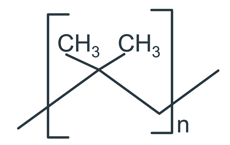
The correct name of the following polymer is:
Which of the given statements is incorrect about glycogen?
Login to view the detailed solution.
If $$\alpha$$, $$\beta$$ and $$\gamma$$ are three consecutive terms of a non-constant G.P. Such that the equations $$\alpha x^2 + 2\beta x + \gamma = 0$$ and $$x^2 + x - 1 = 0$$ have a common root, then $$\alpha(\beta + \gamma)$$ is equal to:
Login to view the detailed solution.
Let $$z \in C$$ with Im(z) = 10 and it satisfies $$\frac{2z - n}{2z + n} = 2i - 1$$ for some natural number n. Then
Login to view the detailed solution.
A group of students comprises of 5 boys and n girls. If the number of ways, in which a team of 3 students can randomly be selected from this group such that there is at least one boy and at least one girl in each team, is 1750, then n is equal to
Login to view the detailed solution.
If $$a_1, a_2, a_3, \ldots$$ are in A.P. such that $$a_1 + a_7 + a_{16} = 40$$, then the sum of the first 15 terms of this A.P is:
Login to view the detailed solution.
If $$^{20}C_1 + (2^2)\,^{20}C_2 + (3^2)\,^{20}C_3 + \ldots + (20^2)\,^{20}C_{20} = A(2^\beta)$$, then the ordered pair $$(A, \beta)$$ is equal to
Login to view the detailed solution.
The term independent of x in the expansion of $$\left(\frac{1}{60} - \frac{x^8}{81}\right) \cdot \left(2x^2 - \frac{3}{x^2}\right)^6$$ is equal to
Login to view the detailed solution.
Let S be the set of all $$\alpha \in R$$ such that the equation, $$\cos 2x + \alpha \sin x = 2\alpha - 7$$ has a solution. Then S is equal to:
Login to view the detailed solution.
A triangle has a vertex at (1, 2) and the mid points of the two sides through it are (-1, 1) and (2, 3). Then the centroid of this triangle is:
Login to view the detailed solution.
A straight line L at a distance of 4 units from the origin makes positive intercepts on the coordinate axes and the perpendicular from the origin to this line makes an angle of 60° with the line x + y = 0. Then an equation of the line L is:
Login to view the detailed solution.
A circle touching the x-axis at (3, 0) and making an intercept of length 8 on the y-axis passes through the point:
Login to view the detailed solution.
The tangents to the curve $$y = (x - 2)^2 - 1$$ at its points of intersection with the line $$x - y = 3$$, intersect at the point:
Login to view the detailed solution.
An ellipse, with foci at (0, 2) and (0, -2) and minor axis of length 4, passes through which of the following points?
Login to view the detailed solution.
The equation of a common tangent to the curves, $$y^2 = 16x$$ and $$xy = -4$$, is:
Login to view the detailed solution.
$$\lim_{x \to 0} \frac{x + 2\sin x}{\sqrt{x^2 + 2\sin x + 1} - \sqrt{\sin^2 x - x + 1}}$$ is
Login to view the detailed solution.
The Boolean expression $$\sim(p \Rightarrow (\sim q))$$ is equivalent to
Login to view the detailed solution.
The angle of the top of a vertical tower standing on a horizontal plane is observed to be 45° from a point A on the plane. Let B be the point 30 m vertically above the point A. If the angle of elevation of the top of the tower from B be 30°, then the distance (in m) of the foot of the tower from the point A is:
Login to view the detailed solution.
Let A, B and C be sets such that $$\phi \neq A \cap B \subseteq C$$. Then which of the following statements is not true?
Login to view the detailed solution.
A value of $$\theta \in \left(0, \frac{\pi}{3}\right)$$, for which $$\begin{vmatrix} 1 + \cos^2\theta & \sin^2\theta & 4\cos 6\theta \\ \cos^2\theta & 1 + \sin^2\theta & 4\cos 6\theta \\ \cos^2\theta & \sin^2\theta & 1 + 4\cos 6\theta \end{vmatrix} = 0$$, is
Login to view the detailed solution.
If [x] denotes the greatest integer $$\leq x$$, then the system of linear equations $$[\sin\theta]x + [-\cos\theta]y = 0$$, $$[\cot\theta]x + y = 0$$
Login to view the detailed solution.
The derivative of $$\tan^{-1}\left(\frac{\sin x - \cos x}{\sin x + \cos x}\right)$$ with respect to $$\frac{x}{2}$$, where $$x \in \left(0, \frac{\pi}{2}\right)$$, is
Login to view the detailed solution.
Let $$f(x) = 5 - |x - 2|$$ and $$g(x) = |x + 1|$$, $$x \in R$$. If $$f(x)$$ attains maximum value at $$\alpha$$ and $$g(x)$$ attains minimum value at $$\beta$$, then $$\lim_{x \to -\alpha\beta} \frac{(x - 1)(x^2 - 5x + 6)}{x^2 - 6x + 8}$$ is equal to
Login to view the detailed solution.
Let $$\alpha \in \left(0, \frac{\pi}{2}\right)$$, be constant. If the integral $$\int \frac{\tan x + \tan\alpha}{\tan x - \tan\alpha} dx = A(x)\cos 2\alpha + B(x)\sin 2\alpha + C$$, where C is a constant of integration, then the functions A(x) and B(x) are respectively
Login to view the detailed solution.
A value of $$\alpha$$ such that $$\int_\alpha^{\alpha+1} \frac{dx}{(x + \alpha)(x + \alpha + 1)} = \log_e\left(\frac{9}{8}\right)$$ is
Login to view the detailed solution.
If the area (in sq. units) bounded by the parabola $$y^2 = 4\lambda x$$ and the line $$y = \lambda x$$, $$\lambda > 0$$, is $$\frac{1}{9}$$, then $$\lambda$$ is equal to
Login to view the detailed solution.
The general solution of the differential equation $$(y^2 - x^3)dx - xy\,dy = 0$$, $$(x \neq 0)$$ is (where c is a constant of integration)
Login to view the detailed solution.
Let $$\alpha \in R$$ and the three vectors $$\vec{a} = \alpha\hat{i} + \hat{j} + 3\hat{k}$$, $$\vec{b} = 2\hat{i} + \hat{j} - \alpha\hat{k}$$ and $$\vec{c} = \alpha\hat{i} - 2\hat{j} + 3\hat{k}$$. Then the set S = {$$\alpha$$: $$\vec{a}$$, $$\vec{b}$$ and $$\vec{c}$$ are coplanar}
Login to view the detailed solution.
A plane which bisects the angle between the two given planes $$2x - y + 2z - 4 = 0$$ and $$x + 2y + 2z - 2 = 0$$, passes through the point
Login to view the detailed solution.
The length of the perpendicular drawn from the point (2, 1, 4) to the plane containing the lines $$\vec{r} = (\hat{i} + \hat{j}) + \lambda(\hat{i} + 2\hat{j} - \hat{k})$$ and $$\vec{r} = (\hat{i} + \hat{j}) + \mu(-\hat{i} + \hat{j} - 2\hat{k})$$ is
Login to view the detailed solution.
A person throws two fair dice. He wins Rs. 15 for throwing a doublet (same numbers on the two dice), wins Rs 12 when the throw results in the sum of 9, and loses Rs. 6 for any other outcome on the throw. Then the expected gain/loss (in Rs.) of the person is:
Login to view the detailed solution.
For an initial screening of an admission test, a candidate is given fifty problems to solve. If the probability that the candidate can solve any problem is $$\frac{4}{5}$$, then the probability that he is unable to solve less than two problems is
Login to view the detailed solution.
Educational materials for JEE preparation
 Share
Share