
Join Our JEE Preparation Group
Prep with like-minded aspirants; Get access to free daily tests and study material.
Sign in
Please select an account to continue using cracku.in
↓ →
Join Our JEE Preparation Group
Prep with like-minded aspirants; Get access to free daily tests and study material.
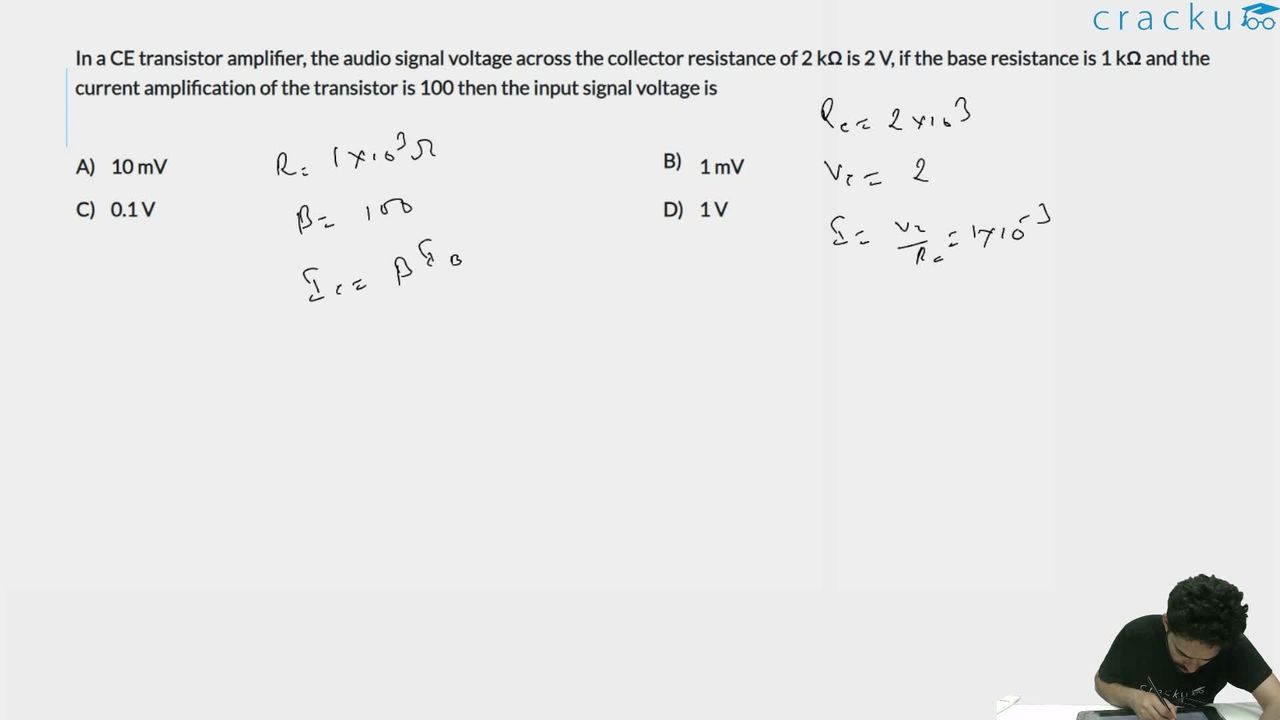
In a CE transistor amplifier, the audio signal voltage across the collector resistance of 2 kΩ is 2 V, if the base resistance is 1 kΩ and the current amplification of the transistor is 100 then the input signal voltage is
We have a common-emitter (CE) transistor amplifier in which the a.c. signal voltage developed across the collector resistance is given as $$V_C = 2\ \text{V}$$ and the value of this collector resistance is $$R_C = 2\ \text{k}\Omega$$.
First, by applying Ohm’s law $$V = I R$$ to the collector circuit, the corresponding a.c. collector current is obtained from
$$I_C = \frac{V_C}{R_C}.$$
Substituting the given numbers,
$$I_C \;=\; \frac{2\ \text{V}}{2\ \text{k}\Omega} \;=\; \frac{2}{2000}\ \text{A} \;=\; 1 \times 10^{-3}\ \text{A} \;=\; 1\ \text{mA}.$$
Now, the transistor is specified to have a current amplification (common-emitter current gain) of $$\beta = 100$$. By definition of this gain,
$$I_C = \beta\, I_B,$$
where $$I_B$$ is the a.c. base current. Solving for $$I_B$$,
$$I_B = \frac{I_C}{\beta}.$$
Substituting the value of $$I_C$$ we have just found,
$$I_B \;=\; \frac{1\ \text{mA}}{100} \;=\; 0.01\ \text{mA} \;=\; 10^{-2}\ \text{mA} \;=\; 10\ \mu\text{A}.$$
The base circuit contains the base resistance $$R_B = 1\ \text{k}\Omega$$. The input signal voltage across this resistance follows Ohm’s law again,
$$V_{\text{in}} = I_B\, R_B.$$
Substituting $$I_B = 10\ \mu\text{A} = 10 \times 10^{-6}\ \text{A}$$ and $$R_B = 1\ \text{k}\Omega = 1000\ \Omega$$,
$$\begin{aligned} V_{\text{in}} &= (10 \times 10^{-6}\ \text{A}) \times (1000\ \Omega) \\ &= 10 \times 10^{-6} \times 10^{3}\ \text{V} \\ &= 10 \times 10^{-3}\ \text{V} \\ &= 0.01\ \text{V} \\ &= 10\ \text{mV}. \end{aligned}$$
Hence, the correct answer is Option A.
Was this solution helpful?
Click on the Email ☝️ to Watch the Video Solution
Create a FREE account and get:
_1.webp)

Educational materials for JEE preparation

Ask our AI anything

AI can make mistakes. Please verify important information.
AI can make mistakes. Please verify important information.


