
Join Our JEE Preparation Group
Prep with like-minded aspirants; Get access to free daily tests and study material.
Sign in
Please select an account to continue using cracku.in
↓ →
Join Our JEE Preparation Group
Prep with like-minded aspirants; Get access to free daily tests and study material.
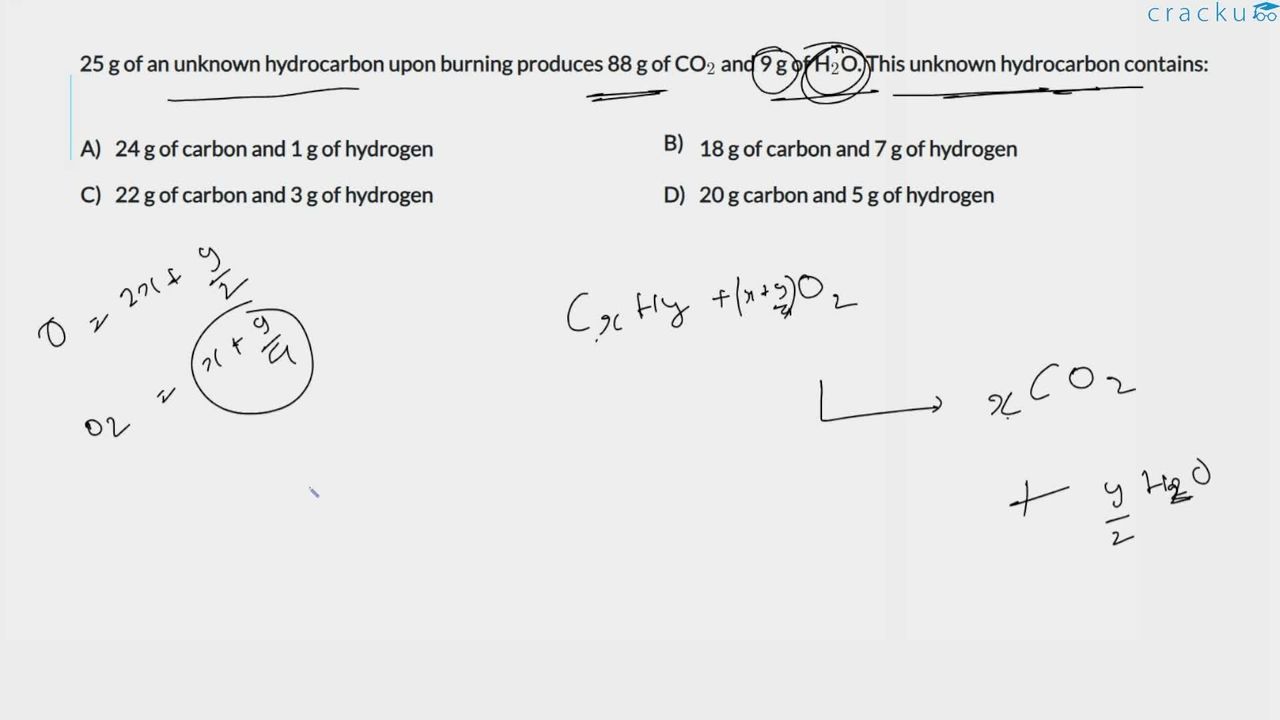
25 g of an unknown hydrocarbon upon burning produces 88 g of CO$$_2$$ and 9 g of H$$_2$$O. This unknown hydrocarbon contains:
We are told that complete combustion of 25 g of an unknown hydrocarbon gives 88 g of CO$$\_2$$ and 9 g of H$$\_2$$O. From these products we will back-calculate the masses of carbon and hydrogen that must have been present in the original sample.
First, we look at the carbon that appears in CO$$\_2$$. The molar mass of CO$$\_2$$ is $$44\;\text{g mol}^{-1}$$, made up of $$12\;\text{g}$$ of carbon and $$32\;\text{g}$$ of oxygen. The fraction of the mass of CO$$\_2$$ that is due to carbon is therefore
$$\frac{12}{44}.$$
The given mass of CO$$\_2$$ is 88 g. Hence the mass of carbon in those 88 g is
$$\text{mass of C} \;=\; \frac{12}{44}\times 88 =\;12\times\frac{88}{44} =\;12\times 2 =\;24\;\text{g}.$$
Now we examine the hydrogen that appears in H$$\_2$$O. The molar mass of H$$\_2$$O is $$18\;\text{g mol}^{-1}$$, which contains $$2\;\text{g}$$ of hydrogen and $$16\;\text{g}$$ of oxygen. Thus the fraction of the mass of H$$\_2$$O that corresponds to hydrogen is
$$\frac{2}{18}.$$
The mass of water produced is 9 g, so the mass of hydrogen present in it is
$$\text{mass of H} \;=\; \frac{2}{18}\times 9 =\;2\times\frac{9}{18} =\;2\times\frac{1}{2} =\;1\;\text{g}.$$
Therefore, in the 25 g of the original unknown hydrocarbon, we had 24 g of carbon and 1 g of hydrogen.
Among the given options, this matches
A. 24 g of carbon and 1 g of hydrogen.
Hence, the correct answer is Option A.
Was this solution helpful?
Click on the Email ☝️ to Watch the Video Solution
Create a FREE account and get:
_1.webp)

Educational materials for JEE preparation

Ask our AI anything

AI can make mistakes. Please verify important information.
AI can make mistakes. Please verify important information.


