
Join Our JEE Preparation Group
Prep with like-minded aspirants; Get access to free daily tests and study material.
Sign in
Please select an account to continue using cracku.in
↓ →
Join Our JEE Preparation Group
Prep with like-minded aspirants; Get access to free daily tests and study material.
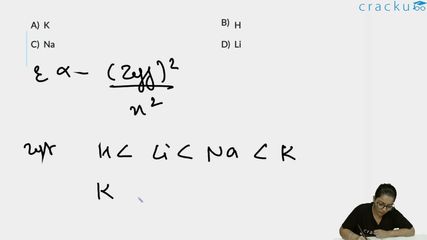
Among the following, the energy of 2s orbital is lowest in:
To decide in which atom the $$2s$$ orbital possesses the lowest (most negative) energy, we compare how strongly the nucleus attracts an electron in that same $$2s$$ orbital for each element.
First recall the general principle that governs one-electron energies in multi-electron atoms: the energy of a given subshell becomes more negative as the effective nuclear charge $$Z_{\text{eff}}$$ felt by the electron increases. The mathematical statement is that, after accounting for shielding, the approximate one-electron energy varies as
$$E_{n,\ell}\;\propto\;-\dfrac{\left(Z_{\text{eff}}\right)^{2}}{n^{2}},$$
where $$n$$ is the principal quantum number and $$\ell$$ the azimuthal quantum number. For all the atoms listed the quantum numbers of the orbital of interest are the same: $$n = 2$$ and $$\ell = 0$$ (because it is an $$s$$ orbital). Hence, the only factor that can change the energy is $$Z_{\text{eff}}$$.
Now $$Z_{\text{eff}}$$ increases with the actual nuclear charge $$Z$$ but is slightly reduced by shielding from the inner electrons. Even after shielding, a higher $$Z$$ still means a larger $$Z_{\text{eff}}$$ and therefore a more negative energy.
Let us list the atomic numbers:
$$\begin{aligned} \text{H}: &\; Z = 1,\\ \text{Li}: &\; Z = 3,\\ \text{Na}: &\; Z = 11,\\ \text{K}: &\; Z = 19. \end{aligned}$$
As we move from hydrogen to potassium, $$Z$$ clearly increases. Shielding does grow because more inner shells appear (for example, Na has the complete $$1s^{2}2s^{2}2p^{6}$$ core; K has even more inner electrons), yet the growth of nuclear charge is still greater than the added shielding. Consequently, the net $$Z_{\text{eff}}$$ experienced by a $$2s$$ electron rises in the order
$$\text{H} \lt \text{Li} \lt \text{Na} \lt \text{K}.$$
Because the energy is proportional to $$-Z_{\text{eff}}^{2}$$, a larger $$Z_{\text{eff}}$$ makes the energy more negative, i.e. lower. Thus the $$2s$$ orbital is most stabilised in potassium.
Hence, the correct answer is Option A.
Was this solution helpful?
Click on the Email ☝️ to Watch the Video Solution
Create a FREE account and get:
_1.webp)

Educational materials for JEE preparation

Ask our AI anything

AI can make mistakes. Please verify important information.
AI can make mistakes. Please verify important information.


