
Join Our JEE Preparation Group
Prep with like-minded aspirants; Get access to free daily tests and study material.
Sign in
Please select an account to continue using cracku.in
↓ →
Join Our JEE Preparation Group
Prep with like-minded aspirants; Get access to free daily tests and study material.
Consider the LR circuit shown in the figure. If the switch S is closed at t = 0 then the amount of charge that passes through the battery between t = 0 and t = $$\frac{L}{R}$$ is:
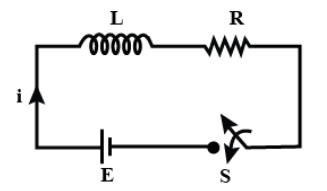
We are dealing with a series LR circuit whose switch is closed at the instant $$t = 0$$. At that moment the current is zero, and thereafter it rises according to the well-known growth law for an LR circuit.
First, we recall the current-time relation for a resistor $$R$$ in series with an inductor $$L$$ connected to a constant emf $$E$$. The standard formula is stated as
$$i(t) = \frac{E}{R}\Bigl(1 - e^{-\,\frac{R}{L}t}\Bigr).$$
This expression comes from solving the differential equation $$E = L\dfrac{di}{dt} + Ri$$ with the initial condition $$i(0)=0$$.
We are asked for the total charge that flows through the battery from $$t = 0$$ up to the time $$t = \dfrac{L}{R}$$. Charge is the time integral of current, so we write
$$Q = \int_{0}^{\,L/R} i(t)\,dt.$$
Substituting the expression for $$i(t)$$ obtained above, we have
$$Q = \int_{0}^{\,L/R} \frac{E}{R}\Bigl(1 - e^{-\,\frac{R}{L}t}\Bigr)\,dt.$$
The constant factor $$\frac{E}{R}$$ can be taken outside the integral:
$$Q = \frac{E}{R}\int_{0}^{\,L/R} \Bigl(1 - e^{-\,\frac{R}{L}t}\Bigr)\,dt.$$
Now we integrate term by term. The integral of $$1$$ with respect to $$t$$ is simply $$t$$. The integral of $$-e^{-at}$$, where $$a = \dfrac{R}{L}$$, is $$\dfrac{1}{a}e^{-at}$$ because
$$\int -e^{-at}\,dt = \frac{1}{a}e^{-at} + C.$$
Using $$a = \dfrac{R}{L}$$, the integral becomes
$$\int_{0}^{\,L/R} \Bigl(1 - e^{-\,\frac{R}{L}t}\Bigr)\,dt = \Bigl[t + \frac{L}{R}\,e^{-\,\frac{R}{L}t}\Bigr]_{0}^{\,L/R}.$$
We now evaluate the definite integral at its limits. First at the upper limit $$t = \dfrac{L}{R}$$:
$$t = \frac{L}{R}, \quad e^{-\,\frac{R}{L}\cdot\frac{L}{R}} = e^{-1} = \frac{1}{e}.$$
So the expression at the upper limit is
$$\frac{L}{R} + \frac{L}{R}\cdot\frac{1}{e}.$$
Next, evaluate at the lower limit $$t=0$$:
$$t = 0, \quad e^{-\,\frac{R}{L}\cdot 0} = e^{0} = 1,$$
giving
$$0 + \frac{L}{R}\cdot 1 = \frac{L}{R}.$$
Subtracting the lower-limit value from the upper-limit value we obtain
$$\left(\frac{L}{R} + \frac{L}{R}\cdot\frac{1}{e}\right) \;-\; \left(\frac{L}{R}\right) = \frac{L}{R}\Bigl(\frac{1}{e}\Bigr).$$
Hence the definite integral equals $$\dfrac{L}{R}\dfrac{1}{e}$$, and therefore
$$Q = \frac{E}{R} \times \frac{L}{R}\times\frac{1}{e} = \frac{EL}{e\,R^{2}}.$$
Numerically, $$e \approx 2.718 \approx 2.7$$, so the charge can be written approximately as
$$Q \approx \frac{EL}{2.7\,R^{2}}.$$
This matches exactly with option D.
Hence, the correct answer is Option D.
Was this solution helpful?
Create a FREE account and get:
_1.webp)

Educational materials for JEE preparation

Ask our AI anything

AI can make mistakes. Please verify important information.
AI can make mistakes. Please verify important information.


