
Join Our JEE Preparation Group
Prep with like-minded aspirants; Get access to free daily tests and study material.
Sign in
Please select an account to continue using cracku.in
↓ →
Join Our JEE Preparation Group
Prep with like-minded aspirants; Get access to free daily tests and study material.
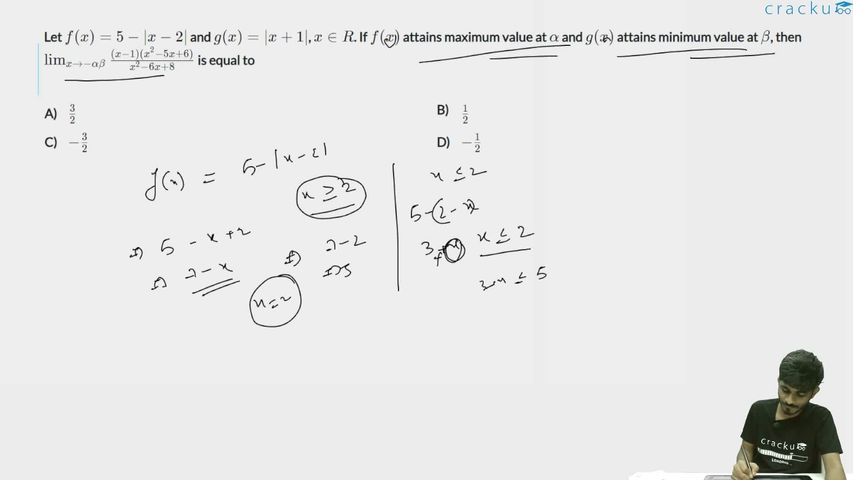
Let $$f(x) = 5 - |x - 2|$$ and $$g(x) = |x + 1|$$, $$x \in R$$. If $$f(x)$$ attains maximum value at $$\alpha$$ and $$g(x)$$ attains minimum value at $$\beta$$, then $$\lim_{x \to -\alpha\beta} \frac{(x - 1)(x^2 - 5x + 6)}{x^2 - 6x + 8}$$ is equal to
We have the functions $$f(x)=5-|x-2|$$ and $$g(x)=|x+1|$$ defined for all real $$x$$.
First, we find the point $$\alpha$$ at which $$f(x)$$ attains its maximum value. For any real number $$t$$, the quantity $$|t|$$ is always non-negative and its minimum possible value is $$0$$. In the expression $$f(x)=5-|x-2|$$ the term $$|x-2|$$ will therefore be smallest, namely $$0$$, when $$x-2=0$$, that is when $$x=2$$. So $$|x-2|_{\min}=0$$ and consequently $$f(x)_{\max}=5-0=5$$ at $$x=2$$. Hence $$\alpha=2$$.
Next, we determine the point $$\beta$$ at which $$g(x)=|x+1|$$ attains its minimum value. Exactly as before, $$|x+1|$$ is minimized when its inside quantity is zero: $$x+1=0 \implies x=-1$$. Thus $$|x+1|_{\min}=0$$, and this occurs at $$x=-1$$. Hence $$\beta=-1$$.
We now need the limit $$ \lim_{x \to -\alpha\beta} \frac{(x-1)(x^2-5x+6)}{x^2-6x+8}. $$ First we compute $$-\alpha\beta$$: $$\alpha\beta = (2)(-1)=-2 \quad\Longrightarrow\quad -\alpha\beta = -(-2)=2.$$ So we shall evaluate the limit as $$x \to 2$$.
Before substituting $$x=2$$, we simplify the rational function algebraically. We factor every quadratic completely:
$$x^2-5x+6 = (x-2)(x-3),$$ $$x^2-6x+8 = (x-2)(x-4).$$
Substituting these factorizations, the original fraction becomes
$$ \frac{(x-1)(x^2-5x+6)}{x^2-6x+8} =\frac{(x-1)\bigl(x-2\bigr)\bigl(x-3\bigr)}{\bigl(x-2\bigr)\bigl(x-4\bigr)}. $$
For $$x \neq 2$$ the common factor $$x-2$$ can be cancelled:
$$ \frac{(x-1)(x-2)(x-3)}{(x-2)(x-4)} =\frac{(x-1)(x-3)}{x-4}. $$
Now the limit as $$x \to 2$$ can be found by straightforward substitution because the denominator is no longer zero at $$x=2$$:
Numerator at $$x=2$$: $$ (2-1)(2-3)=1\cdot(-1)=-1. $$
Denominator at $$x=2$$: $$ 2-4=-2. $$
Therefore the value of the fraction at $$x=2$$ is
$$ \frac{-1}{-2}= \frac12. $$
So $$ \lim_{x \to 2} \frac{(x-1)(x^2-5x+6)}{x^2-6x+8}= \frac12. $$
Hence, the correct answer is Option B.
Was this solution helpful?
Click on the Email ☝️ to Watch the Video Solution
Create a FREE account and get:
_1.webp)

Educational materials for JEE preparation

Ask our AI anything

AI can make mistakes. Please verify important information.
AI can make mistakes. Please verify important information.


