
Join Our JEE Preparation Group
Prep with like-minded aspirants; Get access to free daily tests and study material.
Sign in
Please select an account to continue using cracku.in
↓ →
Join Our JEE Preparation Group
Prep with like-minded aspirants; Get access to free daily tests and study material.
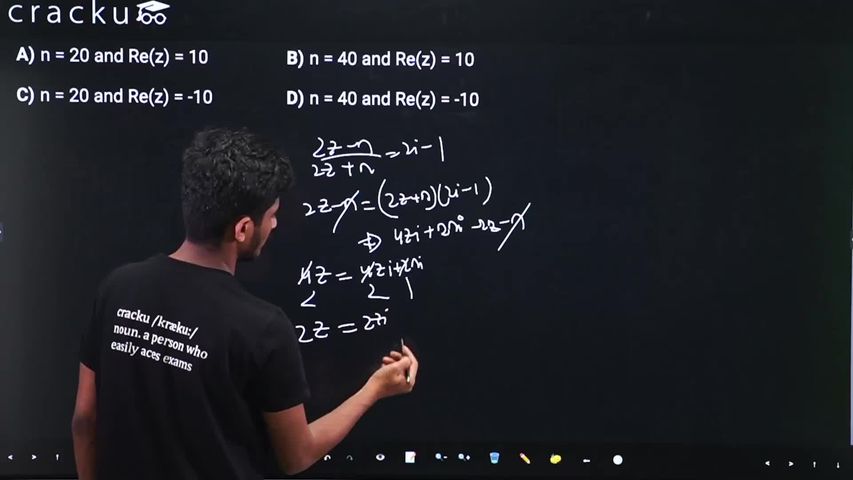
Let $$z \in C$$ with Im(z) = 10 and it satisfies $$\frac{2z - n}{2z + n} = 2i - 1$$ for some natural number n. Then
Let us write the unknown complex number in algebraic form. We put $$z = x + iy,$$ where $$x = \operatorname{Re}(z)$$ and $$y = \operatorname{Im}(z).$$
According to the question $$\operatorname{Im}(z) = 10,$$ so we immediately have $$y = 10.$$
The equation to be satisfied is
$$\frac{2z - n}{2z + n} = 2i - 1.$$
First substitute $$z = x + iy$$ into the left-hand side. We obtain
$$2z = 2(x + iy) = 2x + 2iy,$$
so
$$2z - n = (2x + 2iy) - n = (2x - n) + 2iy,$$
$$2z + n = (2x + 2iy) + n = (2x + n) + 2iy.$$
Hence
$$\frac{2z - n}{2z + n} \;=\; \frac{(2x - n) + 2iy}{(2x + n) + 2iy}.$$
This fraction must equal the complex number $$2i - 1,$$ whose real part is $$-1$$ and imaginary part is $$2.$$
To equate two complex numbers we cross-multiply, obtaining
$$\bigl((2x - n) + 2iy\bigr) \;=\; (-1 + 2i)\,\bigl((2x + n) + 2iy\bigr).$$
Next we expand the right-hand product. Write the second factor as $$A + iB,$$ where
$$A = 2x + n, \qquad B = 2y.$$
Using the distributive law,
$$(\!-1 + 2i)(A + iB) \;=\; (-1)A + (-1)iB + 2iA + 2i\cdot iB.$$
Because $$i^2 = -1,$$ the term $$2i\cdot iB$$ becomes $$2(-1)B = -2B.$$ Writing everything out again with $$A, B$$ replaced, we get
$$$ \begin{aligned} (-1 + 2i)\bigl((2x + n) + 2iy\bigr) &= -\bigl(2x + n\bigr) \;-\; 2iy \;+\; 2i\bigl(2x + n\bigr) \;-\; 2(2y) \\ &= \bigl(-2x - n - 4y\bigr) \;+\; i\bigl(-2y + 4x + 2n\bigr). \end{aligned} $$$
The left-hand side of the original equality is simply
$$(2x - n) + 2iy \;=\; (2x - n) + i(2y).$$
Because two complex numbers are equal only when both their real parts and their imaginary parts are equal, we set
$$\text{Real parts:}\qquad 2x - n = -2x - n - 4y,$$
$$\text{Imaginary parts:}\qquad 2y = -2y + 4x + 2n.$$
Simplify the real-part equation first:
$$$ \begin{aligned} 2x - n &= -2x - n - 4y, \\ 2x &= -2x - 4y, \qquad\text{(adding } n \text{ to both sides)}\\ 4x &= -4y, \qquad\text{(adding } 2x \text{ to both sides)}\\ x &= -y. \end{aligned} $$$
But we already know $$y = 10,$$ so
$$x = -\,10.$$
Now employ this value in the imaginary-part equation:
$$$ \begin{aligned} 2y &= -2y + 4x + 2n, \\ 2(10) &= -2(10) + 4(-10) + 2n, \\ 20 &= -20 - 40 + 2n, \\ 20 &= -60 + 2n, \\ 2n &= 80, \\ n &= 40. \end{aligned} $$$
Thus we have found
$$n = 40 \quad\text{and}\quad \operatorname{Re}(z) = x = -10.$$
Comparing these values with the given options, we see they correspond to Option 4.
Hence, the correct answer is Option 4.
Was this solution helpful?
Click on the Email ☝️ to Watch the Video Solution
Create a FREE account and get:
_1.webp)

Educational materials for JEE preparation

Ask our AI anything

AI can make mistakes. Please verify important information.
AI can make mistakes. Please verify important information.


