
Join Our JEE Preparation Group
Prep with like-minded aspirants; Get access to free daily tests and study material.
Sign in
Please select an account to continue using cracku.in
↓ →
Join Our JEE Preparation Group
Prep with like-minded aspirants; Get access to free daily tests and study material.
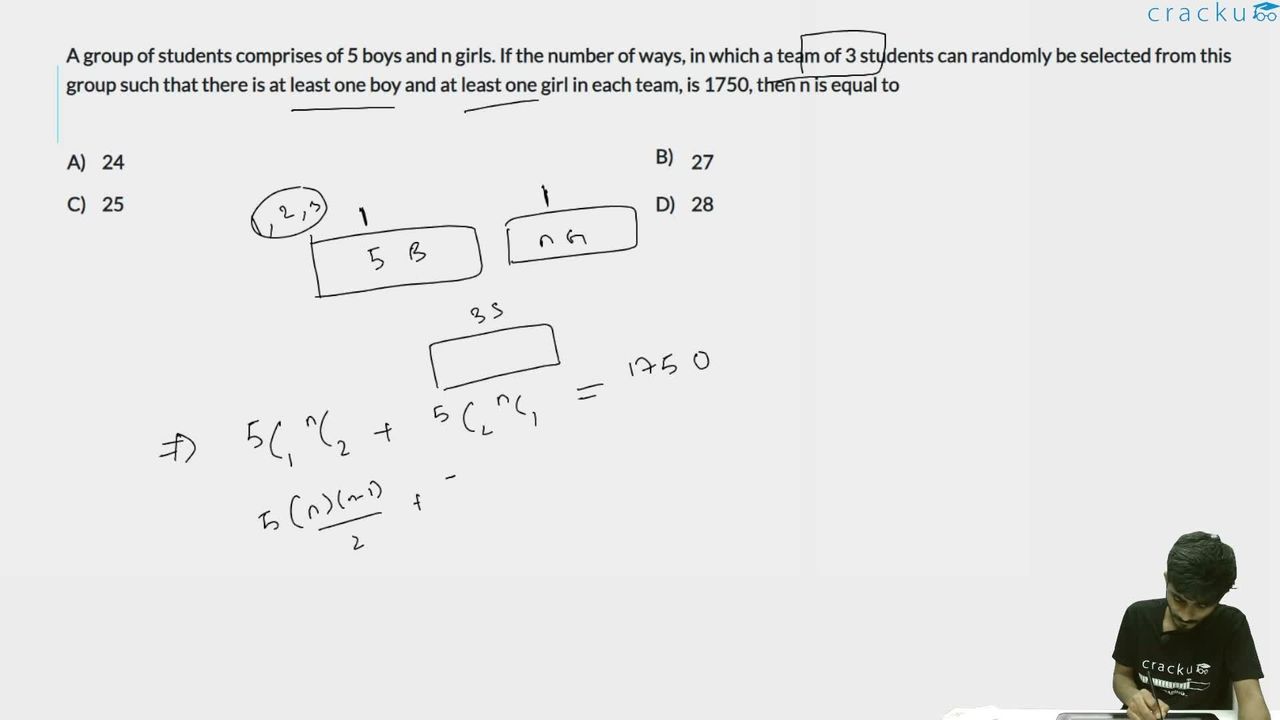
A group of students comprises of 5 boys and n girls. If the number of ways, in which a team of 3 students can randomly be selected from this group such that there is at least one boy and at least one girl in each team, is 1750, then n is equal to
We have a total of 5 boys and $$n$$ girls in the group, so the total number of students is $$5+n$$. We need to form teams of exactly 3 students, with the extra condition that each chosen team must contain at least one boy and at least one girl. This requirement can be met in only two mutually exclusive ways:
• the team has 1 boy and 2 girls, or
• the team has 2 boys and 1 girl.
We now count the number of selections for each of these two cases using the combination formula. First, we recall the formula for combinations:
$$^rC_s \;=\; \binom{r}{s} \;=\; \dfrac{r!}{s!\,(r-s)!}\;,$$
which gives the number of ways to choose $$s$$ objects out of $$r$$ distinct objects when order does not matter.
Case 1 (1 boy, 2 girls):
We select 1 boy out of 5 and 2 girls out of $$n$$. The count is therefore
$$\binom{5}{1}\,\binom{n}{2}.$$
Case 2 (2 boys, 1 girl):
We select 2 boys out of 5 and 1 girl out of $$n$$. The count is
$$\binom{5}{2}\,\binom{n}{1}.$$
Since the two cases are disjoint and together exhaust all possibilities that meet the given condition, the total number of valid teams is the sum of the two counts. According to the statement of the problem, this total equals 1750, so we write
$$\binom{5}{1}\binom{n}{2} \;+\; \binom{5}{2}\binom{n}{1} \;=\; 1750.$$
We now substitute the numerical values of the combinations involving only the boys:
First, $$\binom{5}{1}=5,$$ and $$\binom{5}{2}=\dfrac{5\cdot4}{2\cdot1}=10.$$
Hence the equation becomes
$$5\binom{n}{2}+10\binom{n}{1}=1750.$$
Next, we express the remaining combinations in algebraic form. For any positive integer $$n$$, we have
$$\binom{n}{2}=\dfrac{n(n-1)}{2},\qquad \binom{n}{1}=n.$$
Substituting these expressions into our equation, we obtain
$$5\left(\dfrac{n(n-1)}{2}\right)+10(n)=1750.$$
We now perform each algebraic step carefully. First multiply the fraction inside the parentheses by 5:
$$\dfrac{5}{2}\bigl(n^2-n\bigr)+10n=1750.$$
To clear the denominator, multiply every term of the equation by 2:
$$5\bigl(n^2-n\bigr)+20n=3500.$$
Next, distribute the 5 inside the parentheses:
$$5n^2-5n+20n=3500.$$
Combine the like terms $$-5n+20n$$ to get $$15n$$:
$$5n^2+15n=3500.$$
Divide the entire equation by 5 to simplify:
$$n^2+3n=700.$$
Now bring 700 to the left-hand side to form a quadratic equation equal to zero:
$$n^2+3n-700=0.$$
We solve this quadratic using the quadratic formula. For an equation of the form $$ax^2+bx+c=0$$, the solutions are
$$x=\dfrac{-b\pm\sqrt{b^2-4ac}}{2a}.$$
Here, $$a=1,\; b=3,\; c=-700$$. Substituting these values, we get
$$n=\dfrac{-3\pm\sqrt{3^2-4\cdot1\cdot(-700)}}{2\cdot1}.$$
Simplify inside the square root:
$$3^2=9,\quad -4\cdot1\cdot(-700)=+2800,$$
so
$$n=\dfrac{-3\pm\sqrt{9+2800}}{2}=\dfrac{-3\pm\sqrt{2809}}{2}.$$
Compute the square root: $$\sqrt{2809}=53$$ because $$53^2=2809.$$ Thus
$$n=\dfrac{-3\pm53}{2}.$$
This gives two possible values:
1. $$n=\dfrac{-3+53}{2}=\dfrac{50}{2}=25,$$
2. $$n=\dfrac{-3-53}{2}=\dfrac{-56}{2}=-28.$$
The number of girls cannot be negative, so we discard $$n=-28$$. Therefore, the only acceptable value is
$$n=25.$$
The option list shows that 25 corresponds to Option C.
Hence, the correct answer is Option C.
Was this solution helpful?
Click on the Email ☝️ to Watch the Video Solution
Create a FREE account and get:
_1.webp)

Educational materials for JEE preparation

Ask our AI anything

AI can make mistakes. Please verify important information.
AI can make mistakes. Please verify important information.


