
Join Our JEE Preparation Group
Prep with like-minded aspirants; Get access to free daily tests and study material.
Sign in
Please select an account to continue using cracku.in
↓ →
Join Our JEE Preparation Group
Prep with like-minded aspirants; Get access to free daily tests and study material.
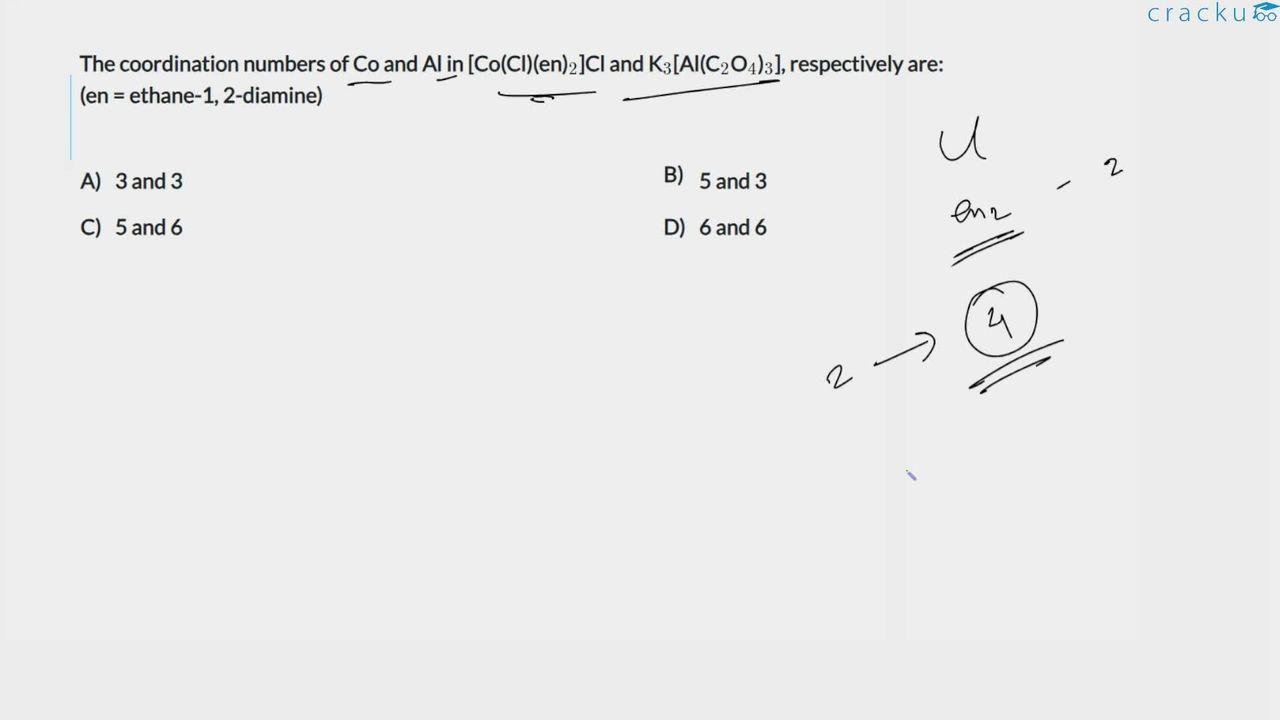
The coordination numbers of Co and Al in [Co(Cl)(en)$$_2$$]Cl and K$$_3$$[Al(C$$_2$$O$$_4$$)$$_3$$], respectively are:
(en = ethane-1, 2-diamine)
The coordination number (often written as $$\text{C.N.}$$) of a metal ion in a coordination compound is defined as the total number of donor atoms of all the ligands that are directly bonded (through a coordinate bond) to that metal ion.
We first examine the complex $$[\,\text{Co}(\text{Cl})(\text{en})_{2}\,]\text{Cl}.$$
Inside the inner square brackets we have the actual coordination sphere, viz. $$[\,\text{Co}(\text{Cl})(\text{en})_{2}\,]^{+}.$$ The chloride ion written outside the bracket is the counter-ion and does not enter the coordination sphere, so it does not affect the coordination number.
Now, within the coordination sphere we list every ligand along with the number of donor atoms it supplies:
• One $$\text{Cl}^{-}$$ ligand is monodentate; it donates only one lone pair to cobalt, giving one Co-Cl bond.
• The symbol $$(\text{en})$$ stands for ethane-1,2-diamene, $$\text{H}_{2}\text{N-CH}_{2}\text{CH}_{2}\text{-NH}_{2},$$ which is a bidentate ligand. Each en molecule donates two nitrogen lone pairs to the metal.
There are two en ligands, so the total number of donor atoms from en equals $$2 \text{(ligands)} \times 2 \text{(donor atoms per ligand)} = 4.$$
Adding the donors from all ligands, we obtain
$$\text{C.N. of Co} = 1 \;(\text{from Cl}^{-}) + 4 \;(\text{from }2\,\text{en}) = 5.$$
Next we consider $$\text{K}_{3}[\,\text{Al}(\text{C}_{2}\text{O}_{4})_{3}\,].$$
The part within brackets, $$[\,\text{Al}(\text{C}_{2}\text{O}_{4})_{3}\,]^{3-},$$ is the coordination entity. The potassium ions are mere counter-ions and lie outside the coordination sphere, so they play no role in determining the coordination number.
Oxalate, $$\text{C}_{2}\text{O}_{4}^{2-},$$ abbreviated as $$\text{ox}^{2-},$$ is a bidentate ligand; each oxalate ion uses two oxygen atoms to form two Al-O coordinate bonds.
There are three oxalate ligands; therefore the number of donor atoms contributed equals
$$3 \text{(ligands)} \times 2 \text{(donor atoms per ligand)} = 6.$$
Hence,
$$\text{C.N. of Al} = 6.$$
Putting the two results side by side, we have
$$\text{C.N. of Co} = 5 \quad\text{and}\quad \text{C.N. of Al} = 6.$$
The option that lists $$5$$ for cobalt and $$6$$ for aluminium is Option C.
Hence, the correct answer is Option C.
Was this solution helpful?
Click on the Email ☝️ to Watch the Video Solution
Create a FREE account and get:
_1.webp)

Educational materials for JEE preparation

Ask our AI anything

AI can make mistakes. Please verify important information.
AI can make mistakes. Please verify important information.


