
Join Our JEE Preparation Group
Prep with like-minded aspirants; Get access to free daily tests and study material.
Sign in
Please select an account to continue using cracku.in
↓ →
Join Our JEE Preparation Group
Prep with like-minded aspirants; Get access to free daily tests and study material.
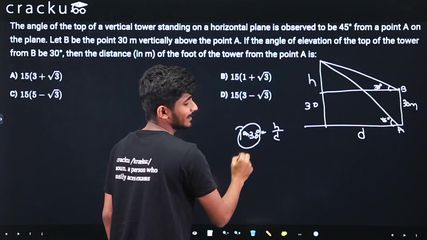
The angle of the top of a vertical tower standing on a horizontal plane is observed to be 45° from a point A on the plane. Let B be the point 30 m vertically above the point A. If the angle of elevation of the top of the tower from B be 30°, then the distance (in m) of the foot of the tower from the point A is:
Let us denote the foot of the tower by $$O$$ and the top of the tower by $$T$$. The given point on the horizontal plane is $$A$$, and a point $$B$$ is located vertically above $$A$$ at a height of $$30\text{ m}$$. We denote the horizontal distance $$OA$$ by $$x\text{ m}$$ and the height of the tower $$OT$$ by $$h\text{ m}$$.
We first use the information from point $$A$$. The angle of elevation of $$T$$ from $$A$$ is $$45^\circ$$. For a right-angled triangle, the basic trigonometric definition is $$\tan(\theta)=\dfrac{\text{opposite side}}{\text{adjacent side}}.$$ Applying this to $$\triangle OAT$$, we have
$$\tan 45^\circ=\dfrac{OT}{OA}\;.$$
Since $$\tan 45^\circ=1$$, this yields
$$1=\dfrac{h}{x}\quad\Longrightarrow\quad h=x.$$ So the height of the tower equals the horizontal distance $$OA$$.
Next we use the information from point $$B$$, which is $$30\text{ m}$$ directly above $$A$$. Hence $$AB=30\text{ m}$$, and the horizontal distance from $$B$$ to the foot of the tower is still $$x\text{ m}$$ (because $$B$$ is vertically above $$A$$).
The angle of elevation of $$T$$ from $$B$$ is $$30^\circ$$, so for right-angled triangle $$\triangle OBT$$ we again apply $$\tan(\theta)=\dfrac{\text{opposite side}}{\text{adjacent side}}.$$ Here the vertical side opposite the angle at $$B$$ is $$TB$$, whose length is the difference between the tower’s height and the height of $$B$$ above the plane, namely $$h-30$$. Thus
$$\tan 30^\circ=\dfrac{TB}{OB}=\dfrac{h-30}{x}\;.$$
Since $$\tan 30^\circ=\dfrac{1}{\sqrt3}$$, we write
$$\dfrac{1}{\sqrt3}=\dfrac{h-30}{x}\;.$$
But from the first part we already have $$h=x$$. Substituting $$h=x$$ into the above gives
$$\dfrac{1}{\sqrt3}=\dfrac{x-30}{x}\;.$$
Now we solve this equation for $$x$$ step by step. First multiply both sides by $$x$$:
$$\dfrac{x}{\sqrt3}=x-30\;.$$
Next, bring the term $$x$$ on the right to the left side:
$$\dfrac{x}{\sqrt3}-x=-30\;.$$
Factor out $$x$$ on the left:
$$x\left(\dfrac{1}{\sqrt3}-1\right)=-30\;.$$
Combine the terms inside the parentheses by taking a common denominator $$\sqrt3$$:
$$x\left(\dfrac{1-\sqrt3}{\sqrt3}\right)=-30\;.$$
Now multiply both sides by $$\dfrac{\sqrt3}{1-\sqrt3}$$ to isolate $$x$$:
$$x=-30\cdot\dfrac{\sqrt3}{1-\sqrt3}\;.$$
Notice that the numerator is negative because $$1-\sqrt3<0$$, so the negatives cancel. We rationalise the denominator by multiplying top and bottom by $$1+\sqrt3$$:
$$x=30\cdot\dfrac{\sqrt3}{\sqrt3-1} =30\cdot\dfrac{\sqrt3(1+\sqrt3)}{(\sqrt3-1)(1+\sqrt3)} =30\cdot\dfrac{\sqrt3(1+\sqrt3)}{3-1} =30\cdot\dfrac{\sqrt3(1+\sqrt3)}{2}\;.$$
Simplify the factor $$\sqrt3(1+\sqrt3)=\sqrt3+\sqrt3\cdot\sqrt3=\sqrt3+3$$, giving
$$x=\dfrac{30}{2}\,\bigl(3+\sqrt3\bigr) =15\bigl(3+\sqrt3\bigr)\;.$$
Thus the horizontal distance of point $$A$$ from the foot of the tower is
$$OA=x=15(3+\sqrt3)\text{ m}.$$
Hence, the correct answer is Option A.
Was this solution helpful?
Click on the Email ☝️ to Watch the Video Solution
Create a FREE account and get:
_1.webp)

Educational materials for JEE preparation

Ask our AI anything

AI can make mistakes. Please verify important information.
AI can make mistakes. Please verify important information.


