
Join Our JEE Preparation Group
Prep with like-minded aspirants; Get access to free daily tests and study material.
Sign in
Please select an account to continue using cracku.in
↓ →
Join Our JEE Preparation Group
Prep with like-minded aspirants; Get access to free daily tests and study material.
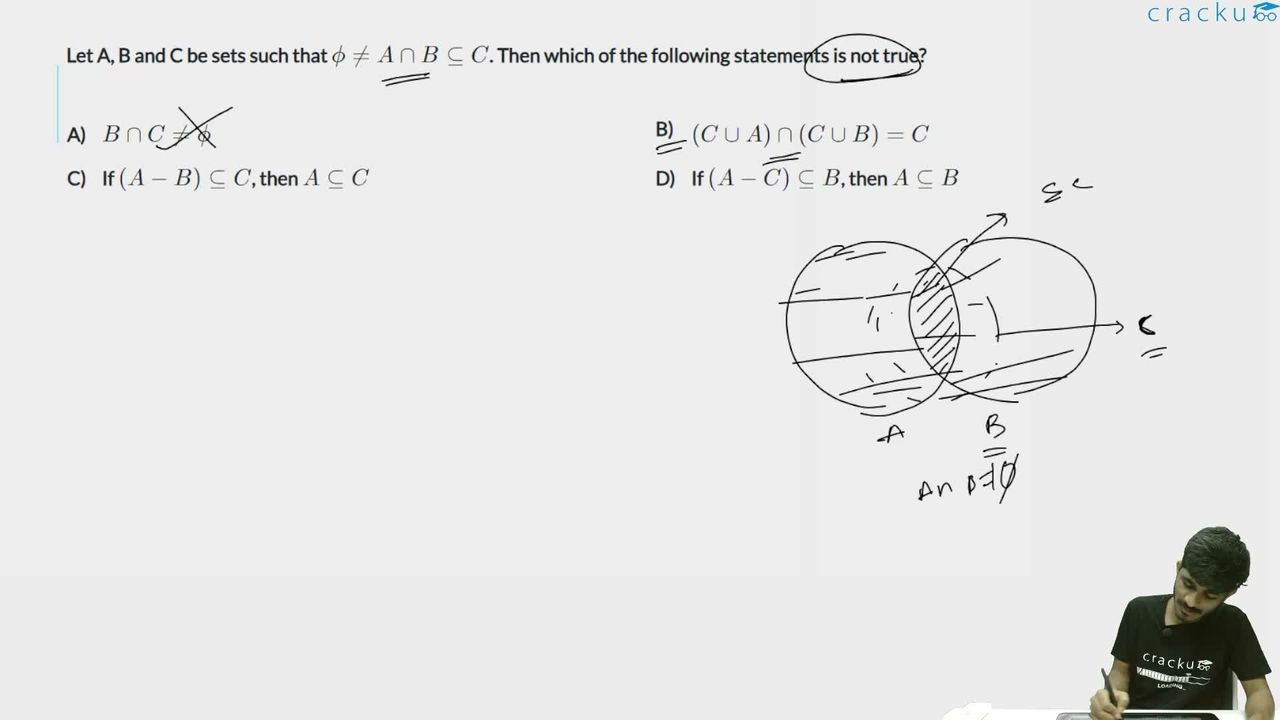
Let A, B and C be sets such that $$\phi \neq A \cap B \subseteq C$$. Then which of the following statements is not true?
We are told that the three sets A, B and C satisfy the double condition $$\phi \neq A \cap B \subseteq C.$$ This means two things at once:
1. $$A \cap B \neq \phi,$$ so at least one element lies in both A and B.
2. Every element that is in $$A \cap B$$ is also in C, that is $$A \cap B \subseteq C.$$
With these facts in hand we now examine each of the four given statements and check whether it must always be true. The statement that fails will be the one that is not true.
Option A. We want to know whether $$B \cap C \neq \phi.$$
Because $$A \cap B \neq \phi,$$ choose an element $$x$$ such that $$x \in A \cap B.$$ From $$x \in A \cap B \subseteq C$$ we immediately obtain $$x \in C.$$ Therefore $$x \in B$$ and $$x \in C$$ at the same time, whence $$x \in B \cap C.$$ Thus $$B \cap C$$ definitely contains at least one element, so $$B \cap C \neq \phi.$$ Option A is always true.
Option B. The expression is $$(C \cup A)\, \cap\, (C \cup B).$$ First recall the standard distributive law of sets:
$$ (X \cup Y) \cap (X \cup Z) \;=\; X \cup (Y \cap Z). $$
Take $$X = C,\; Y = A,\; Z = B.$$ Applying the formula gives
$$ (C \cup A) \cap (C \cup B) \;=\; C \cup (A \cap B). $$
We already know that $$A \cap B \subseteq C,$$ so the union of C with a subset of C is just C itself:
$$ C \cup (A \cap B) = C. $$
Hence the equality in Option B holds for every such triple of sets, so Option B is true.
Option C. We are asked to test the implication
$$ (A - B) \subseteq C \;\Longrightarrow\; A \subseteq C. $$
First write A as the disjoint union of two parts:
$$ A = (A - B)\; \cup\; (A \cap B). $$
If we are given that $$A - B \subseteq C$$ and we already know $$A \cap B \subseteq C,$$ then every element of the left-hand set and every element of the right-hand set lies in C, so their union A also lies in C. Therefore $$A \subseteq C,$$ and Option C is always true.
Option D. Now consider the implication
$$ (A - C) \subseteq B \;\Longrightarrow\; A \subseteq B. $$
Again decompose A, this time relative to C:
$$ A = (A - C)\; \cup\; (A \cap C). $$
The assumption in the hypothesis tells us only that $$A - C \subseteq B.$$ Nothing in the premise gives any information about $$A \cap C,$$ so those elements could fail to belong to B. Hence A may or may not be contained in B; the implication is not guaranteed.
To make this completely concrete, define
$$A = \{1,2\},\quad B = \{1\},\quad C = \{1,2\}.$$
Then
• $$A \cap B = \{1\} \neq \phi,$$ and clearly $$\{1\} \subseteq C,$$ so the initial condition is satisfied.
• Because every element of A is already in C, we have $$A - C = \phi,$$ and the empty set is always a subset of every set, so $$A - C \subseteq B$$ is true.
• However, $$A = \{1,2\}$$ is not a subset of $$B = \{1\},$$ since 2 does not lie in B.
This counter-example shows that the implication in Option D can fail, so Option D is not always true.
Among the four statements the only one that does not hold in every case is Option D.
Hence, the correct answer is Option D.
Was this solution helpful?
Click on the Email ☝️ to Watch the Video Solution
Create a FREE account and get:
_1.webp)

Educational materials for JEE preparation

Ask our AI anything

AI can make mistakes. Please verify important information.
AI can make mistakes. Please verify important information.


