
Join Our JEE Preparation Group
Prep with like-minded aspirants; Get access to free daily tests and study material.
Sign in
Please select an account to continue using cracku.in
↓ →
Join Our JEE Preparation Group
Prep with like-minded aspirants; Get access to free daily tests and study material.
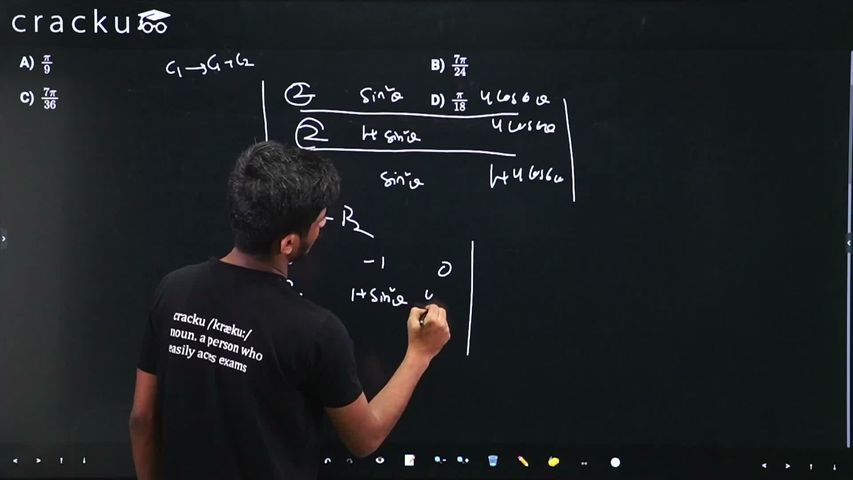
A value of $$\theta \in \left(0, \frac{\pi}{3}\right)$$, for which $$\begin{vmatrix} 1 + \cos^2\theta & \sin^2\theta & 4\cos 6\theta \\ \cos^2\theta & 1 + \sin^2\theta & 4\cos 6\theta \\ \cos^2\theta & \sin^2\theta & 1 + 4\cos 6\theta \end{vmatrix} = 0$$, is
We have to solve the equation
$$ \begin{vmatrix} 1+\cos^2\theta & \sin^2\theta & 4\cos 6\theta\\ \cos^2\theta & 1+\sin^2\theta & 4\cos 6\theta\\ \cos^2\theta & \sin^2\theta & 1+4\cos 6\theta \end{vmatrix}=0 , \qquad 0\lt \theta\lt \dfrac{\pi}{3}. $$
For easier writing, let us put $$c=\cos^2\theta,\quad s=\sin^2\theta,\quad K=4\cos 6\theta.$$ With this notation the determinant becomes
$$ \Delta= \begin{vmatrix} 1+c & s & K\\ c & 1+s & K\\ c & s & 1+K \end{vmatrix}. $$
Now we apply elementary row operations, which do not change the value of the determinant. First, replace the second row by (Row 2 - Row 1) and the third row by (Row 3 - Row 1):
$$ \begin{vmatrix} 1+c & s & K\\ c-(1+c) & (1+s)-s & K-K\\ c-(1+c) & s-s & (1+K)-K \end{vmatrix} = \begin{vmatrix} 1+c & s & K\\ -1 & 1 & 0\\ -1 & 0 & 1 \end{vmatrix}. $$
Next we evaluate this 3 × 3 determinant directly. Expanding along the first row, we use the standard formula $$\det\!(A)=a_{11}M_{11}-a_{12}M_{12}+a_{13}M_{13},$$ where each $$M_{ij}$$ is the minor obtained by deleting the $$i$$-th row and $$j$$-th column.
The minors are:
$$ M_{11}=\begin{vmatrix}1&0\\0&1\end{vmatrix}=1(1)-0(0)=1, $$
$$ M_{12}=\begin{vmatrix}-1&0\\-1&1\end{vmatrix}=(-1)(1)-0(-1)=-1, $$
$$ M_{13}=\begin{vmatrix}-1&1\\-1&0\end{vmatrix}=(-1)(0)-1(-1)=1. $$
Substituting these values we obtain
$$ \Delta=(1+c)\cdot 1-\;s\cdot(-1)+K\cdot 1=(1+c)+s+K. $$
But the Pythagorean identity gives $$c+s=\cos^2\theta+\sin^2\theta=1.$$ Therefore
$$ \Delta=1+K+1=2+K=2+4\cos 6\theta. $$
The condition $$\Delta=0$$ now reads
$$ 2+4\cos 6\theta=0\quad\Longrightarrow\quad\cos 6\theta=-\dfrac12. $$
We recall the standard cosine equation: $$\cos x=-\dfrac12 \;\Longrightarrow\; x=\dfrac{2\pi}{3}+2\pi n\quad\text{or}\quad x=\dfrac{4\pi}{3}+2\pi n,\qquad n\in\mathbb Z.$$ Putting $$x=6\theta$$ we obtain the two families of solutions
$$ 6\theta=\frac{2\pi}{3}+2\pi n\;\;\Longrightarrow\;\;\theta=\frac{2\pi}{3}\cdot\frac16+\frac{2\pi n}{6} =\frac{\pi}{9}+\frac{\pi n}{3}, $$
$$ 6\theta=\frac{4\pi}{3}+2\pi n\;\;\Longrightarrow\;\;\theta=\frac{4\pi}{3}\cdot\frac16+\frac{2\pi n}{6} =\frac{2\pi}{9}+\frac{\pi n}{3}, $$
where $$n$$ is any integer.
We must keep only those values lying strictly between $$0$$ and $$\dfrac{\pi}{3}$$. Taking $$n=0$$ in the first family gives $$\theta=\dfrac{\pi}{9},$$ which satisfies $$0\lt \dfrac{\pi}{9}\lt \dfrac{\pi}{3}$$. Taking $$n=0$$ in the second family gives $$\theta=\dfrac{2\pi}{9},$$ but this number (about $$40^\circ$$) is not offered among the options. Any other integer $$n$$ makes $$\theta$$ either negative or at least $$\dfrac{\pi}{3}$$, so they are to be rejected.
Thus the only option listed that satisfies the determinant condition in the required interval is
$$\theta=\frac{\pi}{9}.$$
Hence, the correct answer is Option A.
Was this solution helpful?
Click on the Email ☝️ to Watch the Video Solution
Create a FREE account and get:
_1.webp)

Educational materials for JEE preparation

Ask our AI anything

AI can make mistakes. Please verify important information.
AI can make mistakes. Please verify important information.


