
Join Our JEE Preparation Group
Prep with like-minded aspirants; Get access to free daily tests and study material.
Sign in
Please select an account to continue using cracku.in
↓ →
Join Our JEE Preparation Group
Prep with like-minded aspirants; Get access to free daily tests and study material.
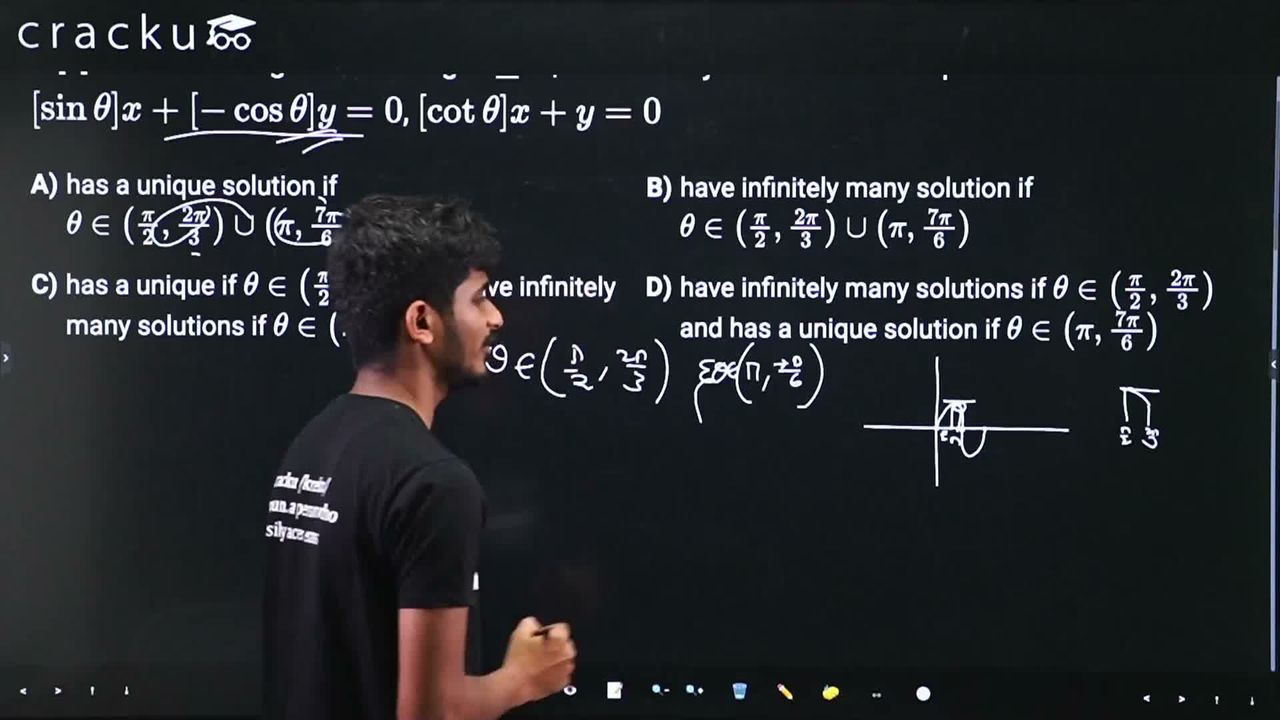
If [x] denotes the greatest integer $$\leq x$$, then the system of linear equations $$[\sin\theta]x + [-\cos\theta]y = 0$$, $$[\cot\theta]x + y = 0$$
We begin with the system
$$[\sin\theta]\,x + [-\cos\theta]\,y = 0,\qquad [\cot\theta]\,x + y = 0.$$
For a $$2\times2$$ homogeneous linear system $$a\,x + b\,y = 0,\qquad c\,x + d\,y = 0,$$ the determinant of the coefficient matrix is $$\Delta = ad - bc.$$ If $$\Delta \neq 0,$$ the only solution is the trivial one $$(x,y) = (0,0)$$; if $$\Delta = 0,$$ the two rows are linearly dependent and every point on a line through the origin satisfies both equations, giving infinitely many solutions.
In our case the coefficients are $$a = [\sin\theta], \; b = [-\cos\theta], \; c = [\cot\theta], \; d = 1,$$ so
$$\Delta = [\sin\theta]\cdot 1 - [-\cos\theta]\,[\cot\theta].$$
We must evaluate the greatest-integer (floor) expressions in the two given $$\theta$$-intervals.
1. Take $$\theta \in \left(\frac{\pi}{2},\;\frac{2\pi}{3}\right).$$ This lies in Quadrant II.
Here $$\sin\theta \in\bigl(0.866,\;1\bigr)\quad\Longrightarrow\quad[\sin\theta]=0,$$ $$\cos\theta \in\bigl(-0.5,\;0\bigr)\quad\Longrightarrow\quad -\cos\theta\in\bigl(0,\;0.5\bigr)\quad\Longrightarrow\quad[-\cos\theta]=0,$$ $$\cot\theta=\frac{\cos\theta}{\sin\theta}\in\bigl(-0.577,\;0\bigr)\quad\Longrightarrow\quad[\cot\theta]=-1.$$ Substituting these integer values we get
$$\Delta = [\sin\theta] - [-\cos\theta]\,[\cot\theta] = 0 - 0\cdot(-1) = 0.$$
Because the determinant is zero, the first equation reduces to $$0x+0y=0,$$ which is an identity, while the second equation is $$(-1)x + y = 0.$$ Thus a single independent linear equation in two unknowns remains, and every point on the line $$y = x$$ (with $$x$$ arbitrary) is a solution. So there are infinitely many solutions in this interval.
2. Take $$\theta \in \left(\pi,\;\frac{7\pi}{6}\right).$$ This lies in Quadrant III.
Here $$\sin\theta\in\bigl(-0.5,\;0\bigr)\quad\Longrightarrow\quad[\sin\theta]=-1,$$ $$\cos\theta\in\bigl(-1,\;-0.866\bigr)\quad\Longrightarrow\quad -\cos\theta\in\bigl(0.866,\;1\bigr)\quad\Longrightarrow\quad[-\cos\theta]=0,$$ $$\cot\theta=\frac{\cos\theta}{\sin\theta}\gt \sqrt3\;( \approx 1.732)\quad\Longrightarrow\quad[\cot\theta]\ge 1.$$
Now the determinant becomes
$$\Delta = [\sin\theta] - [-\cos\theta]\,[\cot\theta] = (-1) - 0\cdot[\cot\theta] = -1.$$ Since $$\Delta=-1\neq 0,$$ the coefficient matrix is non-singular and the homogeneous system possesses only the trivial solution $$(x,y)=(0,0)$$; hence the solution is unique in this interval.
Combining the two discussions, the system has infinitely many solutions when $$\theta \in \left(\frac{\pi}{2},\frac{2\pi}{3}\right)$$ and has a unique solution when $$\theta \in \left(\pi,\frac{7\pi}{6}\right).$$
Hence, the correct answer is Option D.
Was this solution helpful?
Click on the Email ☝️ to Watch the Video Solution
Create a FREE account and get:
_1.webp)

Educational materials for JEE preparation

Ask our AI anything

AI can make mistakes. Please verify important information.
AI can make mistakes. Please verify important information.


