
Join Our JEE Preparation Group
Prep with like-minded aspirants; Get access to free daily tests and study material.
Sign in
Please select an account to continue using cracku.in
↓ →
Join Our JEE Preparation Group
Prep with like-minded aspirants; Get access to free daily tests and study material.
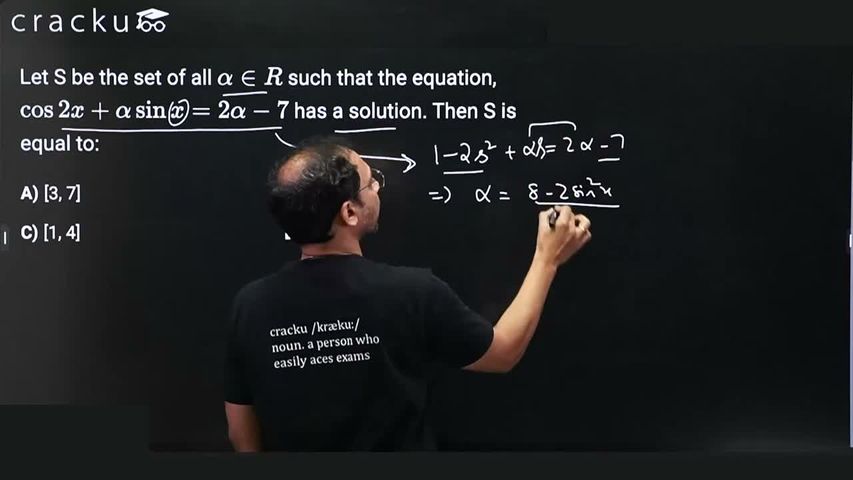
Let S be the set of all $$\alpha \in R$$ such that the equation, $$\cos 2x + \alpha \sin x = 2\alpha - 7$$ has a solution. Then S is equal to:
We begin with the given equation
$$\cos 2x + \alpha \sin x \;=\; 2\alpha - 7.$$
First, we rewrite $$\cos 2x$$ in terms of $$\sin x$$ by using the standard identity
$$\cos 2x \;=\; 1 - 2\sin^{2}x.$$
Substituting this identity, we obtain
$$1 - 2\sin^{2}x + \alpha \sin x \;=\; 2\alpha - 7.$$
For simplicity, let us set
$$y \;=\; \sin x,$$
remembering that $$y$$ must always satisfy $$-1 \le y \le 1.$$ With this substitution the equation becomes
$$1 - 2y^{2} + \alpha y \;=\; 2\alpha - 7.$$
We bring every term to the left-hand side so that the expression equals zero:
$$1 - 2y^{2} + \alpha y - 2\alpha + 7 \;=\; 0.$$
Combining the constant terms $$1 + 7 = 8,$$ we have
$$-2y^{2} + \alpha y + 8 - 2\alpha = 0.$$
Multiplying by $$-1$$ to make the coefficient of $$y^{2}$$ positive, we get
$$2y^{2} - \alpha y - 8 + 2\alpha = 0,$$
or, more neatly,
$$2y^{2} - \alpha y + 2\alpha - 8 = 0.$$
This is a quadratic equation in $$y$$. We want some $$y$$ in the interval $$[-1,\,1]$$ to satisfy it. To find all such $$\alpha,$$ we solve the quadratic for $$\alpha$$ in terms of $$y$$ (treating $$y$$ as the variable and $$\alpha$$ as the unknown constant). Collecting the $$\alpha$$ terms, we write
$$- \alpha y + 2\alpha = \alpha(2 - y).$$
Shifting the remaining terms to the other side gives
$$\alpha(2 - y) = 8 - 2y^{2}.$$
Provided $$y \ne 2$$ (and indeed $$y$$ is never $$2$$ because $$-1 \le y \le 1$$), we can divide to obtain
$$\displaystyle \alpha = \frac{8 - 2y^{2}}{\,2 - y\,}.$$
Factoring a $$2$$ from the numerator yields the simpler expression
$$\alpha = 2\,\frac{4 - y^{2}}{2 - y}.$$\p>
Define the function
$$g(y) = 2\,\frac{4 - y^{2}}{2 - y}, \qquad -1 \le y \le 1.$$
The set $$S$$ that we seek is precisely the set of all values taken by $$g(y)$$ as $$y$$ varies over $$[-1,\,1].$$ To determine this set we examine the monotonicity of $$g(y).$$ Write
$$g(y) = 2\,\frac{N(y)}{D(y)},$$
where $$N(y) = 4 - y^{2}$$ and $$D(y) = 2 - y.$$ Using the quotient rule, the derivative of the inner fraction is
$$\frac{d}{dy}\!\left(\frac{N(y)}{D(y)}\right) = \frac{N'(y)D(y) - N(y)D'(y)}{D(y)^{2}}.$$
We compute each part:
$$N'(y) = -2y, \qquad D'(y) = -1.$$
Substituting these, we obtain
$$\frac{d}{dy}\!\left(\frac{N}{D}\right) = \frac{(-2y)(2 - y) - (4 - y^{2})(-1)}{(2 - y)^{2}} = \frac{-4y + 2y^{2} + 4 - y^{2}}{(2 - y)^{2}} = \frac{y^{2} - 4y + 4}{(2 - y)^{2}} = \frac{(y - 2)^{2}}{(2 - y)^{2}}.$$
Since both numerator and denominator are perfect squares, their ratio is always non-negative and equals zero only when $$y = 2,$$ which is outside the interval $$[-1,\,1].$$ Hence the derivative is strictly positive on $$[-1,\,1]$$ and $$g(y)$$ is strictly increasing on that interval.
Because $$g$$ is increasing, its minimum and maximum values on $$[-1,\,1]$$ occur at the endpoints:
For $$y = -1:$$
$$g(-1) = 2\,\frac{4 - (-1)^{2}}{2 - (-1)} = 2\,\frac{4 - 1}{3} = 2 \times \frac{3}{3} = 2.$$
For $$y = 1:$$
$$g(1) = 2\,\frac{4 - 1^{2}}{2 - 1} = 2\,\frac{3}{1} = 6.$$
Because every intermediate value is attained by continuity and monotonicity, the range of $$g$$ is the closed interval
$$[2,\,6].$$
Therefore the set $$S$$ of all real numbers $$\alpha$$ for which the original trigonometric equation admits a solution is
$$S = [2,\,6].$$
Hence, the correct answer is Option B.
Was this solution helpful?
Click on the Email ☝️ to Watch the Video Solution
Create a FREE account and get:
_1.webp)

Educational materials for JEE preparation

Ask our AI anything

AI can make mistakes. Please verify important information.
AI can make mistakes. Please verify important information.


