
Join Our JEE Preparation Group
Prep with like-minded aspirants; Get access to free daily tests and study material.
Sign in
Please select an account to continue using cracku.in
↓ →
Join Our JEE Preparation Group
Prep with like-minded aspirants; Get access to free daily tests and study material.
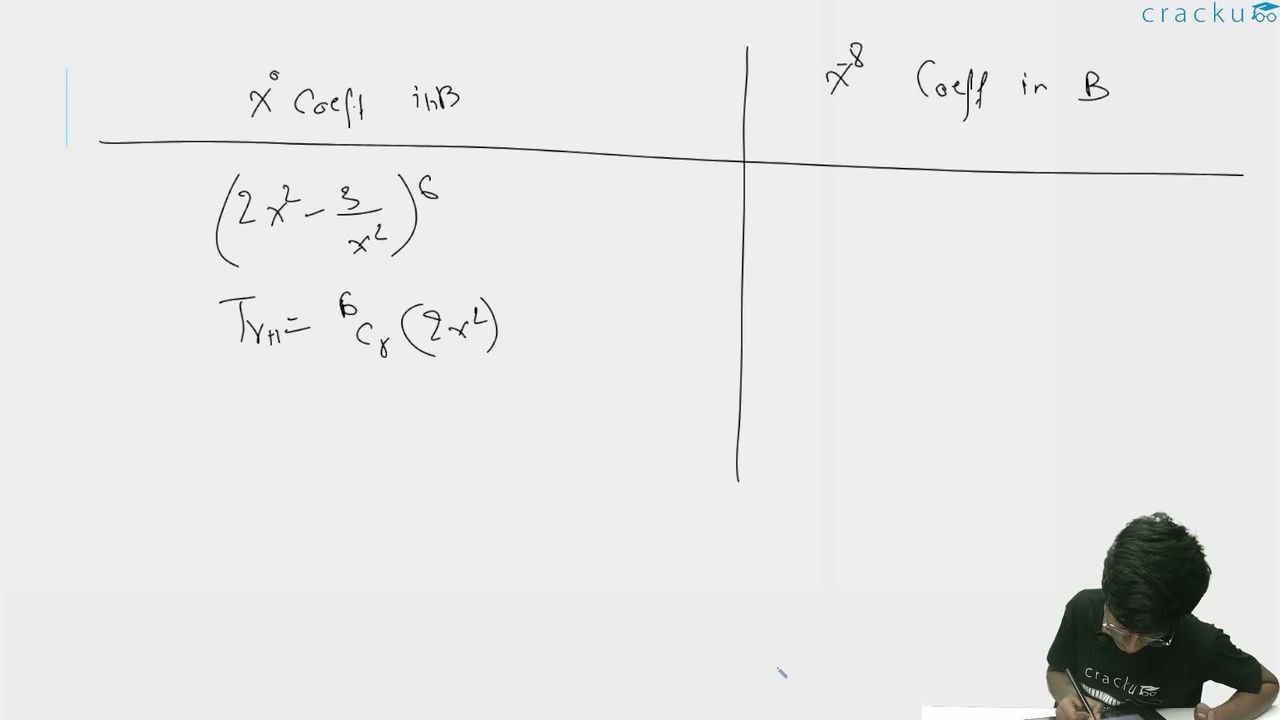
The term independent of x in the expansion of $$\left(\frac{1}{60} - \frac{x^8}{81}\right) \cdot \left(2x^2 - \frac{3}{x^2}\right)^6$$ is equal to
First, we observe that the given expression is a product of two factors:
$$\left(\frac1{60}-\frac{x^{8}}{81}\right)\left(2x^{2}-\frac{3}{x^{2}}\right)^{6}.$$
The term independent of $$x$$ (that is, the constant term) will come from appropriate selections inside this product so that all powers of $$x$$ cancel out.
We begin by expanding the second factor using the binomial theorem. The binomial theorem states:
$$(a+b)^{n}=\sum_{k=0}^{n}\binom{n}{k}\,a^{\,n-k}\,b^{\,k}.$$
Here we identify $$a = 2x^{2}$$, $$b = -\dfrac{3}{x^{2}}$$ and $$n = 6$$. Hence the general term in the expansion of $$\left(2x^{2}-\dfrac{3}{x^{2}}\right)^{6}$$ is
$$T_{k}= \binom{6}{k}\left(2x^{2}\right)^{6-k}\left(-\frac{3}{x^{2}}\right)^{k}.$$ Simplifying the powers of $$x$$, we have
$$T_{k}= \binom{6}{k}\,2^{\,6-k}\,(-3)^{k}\,x^{\,2(6-k)}\,x^{-2k} = \binom{6}{k}\,2^{\,6-k}\,(-3)^{k}\,x^{\,12-4k}.$$
So $$T_{k}$$ contributes a power $$x^{\,12-4k}$$.
Now we multiply each term $$T_{k}$$ by the two terms in the first factor $$\left(\dfrac1{60} - \dfrac{x^{8}}{81}\right)$$ and see when the overall power of $$x$$ becomes zero.
Case 1: Choose $$\dfrac1{60}$$. The resulting power of $$x$$ is unchanged, so we need
$$12-4k = 0 \quad\Longrightarrow\quad 4k = 12 \quad\Longrightarrow\quad k = 3.$$
For $$k = 3$$ we compute the coefficient:
$$\binom{6}{3} = 20,\qquad 2^{\,6-3}=2^{3}=8,\qquad (-3)^{3}=-27.$$
Multiplying,
$$\binom{6}{3}\,2^{3}\,(-3)^{3}=20 \times 8 \times (-27)= -4320.$$
We still have the factor $$\dfrac1{60}$$, so the contribution to the constant term is
$$\frac1{60}\times(-4320)= -\frac{4320}{60}= -72.$$
Case 2: Choose $$-\dfrac{x^{8}}{81}$$. The extra factor $$x^{8}$$ changes the power, so we now need
$$12-4k + 8 = 0 \quad\Longrightarrow\quad 20-4k = 0 \quad\Longrightarrow\quad k = 5.$$
For $$k = 5$$ we compute the coefficient:
$$\binom{6}{5}=6,\qquad 2^{\,6-5}=2,\qquad (-3)^{5} = -243.$$
Thus,
$$\binom{6}{5}\,2\,(-3)^{5}=6 \times 2 \times (-243)= -2916.$$
Multiplying by the prefactor $$-\dfrac1{81}$$ gives
$$-\frac1{81}\times(-2916)=\frac{2916}{81}=36.$$
Adding the two contributions obtained in Case 1 and Case 2, the net constant term is
$$-72 + 36 = -36.$$
Hence, the correct answer is Option D.
Was this solution helpful?
Click on the Email ☝️ to Watch the Video Solution
Create a FREE account and get:
_1.webp)

Educational materials for JEE preparation

Ask our AI anything

AI can make mistakes. Please verify important information.
AI can make mistakes. Please verify important information.


