
Join Our JEE Preparation Group
Prep with like-minded aspirants; Get access to free daily tests and study material.
Sign in
Please select an account to continue using cracku.in
↓ →
Join Our JEE Preparation Group
Prep with like-minded aspirants; Get access to free daily tests and study material.
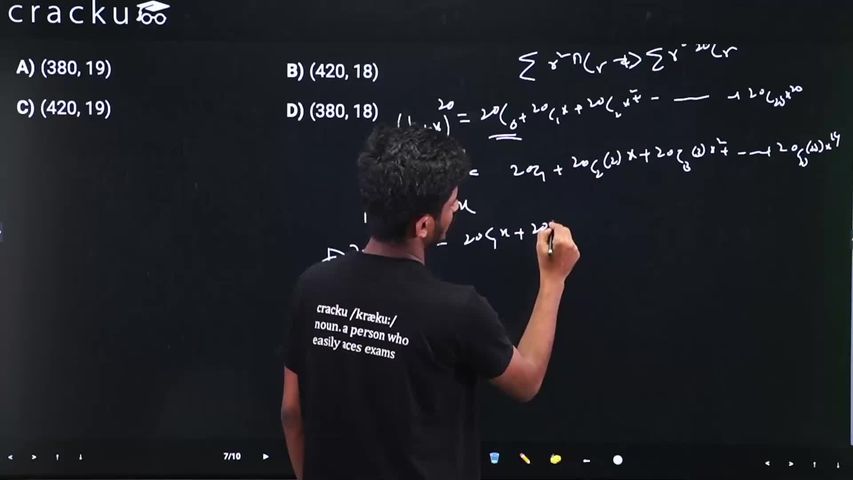
If $$^{20}C_1 + (2^2)\,^{20}C_2 + (3^2)\,^{20}C_3 + \ldots + (20^2)\,^{20}C_{20} = A(2^\beta)$$, then the ordered pair $$(A, \beta)$$ is equal to
We begin with the given summation
$$S \;=\;\sum_{k=1}^{20} k^{2}\,{}^{20}C_{k}.$$
To evaluate this, we recall the binomial expansion formula
$$\bigl(1+x\bigr)^{n} \;=\;\sum_{k=0}^{n} {}^{\,n}C_{k}\,x^{k}.$$
From this, two standard derivative identities follow.
1. Differentiating once with respect to $$x$$ gives
$$n(1+x)^{\,n-1} \;=\;\sum_{k=0}^{n} k\,{}^{n}C_{k}\,x^{\,k-1}.$$
Multiplying both sides by $$x$$ we get the useful form
$$\sum_{k=0}^{n} k\,{}^{n}C_{k}\,x^{\,k} \;=\; n\,x\,(1+x)^{\,n-1}.$$
2. Differentiating the identity in step 1 once more and again multiplying by $$x$$ yields
$$\sum_{k=0}^{n} k(k-1)\,{}^{n}C_{k}\,x^{\,k} \;=\; n(n-1)\,x^{2}\,(1+x)^{\,n-2}.$$
Our goal involves $$k^{2}\,{}^{20}C_{k}$$, which we split as
$$k^{2} = k(k-1) + k.$$
Therefore
$$\sum_{k=0}^{20} k^{2}\,{}^{20}C_{k} \;=\;\sum_{k=0}^{20} k(k-1)\,{}^{20}C_{k} \;+\;\sum_{k=0}^{20} k\,{}^{20}C_{k}.$$
We now evaluate each part at $$x=1$$, because setting $$x=1$$ in the derived identities converts every factor $$(1+x)$$ into $$2$$ and removes any residual $$x$$ powers.
First part:
Using the second identity with $$n=20$$ and $$x=1$$, we have
$$\sum_{k=0}^{20} k(k-1)\,{}^{20}C_{k} \;=\; 20\cdot19\cdot1^{2}\,(1+1)^{18} \;=\;20\cdot19\cdot2^{18}.$$
Second part:
Using the first identity with $$n=20$$ and $$x=1$$, we have
$$\sum_{k=0}^{20} k\,{}^{20}C_{k} \;=\;20\cdot1\,(1+1)^{19} \;=\;20\cdot2^{19}.$$
Adding the two evaluated sums gives
$$\sum_{k=0}^{20} k^{2}\,{}^{20}C_{k} \;=\; \bigl(20\cdot19\cdot2^{18}\bigr) \;+\;\bigl(20\cdot2^{19}\bigr).$$
We factor the common powers of $$2$$:
$$20\cdot19\cdot2^{18} + 20\cdot2^{19} \;=\;20\cdot2^{18}\bigl(19 + 2\bigr) \;=\;20\cdot2^{18}\cdot21.$$
Multiplying the integers,
$$20\times21 = 420,$$
so
$$S \;=\;420\,2^{18}.$$
The general form requested in the question is $$A(2^{\beta})$$. By direct comparison, we identify
$$A = 420,\quad \beta = 18.$$
Hence, the correct answer is Option B.
Was this solution helpful?
Click on the Email ☝️ to Watch the Video Solution
Create a FREE account and get:
_1.webp)

Educational materials for JEE preparation

Ask our AI anything

AI can make mistakes. Please verify important information.
AI can make mistakes. Please verify important information.


