
Join Our JEE Preparation Group
Prep with like-minded aspirants; Get access to free daily tests and study material.
Sign in
Please select an account to continue using cracku.in
↓ →
Join Our JEE Preparation Group
Prep with like-minded aspirants; Get access to free daily tests and study material.
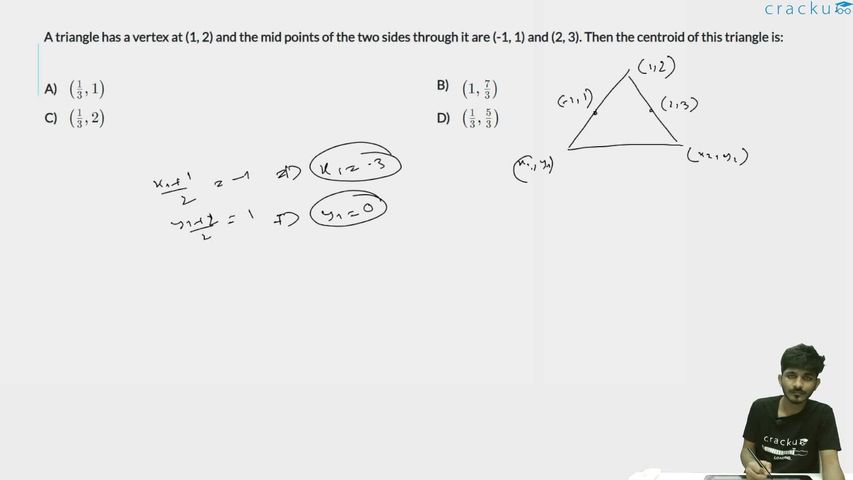
A triangle has a vertex at (1, 2) and the mid points of the two sides through it are (-1, 1) and (2, 3). Then the centroid of this triangle is:
Let us denote the required triangle by $$\triangle ABC$$ and assume, without loss of generality, that $$A(1,\,2)$$ is the given vertex. We are further told that the mid-points of the two sides through this vertex are $$M_1(-1,\,1)$$ and $$M_2(2,\,3).$$ Therefore $$M_1$$ is the mid-point of side $$AB$$ and $$M_2$$ is the mid-point of side $$AC.$$
We now recall the Mid-point Formula: for the segment joining $$(x_1,\,y_1)$$ and $$(x_2,\,y_2),$$ the co-ordinates of the mid-point are $$\left(\dfrac{x_1+x_2}{2},\ \dfrac{y_1+y_2}{2}\right).$$
Applying this formula to $$AB,$$ we write $$M_1(-1,\,1)=\left(\dfrac{1+x_B}{2},\ \dfrac{2+y_B}{2}\right).$$ Equating the individual co-ordinates, we obtain each step explicitly:
For the $$x$$-coordinate $$\dfrac{1+x_B}{2}=-1$$ $$\Longrightarrow\ 1+x_B = -2$$ $$\Longrightarrow\ x_B = -3.$$
For the $$y$$-coordinate $$\dfrac{2+y_B}{2}=1$$ $$\Longrightarrow\ 2+y_B = 2$$ $$\Longrightarrow\ y_B = 0.$$
Hence we have found $$B(-3,\,0).$$
In the same manner, using $$M_2$$ as the mid-point of $$AC,$$ we write $$M_2(2,\,3)=\left(\dfrac{1+x_C}{2},\ \dfrac{2+y_C}{2}\right).$$
Again, matching co-ordinates one by one:
For the $$x$$-coordinate $$\dfrac{1+x_C}{2}=2$$ $$\Longrightarrow\ 1+x_C = 4$$ $$\Longrightarrow\ x_C = 3.$$
For the $$y$$-coordinate $$\dfrac{2+y_C}{2}=3$$ $$\Longrightarrow\ 2+y_C = 6$$ $$\Longrightarrow\ y_C = 4.$$
Thus we have $$C(3,\,4).$$
With all three vertices now known as $$A(1,2),\ B(-3,0),\ C(3,4),$$ we proceed to the centroid. The Centroid Formula states that the centroid $$G(x_G,\,y_G)$$ of the triangle whose vertices are $$(x_A,\,y_A),\ (x_B,\,y_B),\ (x_C,\,y_C)$$ is
$$\bigl(x_G,\,y_G\bigr)=\left(\dfrac{x_A+x_B+x_C}{3},\ \dfrac{y_A+y_B+y_C}{3}\right).$$
Substituting the specific values we have gathered:
$$x_G=\dfrac{1+(-3)+3}{3}=\dfrac{1-3+3}{3}=\dfrac{1}{3},$$
$$y_G=\dfrac{2+0+4}{3}=\dfrac{6}{3}=2.$$
So the centroid is $$\left(\dfrac{1}{3},\,2\right).$$
Hence, the correct answer is Option C.
Was this solution helpful?
Click on the Email ☝️ to Watch the Video Solution
Create a FREE account and get:
_1.webp)

Educational materials for JEE preparation

Ask our AI anything

AI can make mistakes. Please verify important information.
AI can make mistakes. Please verify important information.


