
Join Our JEE Preparation Group
Prep with like-minded aspirants; Get access to free daily tests and study material.
Sign in
Please select an account to continue using cracku.in
↓ →
Join Our JEE Preparation Group
Prep with like-minded aspirants; Get access to free daily tests and study material.
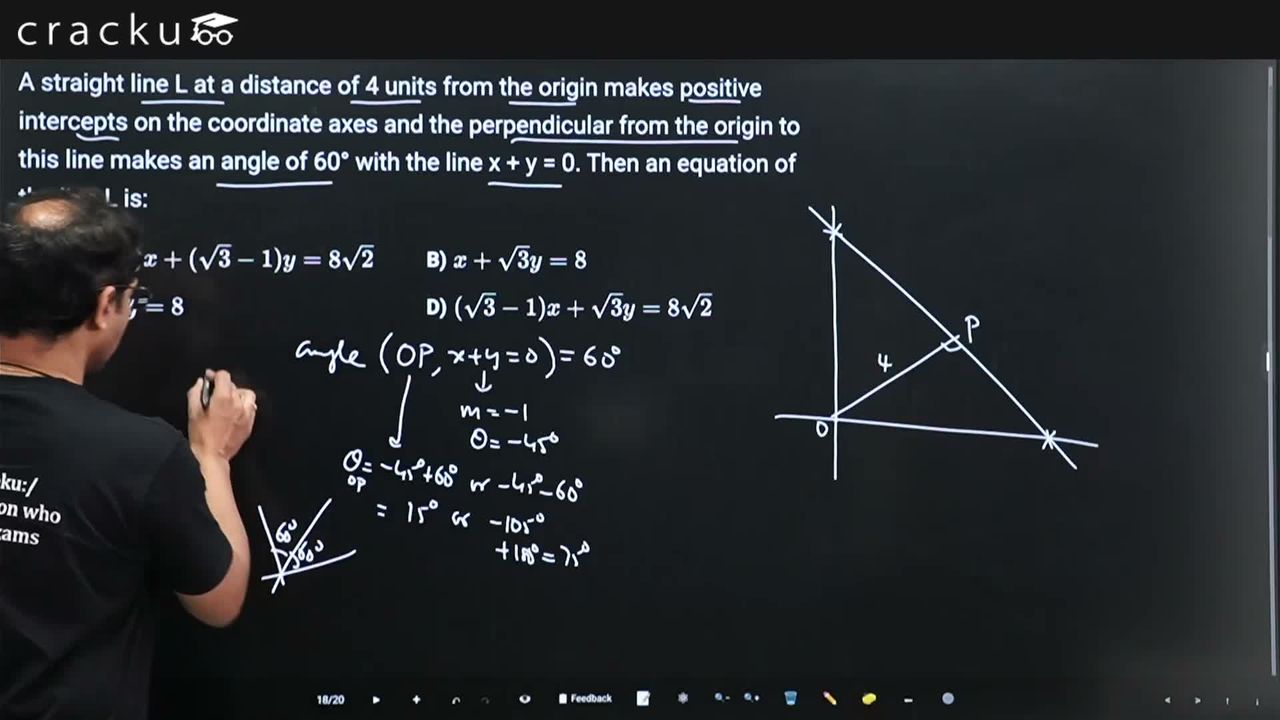
A straight line L at a distance of 4 units from the origin makes positive intercepts on the coordinate axes and the perpendicular from the origin to this line makes an angle of 60° with the line x + y = 0. Then an equation of the line L is:
Let the required line L cut the positive x-axis at $$A(a,0)$$ and the positive y-axis at $$B(0,b)$$, where of course $$a \gt 0$$ and $$b \gt 0$$. In intercept form we therefore write
$$\frac{x}{a}\;+\;\frac{y}{b}=1\qquad \qquad(1)$$
Re-writing (1) in the general form $$Px+Qy+R=0$$ we obtain
$$bx+ay-ab=0\;.\qquad \qquad(2)$$
Formula for distance of a point $$(x_0,y_0)$$ from the line $$Px+Qy+R=0$$ is
$$\text{Distance}=\frac{\left|P\,x_0+Q\,y_0+R\right|}{\sqrt{P^{2}+Q^{2}}}\;.$$
The origin $$(0,0)$$ has to be 4 units away from L, hence using (2)
$$\frac{\left|-ab\right|}{\sqrt{b^{2}+a^{2}}}=4 \;\Longrightarrow\; \frac{ab}{\sqrt{a^{2}+b^{2}}}=4\;.$$
Squaring both sides gives
$$\frac{a^{2}b^{2}}{a^{2}+b^{2}}=16 \;\Longrightarrow\; \frac{1}{a^{2}}+\frac{1}{b^{2}}=\frac{1}{16}\;.\qquad \qquad(3)$$
Next we use the information about the angle. The perpendicular drawn from the origin to L is along the normal vector of L. From (2) that normal vector is $$\mathbf{n}=(b,a)\,.$$
The given line $$x+y=0$$ has direction vector $$\mathbf{v}=(1,-1)$$ (because its normal is $$(1,1)$$). The angle between the vectors $$\mathbf{n}$$ and $$\mathbf{v}$$ is 60°, so by the dot-product formula
$$\cos 60^{\circ}=\frac{|\mathbf{n}\cdot\mathbf{v}|}{|\mathbf{n}|\,|\mathbf{v}|} =\frac{|\,b-a\,|}{\sqrt{a^{2}+b^{2}}\;\sqrt{1^{2}+(-1)^{2}}} =\frac{|\,b-a\,|}{\sqrt{a^{2}+b^{2}}\;\sqrt2}\;.$$
Because $$\cos 60^{\circ}= \dfrac12$$, we have
$$|\,b-a\,|=\frac{\sqrt2}{2}\,\sqrt{a^{2}+b^{2}}\;.$$
Squaring and simplifying every term carefully,
$$\bigl(b-a\bigr)^{2}=\frac12\bigl(a^{2}+b^{2}\bigr) \;\Longrightarrow\; b^{2}-2ab+a^{2}=\frac12a^{2}+\frac12b^{2}$$
$$\Longrightarrow\;2b^{2}-4ab+2a^{2}=a^{2}+b^{2} \;\Longrightarrow\; a^{2}-4ab+b^{2}=0\;.$$
Dividing through by $$a^{2}$$ (which is positive) gives
$$\left(\frac{b}{a}\right)^{2}-4\left(\frac{b}{a}\right)+1=0\;.$$
Let $$k=\dfrac{b}{a}$$. Solving the quadratic $$k^{2}-4k+1=0$$,
$$k=\frac{4\pm\sqrt{16-4}}{2}=\frac{4\pm2\sqrt3}{2}=2\pm\sqrt3\;.$$
Both values are positive, but we shall see that $$k=2+\sqrt3$$ will match the options. So we fix
$$b=k\,a,\quad\text{where }k=2+\sqrt3\;.\qquad \qquad(4)
Now substitute (4) into the distance relation (3):
$$\frac{1}{a^{2}}+\frac{1}{k^{2}a^{2}}=\frac{1}{16} \;\Longrightarrow\; \frac{1+\frac{1}{k^{2}}}{a^{2}}=\frac{1}{16} \;\Longrightarrow\; a^{2}=16\!\left(1+\frac{1}{k^{2}}\right).$$
First compute $$k^{2}=(2+\sqrt{3})^{2}=4+4\sqrt{3}+3=7+4\sqrt{3}\;.$$ Because $$7^{2}-(4\sqrt{3})^{2}=49-48=1,$$ we may rationalise neatly:
$$\frac{1}{k^{2}}=\frac{1}{7+4\sqrt{3}}=\frac{7-4\sqrt{3}}{(7)^{2}-(4\sqrt{3})^{2}}=7-4\sqrt{3}\;.$$
Hence
$$1+\frac{1}{k^{2}}=1+7-4\sqrt{3}=8-4\sqrt{3}\;,$$
so that
$$a^{2}=16\bigl(8-4\sqrt{3}\bigr),\qquad a=4\sqrt{8-4\sqrt{3}}\;.$$
From (4) we also have
$$b=k\,a=(2+\sqrt{3})\cdot 4\sqrt{8-4\sqrt{3}}\;.$$
Go back to the intercept form (1):
$$\frac{x}{a}+\frac{y}{b}=1 \;\Longrightarrow\; bx+ay=ab\;.$$
To obtain simpler numerical coefficients we multiply the whole equation by $$\lambda=\sqrt{3}-1$$. Observe that
$$\lambda\,b=(\sqrt{3}-1)b =(\sqrt{3}-1)(2+\sqrt{3})a =(\sqrt{3}+1)a$$
because $$(\sqrt{3}-1)(2+\sqrt{3})=\sqrt{3}+1.$$
Therefore
$$(\sqrt{3}+1)x+(\sqrt{3}-1)y=(\sqrt{3}+1)a\;.$$
It only remains to show that $$(\sqrt{3}+1)a=8\sqrt{2}.$$ Indeed, using $$a=4\sqrt{8-4\sqrt{3}},$$
$$(\sqrt{3}+1)a =(\sqrt{3}+1)\cdot 4\sqrt{8-4\sqrt{3}}.$$
Square both sides to verify it equals $$(8\sqrt{2})^{2}=128.$$ Left-hand side squared is
$$16\,(\sqrt{3}+1)^{2}\,(8-4\sqrt{3}) =16\,(4+2\sqrt{3})\,(8-4\sqrt{3})$$
$$=16\cdot 2(2+\sqrt{3})\cdot 4(2-\sqrt{3}) =16\cdot 8\,(2+\sqrt{3})(2-\sqrt{3}) =128\,(4-3)=128.$$
Since the squares match, the quantities themselves match in magnitude, and both sides are positive, so indeed
$$(\sqrt{3}+1)a = 8\sqrt{2}.$$
Thus the equation of L is
$$(\sqrt{3}+1)\,x + (\sqrt{3}-1)\,y = 8\sqrt{2}.$$
This coincides exactly with Option A.
Hence, the correct answer is Option A.
Was this solution helpful?
Click on the Email ☝️ to Watch the Video Solution
Create a FREE account and get:
_1.webp)

Educational materials for JEE preparation

Ask our AI anything

AI can make mistakes. Please verify important information.
AI can make mistakes. Please verify important information.


