
Join Our JEE Preparation Group
Prep with like-minded aspirants; Get access to free daily tests and study material.
Sign in
Please select an account to continue using cracku.in
↓ →
Join Our JEE Preparation Group
Prep with like-minded aspirants; Get access to free daily tests and study material.
A circle touching the x-axis at (3, 0) and making an intercept of length 8 on the y-axis passes through the point:
We are looking for the equation of a circle which satisfies two geometrical conditions and then checking which given point lies on that circle.
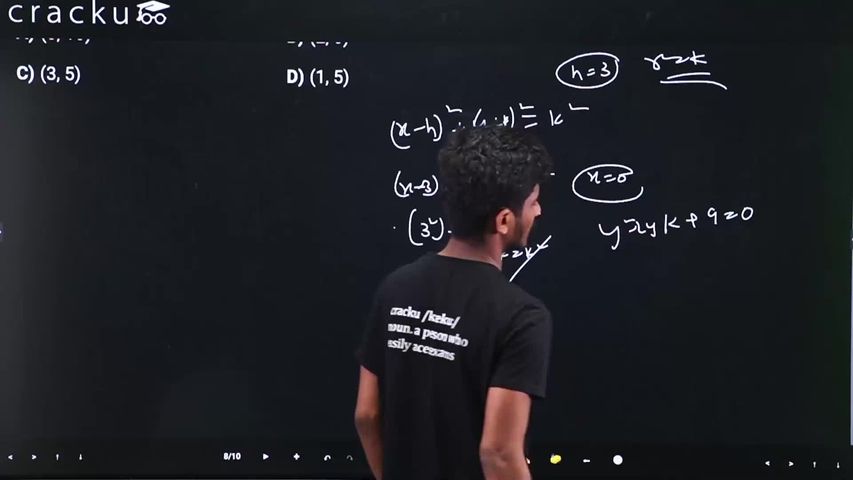
First, we are told that the circle touches the x-axis at the point $$(3,0)$$. When a circle touches a line, the point of contact is perpendicular to the radius drawn to that point. Hence, the centre of the circle must lie vertically above (or below) the touching point, at a distance equal to the radius. So, if we denote the centre by $$(h,k)$$ and the radius by $$r$$, touching the x-axis at $$(3,0)$$ immediately gives
$$h = 3 \quad\text{and}\quad k = r.$$
Thus the centre is $$(3,r)$$ and the preliminary equation of the circle may be written as
$$(x-3)^2 + (y-r)^2 = r^2.$$
Secondly, the circle is said to “make an intercept of length 8 on the y-axis.’’ The y-axis is the line $$x = 0$$. So we substitute $$x = 0$$ into the equation of the circle to find the y-coordinates where the circle meets the y-axis.
Substituting $$x = 0$$:
$$(0-3)^2 + (y-r)^2 = r^2.$$
This simplifies to
$$9 + (y-r)^2 = r^2.$$
Rearranging gives
$$(y-r)^2 = r^2 - 9.$$
We now find the two y-intersection points:
$$y - r = \pm\sqrt{\,r^2 - 9\,} \quad\Longrightarrow\quad y = r \pm \sqrt{\,r^2 - 9\,}.$$
The length of the intercept on the y-axis is the distance between these two points:
$$\bigl(r + \sqrt{r^2 - 9}\bigr) - \bigl(r - \sqrt{r^2 - 9}\bigr) = 2\sqrt{r^2 - 9}.$$
We are told that this length equals 8, so
$$2\sqrt{r^2 - 9} = 8.$$
Dividing by 2, we get
$$\sqrt{r^2 - 9} = 4.$$
Squaring both sides leads to
$$r^2 - 9 = 16,$$
and therefore
$$r^2 = 25 \quad\Longrightarrow\quad r = 5.$$
Since $$k = r,$$ we also have $$k = 5.$$ Thus the centre of the circle is $$(3,5)$$ and the full equation of the circle becomes
$$(x-3)^2 + (y-5)^2 = 25.$$
Now we check each option to see which point satisfies this equation.
Option A: $$(3,10).$$ Substituting $$x = 3,\; y = 10$$ gives $$(3-3)^2 + (10-5)^2 = 0^2 + 5^2 = 25,$$ which equals the right-hand side, so this point lies on the circle.
Option B: $$(2,3).$$ Substituting gives $$(2-3)^2 + (3-5)^2 = (-1)^2 + (-2)^2 = 1 + 4 = 5 \neq 25,$$ so this point is not on the circle.
Option C: $$(3,5).$$ Substituting gives $$(3-3)^2 + (5-5)^2 = 0 + 0 = 0 \neq 25,$$ so this point is not on the circle.
Option D: $$(1,5).$$ Substituting gives $$(1-3)^2 + (5-5)^2 = (-2)^2 + 0 = 4 \neq 25,$$ so this point is not on the circle.
Only Option A satisfies the circle’s equation. Hence, the correct answer is Option A.
Was this solution helpful?
Click on the Email ☝️ to Watch the Video Solution
Create a FREE account and get:
_1.webp)

Educational materials for JEE preparation

Ask our AI anything

AI can make mistakes. Please verify important information.
AI can make mistakes. Please verify important information.


