
Join Our JEE Preparation Group
Prep with like-minded aspirants; Get access to free daily tests and study material.
Sign in
Please select an account to continue using cracku.in
↓ →
Join Our JEE Preparation Group
Prep with like-minded aspirants; Get access to free daily tests and study material.
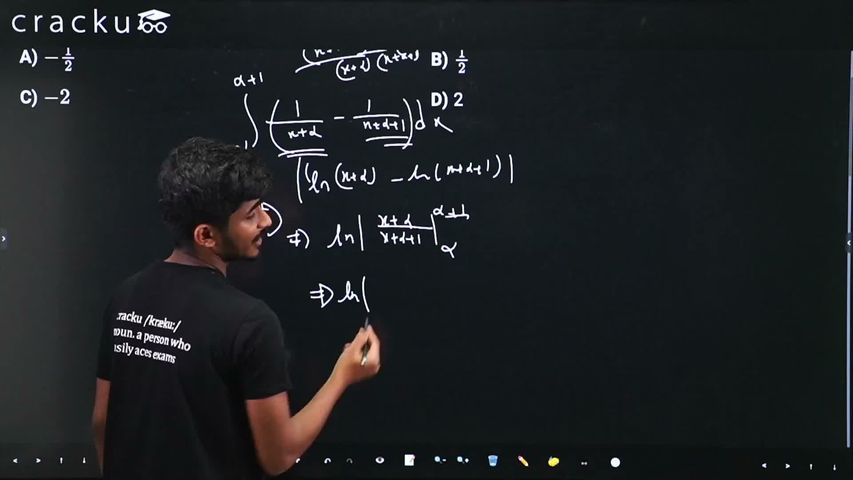
A value of $$\alpha$$ such that $$\int_\alpha^{\alpha+1} \frac{dx}{(x + \alpha)(x + \alpha + 1)} = \log_e\left(\frac{9}{8}\right)$$ is
We start with the given condition
$$\int_\alpha^{\alpha+1}\frac{dx}{(x+\alpha)(x+\alpha+1)}=\log_e\!\left(\frac{9}{8}\right).$$
To simplify the integrand, we put $$t=x+\alpha.$$
Then when $$x=\alpha$$ we have $$t=\alpha+\alpha=2\alpha,$$ and when $$x=\alpha+1$$ we get $$t=(\alpha+1)+\alpha=2\alpha+1.$$
With this substitution $$dx=dt,$$ so the integral becomes
$$\int_{2\alpha}^{2\alpha+1}\frac{dt}{t(t+1)}.$$
Next we decompose the integrand using partial fractions. The standard identity
$$\frac{1}{t(t+1)}=\frac{1}{t}-\frac{1}{t+1}$$
allows us to write
$$\int_{2\alpha}^{2\alpha+1}\left(\frac{1}{t}-\frac{1}{t+1}\right)dt.$$
Integrating term by term and recalling that $$\displaystyle\int\frac{dt}{t}=\ln|t|,$$ we obtain
$$\bigl[\ln|t|-\ln|t+1|\bigr]_{\,2\alpha}^{\,2\alpha+1}.$$
Applying the limits gives
$$\Bigl(\ln(2\alpha+1)-\ln(2\alpha+2)\Bigr)-\Bigl(\ln(2\alpha)-\ln(2\alpha+1)\Bigr).$$
Collecting like terms,
$$2\ln(2\alpha+1)-\ln(2\alpha)-\ln(2\alpha+2).$$
This must equal the given logarithm, so
$$2\ln(2\alpha+1)-\ln(2\alpha)-\ln(2\alpha+2)=\ln\!\left(\frac{9}{8}\right).$$
Using the property $$\ln a-\ln b=\ln\!\left(\frac{a}{b}\right)$$ twice, we combine the left-hand side into a single logarithm:
$$\ln\!\left(\frac{(2\alpha+1)^2}{2\alpha(2\alpha+2)}\right)=\ln\!\left(\frac{9}{8}\right).$$
Exponentiating both sides removes the logarithms:
$$\frac{(2\alpha+1)^2}{2\alpha(2\alpha+2)}=\frac{9}{8}.$$
Simplifying the denominator $$2\alpha(2\alpha+2)=4\alpha(\alpha+1),$$ we have
$$\frac{(2\alpha+1)^2}{4\alpha(\alpha+1)}=\frac{9}{8}.$$
Cross-multiplying gives
$$8(2\alpha+1)^2=9\cdot4\alpha(\alpha+1).$$
Dividing both sides by 4,
$$2(2\alpha+1)^2=9\alpha(\alpha+1).$$
Expanding the square $$\bigl(2\alpha+1\bigr)^2=4\alpha^2+4\alpha+1,$$ we get
$$2(4\alpha^2+4\alpha+1)=9\alpha^2+9\alpha.$$
This simplifies to
$$8\alpha^2+8\alpha+2=9\alpha^2+9\alpha.$$
Bringing all terms to one side,
$$0=9\alpha^2+9\alpha-(8\alpha^2+8\alpha+2)=\alpha^2+\alpha-2.$$
We now solve the quadratic $$\alpha^2+\alpha-2=0.$$
The quadratic formula $$\alpha=\frac{-b\pm\sqrt{b^2-4ac}}{2a}$$ with $$a=1,\;b=1,\;c=-2$$ gives
$$\alpha=\frac{-1\pm\sqrt{1^2-4(1)(-2)}}{2}=\frac{-1\pm\sqrt{9}}{2}=\frac{-1\pm3}{2}.$$
Thus $$\alpha_1=\frac{-1+3}{2}=1,\qquad \alpha_2=\frac{-1-3}{2}=-2.$$
Both values keep the integrand finite over the interval, but only $$\alpha=-2$$ appears among the four offered choices.
Hence, the correct answer is Option C.
Was this solution helpful?
Click on the Email ☝️ to Watch the Video Solution
Create a FREE account and get:
_1.webp)

Educational materials for JEE preparation

Ask our AI anything

AI can make mistakes. Please verify important information.
AI can make mistakes. Please verify important information.


