
Join Our JEE Preparation Group
Prep with like-minded aspirants; Get access to free daily tests and study material.
Sign in
Please select an account to continue using cracku.in
↓ →
Join Our JEE Preparation Group
Prep with like-minded aspirants; Get access to free daily tests and study material.
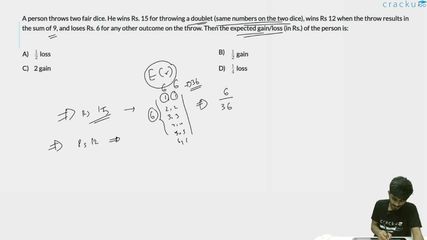
A person throws two fair dice. He wins Rs. 15 for throwing a doublet (same numbers on the two dice), wins Rs 12 when the throw results in the sum of 9, and loses Rs. 6 for any other outcome on the throw. Then the expected gain/loss (in Rs.) of the person is:
We have two fair dice, each die showing one of the numbers 1 to 6 with equal probability. Because the dice are independent, the total number of equally likely ordered outcomes is $$6 \times 6 = 36.$$
First we identify the three mutually exclusive cases mentioned in the question and count how many outcomes belong to each case.
Case 1 - Doublet (both dice show the same number)
The possible doublets are $$(1,1),(2,2),(3,3),(4,4),(5,5),(6,6).$$
So, the number of favourable outcomes is $$6.$$
Case 2 - Sum equals 9
We list all ordered pairs giving a total of 9:
$$(3,6),\;(4,5),\;(5,4),\;(6,3).$$
Hence, the number of favourable outcomes is $$4.$$
(Notice that none of these are doublets, so there is no overlap with Case 1.)
Case 3 - Any other outcome
The remaining outcomes are $$36-6-4 = 26.$$
Next we assign the monetary result to each case:
• Doublet → gain of Rs. 15
• Sum 9 → gain of Rs. 12
• Any other outcome → loss of Rs. 6
The expectation (expected gain) is calculated using the formula for the expected value of a discrete random variable: $$E = \sum (\text{gain or loss}) \times (\text{probability of that outcome}).$$
We now compute the probabilities and the corresponding contributions one by one.
Probability of a doublet $$P(\text{doublet}) = \dfrac{6}{36} = \dfrac16.$$ Contribution to expectation $$\dfrac16 \times 15 = \dfrac{15}{6} = 2.5.$$
Probability of sum 9 $$P(\text{sum }9) = \dfrac{4}{36} = \dfrac19.$$ Contribution to expectation $$\dfrac19 \times 12 = \dfrac{12}{9} = \dfrac43 \approx 1.333\ldots$$
Probability of any other outcome $$P(\text{other}) = \dfrac{26}{36} = \dfrac{13}{18}.$$ Contribution to expectation $$\dfrac{13}{18} \times (-6) = -\dfrac{78}{18} = -\dfrac{13}{3} \approx -4.333\ldots$$
Now we add all three contributions to obtain the overall expected gain:
$$E = 2.5 + \dfrac43 - \dfrac{13}{3}.$$ We first convert every term to a common denominator of 6: $$2.5 = \dfrac{15}{6},\qquad \dfrac43 = \dfrac{8}{6},\qquad -\dfrac{13}{3} = -\dfrac{26}{6}.$$ So, $$E = \dfrac{15}{6} + \dfrac{8}{6} - \dfrac{26}{6} = \dfrac{15 + 8 - 26}{6} = \dfrac{-3}{6} = -\dfrac12.$$
The expectation is $$-\dfrac12,$$ i.e., an average loss of Rs. 0.50 per throw.
Hence, the correct answer is Option A.
Was this solution helpful?
Click on the Email ☝️ to Watch the Video Solution
Create a FREE account and get:
_1.webp)

Educational materials for JEE preparation

Ask our AI anything

AI can make mistakes. Please verify important information.
AI can make mistakes. Please verify important information.


