
Join Our JEE Preparation Group
Prep with like-minded aspirants; Get access to free daily tests and study material.
Sign in
Please select an account to continue using cracku.in
↓ →
Join Our JEE Preparation Group
Prep with like-minded aspirants; Get access to free daily tests and study material.
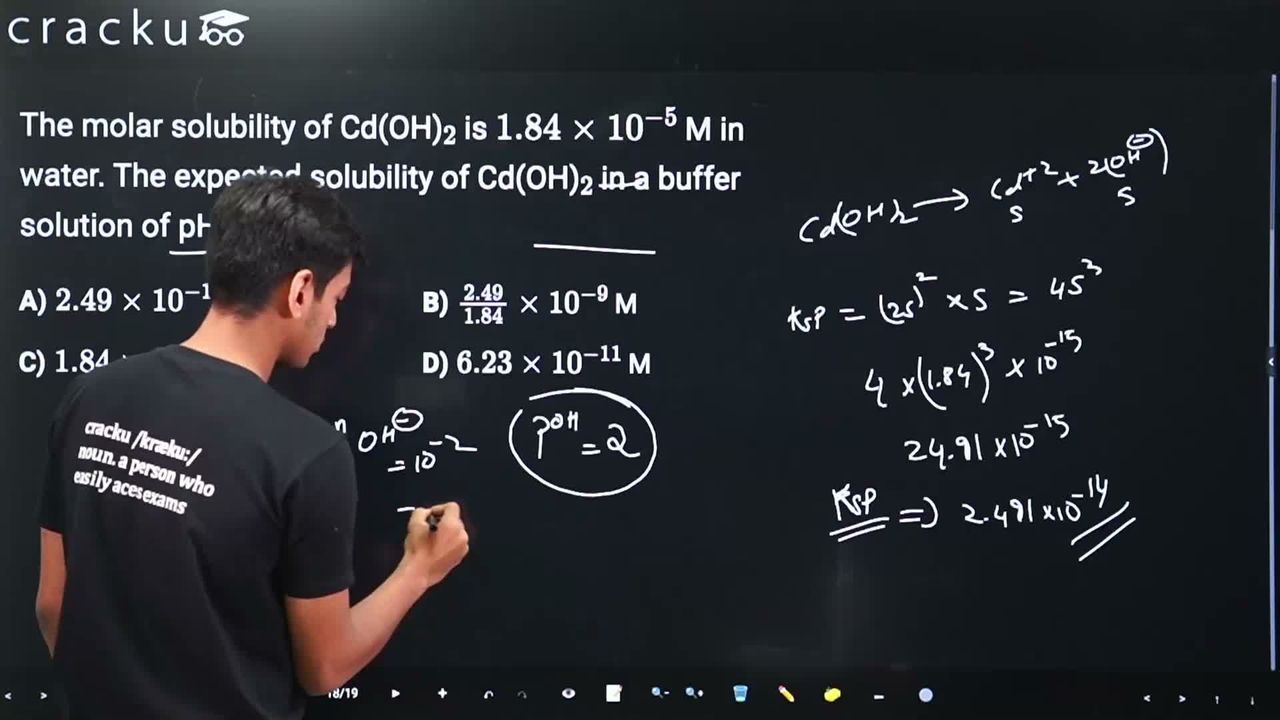
The molar solubility of Cd(OH)$$_2$$ is $$1.84 \times 10^{-5}$$ M in water. The expected solubility of Cd(OH)$$_2$$ in a buffer solution of pH = 12 is:
First, we recall the definition of the solubility‐product constant. For the sparingly soluble salt $$\text{Cd(OH)}_2$$ the dissociation equilibrium in water is
$$\text{Cd(OH)}_2(s) \; \rightleftharpoons \; \text{Cd}^{2+}(aq) + 2\,\text{OH}^{-}(aq)$$
The solubility‐product expression is therefore
$$K_{\text{sp}} \;=\;[\text{Cd}^{2+}]\, [\text{OH}^{-}]^{2}.$$
We are told that the molar solubility in pure water is $$s = 1.84 \times 10^{-5}\ \text{M}.$$ Hence, in pure water we have
$$[\text{Cd}^{2+}] = s = 1.84 \times 10^{-5}\ \text{M},$$
and, because two hydroxide ions are produced per formula unit dissolved,
$$[\text{OH}^{-}] = 2s = 2(1.84 \times 10^{-5}) = 3.68 \times 10^{-5}\ \text{M}.$$
Substituting these concentrations into the expression for $$K_{\text{sp}},$$ we get
$$\begin{aligned} K_{\text{sp}} &= (1.84 \times 10^{-5})\,[\,3.68 \times 10^{-5}\,]^2 \\[4pt] &= (1.84 \times 10^{-5})\,(3.68^2 \times 10^{-10}) \\[4pt] &= (1.84 \times 10^{-5})\,(13.5424 \times 10^{-10}) \\[4pt] &= 24.901 \times 10^{-15} \\[4pt] &= 2.49 \times 10^{-14}. \end{aligned}$$
So, the solubility product constant is
$$K_{\text{sp}} = 2.49 \times 10^{-14}.$$
Now we place the salt in a buffer in which the pH is given as $$12.$$ We convert this to hydroxide‐ion concentration:
$$\text{pOH} = 14 - \text{pH} = 14 - 12 = 2,$$
so
$$[\text{OH}^{-}]_{\text{buffer}} = 10^{-\text{pOH}} = 10^{-2}\ \text{M} = 0.01\ \text{M}.$$
Let the new molar solubility of $$\text{Cd(OH)}_2$$ in this basic medium be $$s' \ (\text{M}).$$ When a small amount dissolves, we obtain
$$[\text{Cd}^{2+}] = s'$$
and, in principle,
$$[\text{OH}^{-}] = 0.01 + 2s'.$$
Because $$0.01\ \text{M}$$ is overwhelmingly larger than $$2s'$$ (the solubility will turn out to be many orders of magnitude smaller), we approximate
$$[\text{OH}^{-}] \approx 0.01\ \text{M}.$$
We again use the solubility‐product expression, this time with the buffered hydroxide concentration:
$$K_{\text{sp}} = [\text{Cd}^{2+}]\,[\text{OH}^{-}]^{2} = s'\,(0.01)^{2}.$$
Substituting the value of $$K_{\text{sp}}$$ we already calculated, we have
$$2.49 \times 10^{-14} = s' \,(0.01)^2 = s' \times 10^{-4}.$$
Solving for $$s'$$ gives
$$\begin{aligned} s' &= \frac{2.49 \times 10^{-14}}{10^{-4}} \\[4pt] &= 2.49 \times 10^{-10}\ \text{M}. \end{aligned}$$
This is the expected molar solubility of $$\text{Cd(OH)}_2$$ in a buffer of pH = 12.
Hence, the correct answer is Option A.
Was this solution helpful?
Click on the Email ☝️ to Watch the Video Solution
Create a FREE account and get:
_1.webp)

Educational materials for JEE preparation

Ask our AI anything

AI can make mistakes. Please verify important information.
AI can make mistakes. Please verify important information.


