
Join Our JEE Preparation Group
Prep with like-minded aspirants; Get access to free daily tests and study material.
Sign in
Please select an account to continue using cracku.in
↓ →
Join Our JEE Preparation Group
Prep with like-minded aspirants; Get access to free daily tests and study material.
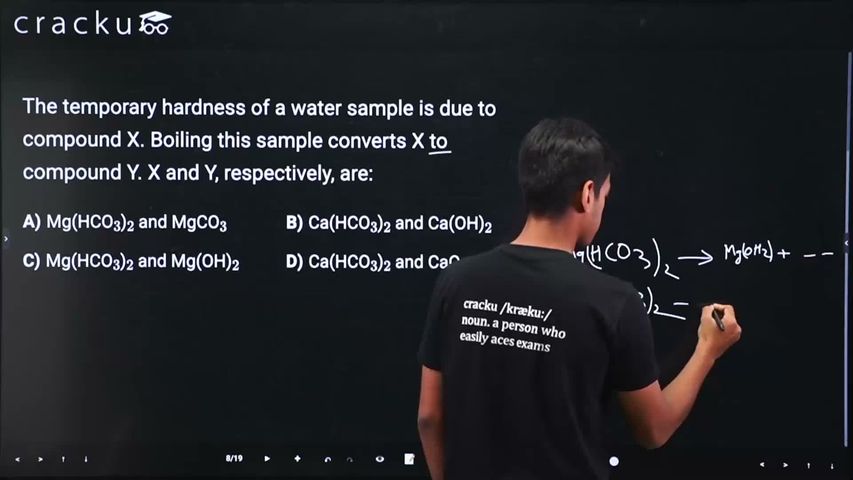
The temporary hardness of a water sample is due to compound X. Boiling this sample converts X to compound Y. X and Y, respectively, are:
We begin by recalling that the temporary hardness of natural water is produced exclusively by the presence of soluble bicarbonates of calcium and magnesium. In symbols, the offending ions are $$\mathrm{Ca^{2+},\ Mg^{2+}}$$ present as their bicarbonate salts $$\mathrm{Ca(HCO_3)_2}$$ and $$\mathrm{Mg(HCO_3)_2}$$.
When such a water sample is boiled, these bicarbonates decompose. The standard thermal‐decomposition equations are:
$$\mathrm{Ca(HCO_3)_2 \ \overset{\Delta}{\rightarrow}\ CaCO_3\downarrow\ +\ H_2O\ +\ CO_2\uparrow}$$
$$\mathrm{Mg(HCO_3)_2 \ \overset{\Delta}{\rightarrow}\ Mg(OH)_2\downarrow\ +\ 2\,CO_2\uparrow}$$
In each reaction the product on the right is an insoluble solid (indicated by the ↓ symbol). Because the solid precipitates out of the water, the hardness originally produced by the bicarbonate (compound X) is removed. The insoluble solid formed on boiling is the new compound Y.
From the magnesium equation we see clearly that:
$$\text{X} = \mathrm{Mg(HCO_3)_2}, \qquad \text{Y} = \mathrm{Mg(OH)_2}$$
Now we compare this pair (X, Y) with the options given:
A. $$\mathrm{Mg(HCO_3)_2 \; and \; MgCO_3}$$ - Y is incorrect (should be Mg(OH)$$_2$$).
B. $$\mathrm{Ca(HCO_3)_2 \; and \; Ca(OH)_2}$$ - both X and Y are incorrect for the magnesium case.
C. $$\mathrm{Mg(HCO_3)_2 \; and \; Mg(OH)_2}$$ - exactly matches the equations above.
D. $$\mathrm{Ca(HCO_3)_2 \; and \; CaO}$$ - Y is incorrect (should be CaCO$$_3$$).
The only option reproducing the correct decomposition product is Option C.
Hence, the correct answer is Option C.
Was this solution helpful?
Click on the Email ☝️ to Watch the Video Solution
Create a FREE account and get:
_1.webp)

Educational materials for JEE preparation

Ask our AI anything

AI can make mistakes. Please verify important information.
AI can make mistakes. Please verify important information.


