
Join Our JEE Preparation Group
Prep with like-minded aspirants; Get access to free daily tests and study material.
Sign in
Please select an account to continue using cracku.in
↓ →
Join Our JEE Preparation Group
Prep with like-minded aspirants; Get access to free daily tests and study material.
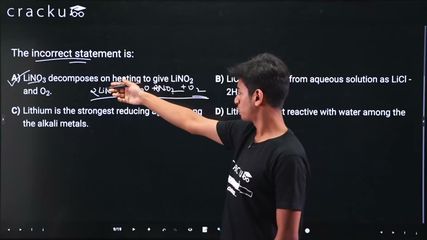
We begin by recalling the thermal decomposition pattern of alkali-metal nitrates. For all Group-1 nitrates except lithium, the general reaction on heating is
$$MNO_3 \;\xrightarrow{\;\Delta\;}\; MNO_2 + \dfrac12\,O_2,$$
where $$M$$ represents Na, K, Rb or Cs. However, lithium behaves anomalously and follows the behaviour of Group-2 nitrates; its nitrate decomposes to the oxide, nitrogen dioxide and oxygen:
$$4\,LiNO_3 \;\xrightarrow{\;\Delta\;}\; 2\,Li_2O + 4\,NO_2 + O_2.$$
Thus the statement “$$LiNO_3$$ decomposes on heating to give $$LiNO_2$$ and $$O_2$$” is false because $$LiNO_2$$ is not formed at all.
Now let us examine the remaining options one by one.
For option B, lithium chloride does crystallise from aqueous solution as the dihydrate. The hydration reaction is
$$LiCl\;+\;2\,H_2O \;\longrightarrow\; LiCl\!\cdot\!2H_2O,$$
so the statement is correct.
For option C, the reducing power of an alkali metal in aqueous medium is governed by its hydration enthalpy as well as its ionisation energy. Because $$Li^+$$ is the smallest cation, its hydration enthalpy is the most negative, and therefore metallic lithium possesses the highest (most negative) standard reduction potential, $$E^\circ = -3.04\,V.$$ Hence lithium is indeed the strongest reducing agent in the group. The statement is correct.
For option D, reactivity with water increases steadily down the alkali-metal group. Lithium reacts gently, sodium reacts vigorously, potassium reacts violently, and rubidium and caesium react explosively. Therefore lithium is indeed the least reactive with water. The statement is correct.
We have found that the only false statement is option A. Hence, the correct answer is Option A.
Was this solution helpful?
Click on the Email ☝️ to Watch the Video Solution
Create a FREE account and get:
_1.webp)

Educational materials for JEE preparation

Ask our AI anything

AI can make mistakes. Please verify important information.
AI can make mistakes. Please verify important information.


