
Join Our JEE Preparation Group
Prep with like-minded aspirants; Get access to free daily tests and study material.
Sign in
Please select an account to continue using cracku.in
↓ →
Join Our JEE Preparation Group
Prep with like-minded aspirants; Get access to free daily tests and study material.
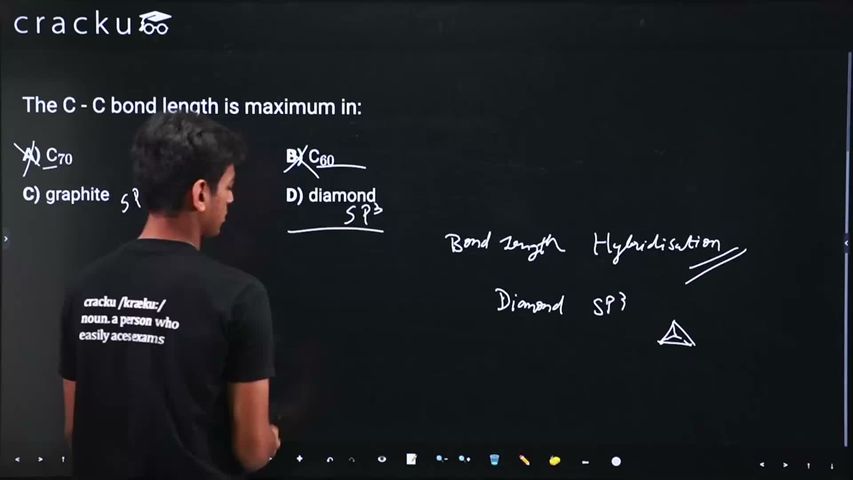
We begin by recalling that the length of a C-C bond depends mainly on the type of hybridisation of the carbon atoms involved. The empirical rule is:
$$\text{Greater }\;s\text{-character} \;\Longrightarrow\; \text{shorter bond length}.$$
This rule comes from the basic idea that orbitals with more $$s$$-character are closer to the nucleus, so the bonded electrons are held more tightly, pulling the two nuclei closer together. Let us put this in mathematical form:
$$\text{Bond length} \propto \dfrac{1}{\%\,s\text{-character}}.$$
Now we list the hybridisations and the corresponding $$s$$-character for the carbon-carbon frameworks present in each option:
• In diamond, every carbon is $$sp^3$$ hybridised. From the definition of hybridisation
$$sp^3:\; 1\,s + 3\,p \;\Longrightarrow\; 4\text{ orbitals},$$
the percentage $$s$$-character is
$$\%s = \dfrac{1}{4}\times 100 = 25\%.$$
• In graphite, each carbon is $$sp^2$$ hybridised, so
$$sp^2:\; 1\,s + 2\,p \;\Longrightarrow\; 3\text{ orbitals},$$
hence
$$\%s = \dfrac{1}{3}\times 100 \approx 33.3\%.$$
• In fullerenes C$$_{60}$$ and C$$_{70}$$, the carbon framework is also largely $$sp^2$$ hybridised (with a small curvature‐induced deviation), giving them approximately the same $$s$$-character as graphite, i.e.
$$\%s \approx 33.3\%.$$
Because the bond length varies inversely with the $$s$$-character, we now compare the values:
• Diamond ⇒ $$25\%$$ $$s$$-character ⇒ longest C-C bond.
• Graphite/C$$_{60}$$/C$$_{70}$$ ⇒ $$33.3\%$$ $$s$$-character ⇒ shorter C-C bonds.
Indeed, experimentally measured bond lengths verify this prediction:
$$ \begin{aligned} \text{Diamond}& : \; 1.54 \text{ \AA}\\[4pt] \text{Fullerenes}& : \; 1.46 \text{ \AA (single)} \;\text{and}\; 1.40 \text{ \AA (double)}\\[4pt] \text{Graphite}& : \; 1.42 \text{ \AA} \end{aligned} $$
We see clearly that $$1.54 \text{ \AA}$$ in diamond is the greatest among all the listed structures. Therefore, the C-C bond length is maximum in diamond.
Hence, the correct answer is Option D.
Was this solution helpful?
Click on the Email ☝️ to Watch the Video Solution
Create a FREE account and get:
_1.webp)

Educational materials for JEE preparation

Ask our AI anything

AI can make mistakes. Please verify important information.
AI can make mistakes. Please verify important information.


