
Join Our JEE Preparation Group
Prep with like-minded aspirants; Get access to free daily tests and study material.
Sign in
Please select an account to continue using cracku.in
↓ →
Join Our JEE Preparation Group
Prep with like-minded aspirants; Get access to free daily tests and study material.
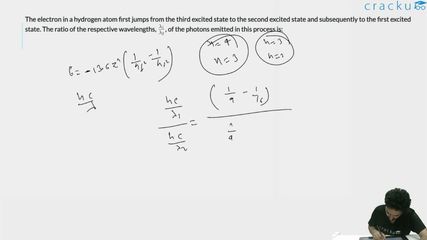
The electron in a hydrogen atom first jumps from the third excited state to the second excited state and subsequently to the first excited state. The ratio of the respective wavelengths, $$\frac{\lambda_1}{\lambda_2}$$, of the photons emitted in this process is:
For a hydrogen atom the stationary‐state energy levels are given by the Bohr formula $$E_n=-\dfrac{13.6\ \text{eV}}{n^{2}},$$ where $$n=1,2,3,\ldots$$ is the principal quantum number.
The electron is stated to start from the third excited state. Counting from the ground state $$n=1$$, we have:
Ground state : $$n=1$$
First excited state : $$n=2$$
Second excited state : $$n=3$$
Third excited state : $$n=4$$
Thus the sequence of transitions is $$n=4 \to n=3$$ followed by $$n=3 \to n=2$$.
The energy released as a photon when the electron falls from a higher level $$n_2$$ to a lower level $$n_1$$ is obtained from the difference of the two level energies:
$$\Delta E = E_{n_1}-E_{n_2}= -\dfrac{13.6}{n_1^{2}} - \Bigl(-\dfrac{13.6}{n_2^{2}}\Bigr)=13.6\Bigl(\dfrac{1}{n_1^{2}}-\dfrac{1}{n_2^{2}}\Bigr)\ \text{eV}.$$
For the first photon of wavelength $$\lambda_1$$ corresponding to $$n=4 \to n=3$$ we have
$$\Delta E_1 = 13.6\Bigl(\dfrac{1}{3^{2}}-\dfrac{1}{4^{2}}\Bigr).$$
We simplify term by term:
$$\dfrac{1}{3^{2}}=\dfrac{1}{9},\quad \dfrac{1}{4^{2}}=\dfrac{1}{16}.$$
So
$$\Delta E_1 = 13.6\Bigl(\dfrac{1}{9}-\dfrac{1}{16}\Bigr)=13.6\Bigl(\dfrac{16-9}{144}\Bigr)=13.6\times\dfrac{7}{144}\ \text{eV}.$$
For the second photon of wavelength $$\lambda_2$$ corresponding to $$n=3 \to n=2$$ we write
$$\Delta E_2 = 13.6\Bigl(\dfrac{1}{2^{2}}-\dfrac{1}{3^{2}}\Bigr).$$
Calculating the fractions:
$$\dfrac{1}{2^{2}}=\dfrac{1}{4},\quad \dfrac{1}{3^{2}}=\dfrac{1}{9}.$$
Hence
$$\Delta E_2 = 13.6\Bigl(\dfrac{1}{4}-\dfrac{1}{9}\Bigr)=13.6\Bigl(\dfrac{9-4}{36}\Bigr)=13.6\times\dfrac{5}{36}\ \text{eV}.$$
The energy of a photon and its wavelength are connected by the Planck relation $$E=\dfrac{hc}{\lambda}.$$ Therefore for two photons, $$\lambda\propto\dfrac{1}{E}$$, and the ratio of wavelengths is the inverse ratio of the corresponding energy differences:
$$\dfrac{\lambda_1}{\lambda_2}=\dfrac{\Delta E_2}{\Delta E_1}.$$
Substituting the expressions we have just obtained:
$$\dfrac{\lambda_1}{\lambda_2}=\dfrac{13.6\times\dfrac{5}{36}}{13.6\times\dfrac{7}{144}}.$$
The common factor $$13.6$$ cancels out, giving
$$\dfrac{\lambda_1}{\lambda_2}=\dfrac{\dfrac{5}{36}}{\dfrac{7}{144}}.$$
Dividing one fraction by another is equivalent to multiplying by its reciprocal, so
$$\dfrac{\lambda_1}{\lambda_2}=\dfrac{5}{36}\times\dfrac{144}{7}.$$
We simplify step by step. First, reduce $$144/36$$:
$$\dfrac{144}{36}=4.$$
Hence
$$\dfrac{\lambda_1}{\lambda_2}=5\times\dfrac{4}{7}=\dfrac{20}{7}.$$
Thus the required ratio of wavelengths is $$\dfrac{20}{7}.$$
Hence, the correct answer is Option B.
Was this solution helpful?
Click on the Email ☝️ to Watch the Video Solution
Create a FREE account and get:
_1.webp)

Educational materials for JEE preparation

Ask our AI anything

AI can make mistakes. Please verify important information.
AI can make mistakes. Please verify important information.


