
Join Our JEE Preparation Group
Prep with like-minded aspirants; Get access to free daily tests and study material.
Sign in
Please select an account to continue using cracku.in
↓ →
Join Our JEE Preparation Group
Prep with like-minded aspirants; Get access to free daily tests and study material.
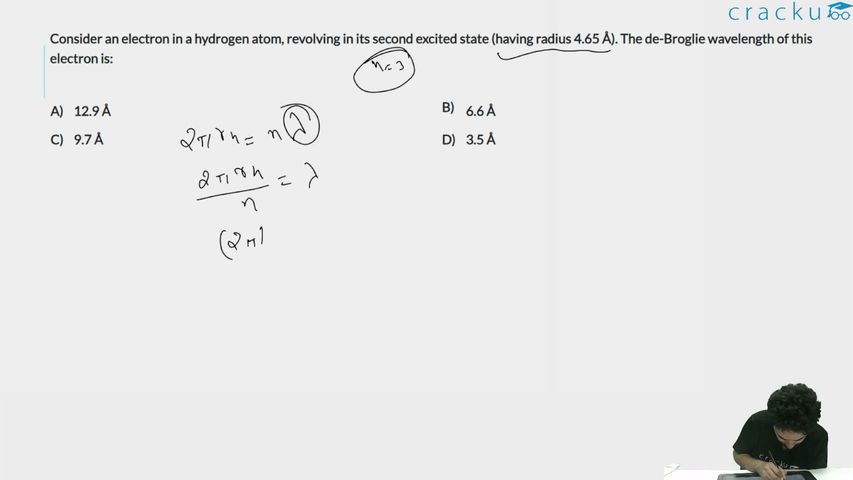
Consider an electron in a hydrogen atom, revolving in its second excited state (having radius 4.65 Å). The de-Broglie wavelength of this electron is:
We are told that an electron in a hydrogen atom is revolving in its second excited state and that the radius of this orbit is $$4.65\;\text{\AA}$$. In the language of the Bohr model, the ground state corresponds to the principal quantum number $$n = 1$$, the first excited state to $$n = 2$$, and therefore the second excited state corresponds to $$n = 3$$. We shall soon verify that this value of $$n$$ is indeed compatible with the given radius.
First, we recall the Bohr‐radius formula for the radius of the $$n^{\text{th}}$$ orbit of hydrogen:
$$r_n = n^2 a_0,$$
where $$a_0 = 0.529\;\text{\AA}$$ is the Bohr radius. Substituting the given radius $$r_n = 4.65\;\text{\AA}$$ and solving for $$n$$ gives
$$n^2 = \frac{r_n}{a_0} = \frac{4.65\;\text{\AA}}{0.529\;\text{\AA}}.$$
We simplify the numerical fraction:
$$\frac{4.65}{0.529} = 8.79,$$
so
$$n^2 = 8.79 \quad\Longrightarrow\quad n = \sqrt{8.79}\approx 2.97.$$
This value rounds essentially to $$n = 3$$, confirming that the electron is indeed in the second excited state as stated.
Now we need the de Broglie wavelength of the electron in this orbit. The Bohr model imposes the standing‐wave condition on the de Broglie matter wave of the electron. The condition is
$$2\pi r_n = n\lambda,$$
where $$\lambda$$ is the de Broglie wavelength of the electron. This relation says that an integral number $$n$$ of wavelengths must fit exactly along the circumference $$2\pi r_n$$ of the circular orbit. We solve this equation for $$\lambda$$:
$$\lambda = \frac{2\pi r_n}{n}.$$
Substituting $$r_n = 4.65\;\text{\AA}$$ and $$n = 3$$ gives
$$\lambda = \frac{2\pi \times 4.65\;\text{\AA}}{3}.$$
We now carry out the multiplication in the numerator:
$$2\pi \times 4.65 = 2 \times 3.1416 \times 4.65 = 6.2832 \times 4.65 = 29.23088.$$
Hence the wavelength becomes
$$\lambda = \frac{29.23088\;\text{\AA}}{3}.$$
Dividing by $$3$$ yields
$$\lambda = 9.7436\;\text{\AA}.$$
Rounding to two significant figures (matching the precision of the data given), we obtain
$$\lambda \approx 9.7\;\text{\AA}.$$
Looking at the options, $$9.7\;\text{\AA}$$ corresponds to Option C.
Hence, the correct answer is Option C.
Was this solution helpful?
Click on the Email ☝️ to Watch the Video Solution
Create a FREE account and get:
_1.webp)

Educational materials for JEE preparation

Ask our AI anything

AI can make mistakes. Please verify important information.
AI can make mistakes. Please verify important information.


