
Join Our JEE Preparation Group
Prep with like-minded aspirants; Get access to free daily tests and study material.
Sign in
Please select an account to continue using cracku.in
↓ →
Join Our JEE Preparation Group
Prep with like-minded aspirants; Get access to free daily tests and study material.
Which one of the following is likely to give a precipitate with AgNO$$_3$$ solution?
We first recall the standard qualitative test: when an alkyl (or benzyl/allyl) halide is treated with ethanolic silver nitrate, the halide ion $$X^-$$ that departs from the molecule combines with the silver ion $$Ag^+$$ to form a curdy white precipitate of silver halide $$AgX$$.
This observation is explained by the nucleophilic substitution mechanism. The rate of substitution for chlorides follows the order
$$\text{tert-alkyl chloride} > \text{sec-alkyl chloride} > \text{prim-alkyl chloride} \gg \text{vinyl or aryl chloride}.$$
Now we analyse each option one by one.
Option A : $$CH_2 = CH{-}Cl$$ (vinyl chloride)
The chlorine atom here is directly attached to an $$sp^2$$ hybridised carbon of a C=C double bond. Such $$C{-}Cl$$ bonds are very strong and do not undergo the usual $$S_N1$$ or $$S_N2$$ processes in ethanolic $$AgNO_3$$. Hence no chloride ion is liberated, so no $$AgCl$$ precipitate forms.
Option B : $$(CH_3)_3CCl$$ (tert-butyl chloride)
This chloride is tertiary. In ethanolic medium the $$C{-}Cl$$ bond ionises readily to give the stable tert-butyl carbocation $$\,(CH_3)_3C^+\,$$ and the chloride ion $$Cl^-$$:
$$ (CH_3)_3CCl \;\longrightarrow\; (CH_3)_3C^+ + Cl^- $$
The released $$Cl^-$$ immediately reacts with silver ion to give an insoluble precipitate:
$$ Ag^+ + Cl^- \;\longrightarrow\; AgCl\downarrow $$
So a white precipitate appears quickly.
Option C : $$CCl_4$$ (carbon tetrachloride)
Although $$CCl_4$$ contains four chlorine atoms, the central carbon has no empty orbital for coordination and the molecule is quite resistant to ionisation in protic solvents. Therefore $$Cl^-$$ is not produced and no precipitate is observed.
Option D : $$CHCl_3$$ (chloroform)
Chloroform is also rather inert toward substitution under these conditions; the $$C{-}Cl$$ bonds are not cleaved by ethanolic $$AgNO_3$$, so again no $$Cl^-$$ is released.
Among the four compounds, only the tertiary chloride $$(CH_3)_3CCl$$ readily furnishes chloride ions that can precipitate silver as $$AgCl$$.
Hence, the correct answer is Option 2.
Was this solution helpful?
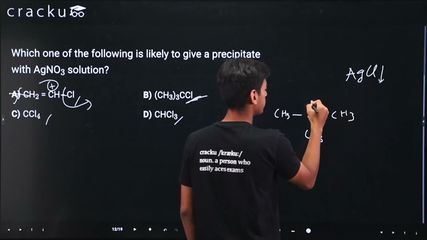
Click on the Email ☝️ to Watch the Video Solution
Create a FREE account and get:
_1.webp)

Educational materials for JEE preparation

Ask our AI anything

AI can make mistakes. Please verify important information.
AI can make mistakes. Please verify important information.


