
Join Our JEE Preparation Group
Prep with like-minded aspirants; Get access to free daily tests and study material.
Sign in
Please select an account to continue using cracku.in
↓ →
Join Our JEE Preparation Group
Prep with like-minded aspirants; Get access to free daily tests and study material.
A smooth wire of length $$2\pi r$$ is bent into a circle and kept in a vertical plane. A bead can slide smoothly on the wire. When the circle is rotating with angular speed $$\omega$$ about the vertical diameter AB, as shown in figure, the bead is at rest with respect to the circular ring at position P as shown. Then the value of $$\omega^2$$ is equal to:
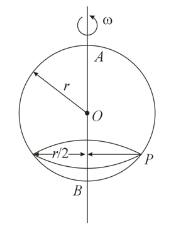
Let the centre of the ring be $$O$$ and let the bead be at the position $$P$$ shown in the figure. The vertical diameter about which the ring is made to rotate is $$AB$$, so the axis of rotation passes through $$A,\;O,\;B$$ and is vertical. Draw the radius $$OP$$. In the figure supplied with the question the radius $$OP$$ makes an angle of $$150^{\circ}$$ with the upward vertical direction $$OA$$ (equivalently, it makes an angle of $$30^{\circ}$$ below the horizontal diameter through $$O$$). We denote this angle by $$\theta$$, so
$$\theta = 150^{\circ},\qquad\cos\theta = \cos150^{\circ}= -\dfrac{\sqrt3}{2},\qquad \sin\theta = \sin150^{\circ}= \dfrac12.$$
The bead is to remain at rest with respect to the ring, so we analyse forces in the non-inertial frame that co-rotates with the ring. In that rotating frame three forces act on the bead:
(i) its weight $$\; \vec W = m\vec g $$ acting vertically downward,
(ii) the normal reaction $$\;\vec N$$ of the wire, directed radially, i.e. along $$\;OP$$ towards the centre,
(iii) the centrifugal (pseudo) force $$\;\vec F_c = m\omega^{2}\,s\,\hat e_s$$, where $$s$$ is the perpendicular distance of the bead from the axis of rotation (the line $$AB$$) and $$\hat e_s$$ is the horizontal unit vector directed away from the axis.
Because the ring is a circle of radius $$r$$ lying in its own plane, the coordinates of the point $$P$$ may be written as $$P\;(x,y) = (r\sin\theta,\; r\cos\theta).$$ Hence the distance of $$P$$ from the axis (the vertical line $$AB$$, which is the $$y$$-axis in this plane) is
$$s = |x| = r\sin\theta.$$
Therefore the magnitude of the centrifugal force is $$F_c = m\omega^{2}s = m\omega^{2} r \sin\theta,$$ and its direction is horizontally outward, i.e. along the positive $$x$$-direction.
For the bead not to slide along the wire, the component of the total force along the tangent to the circle at $$P$$ must vanish. (A non-zero tangential component would give the bead a tangential acceleration relative to the ring.) The tangent to the circle at $$P$$ is perpendicular to the radius $$OP$$. A convenient non-unit vector along the tangent is
$$\vec T = ( \cos\theta,\; -\sin\theta ).$$
Resolving each force along this tangent:
• Component of weight along $$\vec T$$ $$\vec W\!\cdot\!\vec T = (0,\,-mg)\!\cdot\!(\cos\theta,\,-\sin\theta) = mg\sin\theta.$$
• Component of centrifugal force along $$\vec T$$ $$\vec F_c\!\cdot\!\vec T = (m\omega^{2}r\sin\theta,\,0)\!\cdot\!(\cos\theta,\,-\sin\theta)= m\omega^{2}r\sin\theta\cos\theta.$$
• The normal reaction $$\vec N$$ is radial; it is therefore perpendicular to the tangent, so $$\vec N\!\cdot\!\vec T = 0.$$
The condition for no motion of the bead relative to the ring is that the algebraic sum of the tangential components vanish:
$$mg\sin\theta + m\omega^{2}r\sin\theta\cos\theta = 0.$$
Factorising $$m\sin\theta$$ ($$\neq 0$$ at $$P$$), we get
$$g + \omega^{2}r\cos\theta = 0.$$
Solving for $$\omega^{2}$$ gives the basic equilibrium condition
$$\omega^{2} = -\dfrac{g}{r\cos\theta}.$$
The minus sign disappears once we recognise that in the present situation $$\cos\theta$$ is negative (because $$P$$ lies below the centre), so we may write
$$\omega^{2} = \dfrac{g}{r(-\cos\theta)}.$$
Now substitute the value of $$\theta = 150^{\circ}$$ read from the figure:
$$-\cos\theta = -\left(-\dfrac{\sqrt{3}}{2}\right) = \dfrac{\sqrt{3}}{2}.$$
Hence
$$\omega^{2} = \dfrac{g}{r\bigl(\dfrac{\sqrt{3}}{2}\bigr)} = \dfrac{2g}{r\sqrt{3}}.$$
This expression exactly matches Option C in the given list.
Hence, the correct answer is Option C.
Was this solution helpful?
Create a FREE account and get:
_1.webp)

Educational materials for JEE preparation

Ask our AI anything

AI can make mistakes. Please verify important information.
AI can make mistakes. Please verify important information.


