
Join Our JEE Preparation Group
Prep with like-minded aspirants; Get access to free daily tests and study material.
Sign in
Please select an account to continue using cracku.in
↓ →
Join Our JEE Preparation Group
Prep with like-minded aspirants; Get access to free daily tests and study material.
We start by recalling the basic characteristics of colloidal systems. A colloid consists of particles whose diameters lie between about $$1\ \text{nm}$$ and $$1000\ \text{nm}$$; they are therefore much larger than ordinary molecules or ions, yet still small enough to remain dispersed in a medium without settling rapidly.
Let us examine each of the four statements given in the question one by one.
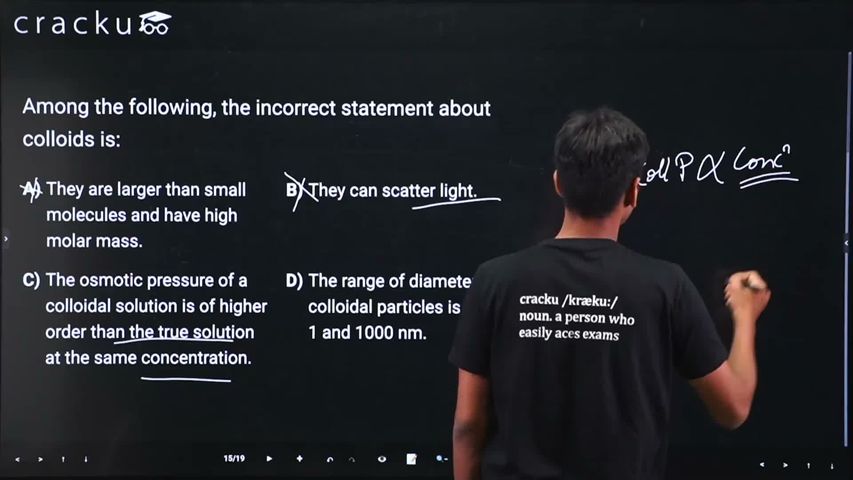
Option A : “They are larger than small molecules and have high molar mass.” Because a single colloidal particle is an aggregate of many small molecules or ions, its molar mass is indeed very large compared with that of ordinary molecules. Thus Option A is a correct statement.
Option B : “They can scatter light.” This is the well-known Tyndall effect: when a beam of light passes through a colloidal dispersion, the light is scattered by the relatively large dispersed particles, making the path of the beam visible. Hence Option B is also correct.
Option D : “The range of diameters of colloidal particles is between 1 and 1000 nm.” This size range is the accepted textbook definition of the colloidal state. Therefore Option D is also correct.
Option C : “The osmotic pressure of a colloidal solution is of higher order than the true solution at the same concentration.” To test this, we recall the van’t Hoff equation for dilute solutions:
$$\pi \;=\; c\,R\,T$$
where $$\pi$$ is the osmotic pressure, $$c$$ is the molar concentration of the solute particles, $$R$$ is the gas constant and $$T$$ is the absolute temperature. For the same mass concentration (say, $$\text{g L}^{-1}$$) a colloidal solute has an enormously larger molar mass $$M$$, so its molar concentration $$c$$ is much smaller:
$$c \;=\; \dfrac{\text{mass concentration}}{M}$$
Because $$c$$ is smaller, the product $$cRT$$, and therefore $$\pi$$, is correspondingly smaller. So, at an identical mass concentration, the osmotic pressure of a colloidal solution is actually lower than that of a true (molecular) solution. Hence the claim that it is “of higher order” is incorrect.
Only Option C contradicts the accepted properties of colloids.
Hence, the correct answer is Option C.
Was this solution helpful?
Click on the Email ☝️ to Watch the Video Solution
Create a FREE account and get:
_1.webp)

Educational materials for JEE preparation

Ask our AI anything

AI can make mistakes. Please verify important information.
AI can make mistakes. Please verify important information.


