
Join Our JEE Preparation Group
Prep with like-minded aspirants; Get access to free daily tests and study material.
Sign in
Please select an account to continue using cracku.in
↓ →
Join Our JEE Preparation Group
Prep with like-minded aspirants; Get access to free daily tests and study material.
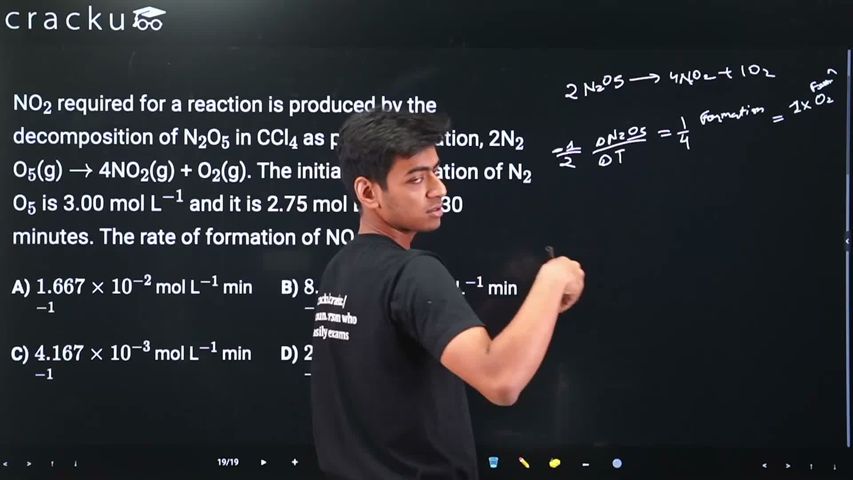
NO$$_2$$ required for a reaction is produced by the decomposition of N$$_2$$O$$_5$$ in CCl$$_4$$ as per the equation, 2N$$_2$$O$$_5$$(g) $$\to$$ 4NO$$_2$$(g) + O$$_2$$(g). The initial concentration of N$$_2$$O$$_5$$ is 3.00 mol L$$^{-1}$$ and it is 2.75 mol L$$^{-1}$$ after 30 minutes. The rate of formation of NO$$_2$$ is:
We have the balanced chemical equation
$$2\,\text{N}_2\text{O}_5(g) \;\longrightarrow\; 4\,\text{NO}_2(g) \;+\; \text{O}_2(g).$$
For any reaction written as $$aA \;\longrightarrow\; bB,$$ the rate is defined by the general relation
$$\text{Rate} \;=\; -\dfrac{1}{a}\,\dfrac{\Delta[A]}{\Delta t} \;=\; \dfrac{1}{b}\,\dfrac{\Delta[B]}{\Delta t}.$$
Here, the stoichiometric coefficients are $$a = 2$$ for $$\text{N}_2\text{O}_5$$ and $$b = 4$$ for $$\text{NO}_2.$$
The initial concentration of $$\text{N}_2\text{O}_5$$ is given as $$[\text{N}_2\text{O}_5]_0 = 3.00\ \text{mol L}^{-1}.$$ After a time interval of $$\Delta t = 30\ \text{min},$$ its concentration becomes $$[\text{N}_2\text{O}_5]_t = 2.75\ \text{mol L}^{-1}.$$
So, the change in concentration of $$\text{N}_2\text{O}_5$$ is
$$\Delta[\text{N}_2\text{O}_5] \;=\; [\text{N}_2\text{O}_5]_t - [\text{N}_2\text{O}_5]_0 \;=\; 2.75 - 3.00 \;=\; -0.25\ \text{mol L}^{-1}.$$
The negative sign simply shows a decrease; for the rate we use its magnitude:
$$|\Delta[\text{N}_2\text{O}_5]| = 0.25\ \text{mol L}^{-1}.$$
Using the definition of rate for the disappearance of $$\text{N}_2\text{O}_5,$$ we write
$$\text{Rate}_{\text{disappearance of } \text{N}_2\text{O}_5} = -\dfrac{1}{2}\,\dfrac{\Delta[\text{N}_2\text{O}_5]}{\Delta t}.$$
Substituting the numerical values,
$$\text{Rate}_{\text{disappearance of } \text{N}_2\text{O}_5} = -\dfrac{1}{2}\,\dfrac{-0.25\ \text{mol L}^{-1}}{30\ \text{min}} = \dfrac{0.25}{2 \times 30}\ \text{mol L}^{-1}\text{min}^{-1} = \dfrac{0.25}{60}\ \text{mol L}^{-1}\text{min}^{-1} = 0.004167\ \text{mol L}^{-1}\text{min}^{-1}.$$
Now we relate this rate to the rate of formation of $$\text{NO}_2.$$ From the stoichiometry, every $$2$$ moles of $$\text{N}_2\text{O}_5$$ that decompose give $$4$$ moles of $$\text{NO}_2.$$ Therefore,
$$\dfrac{1}{4}\,\dfrac{\Delta[\text{NO}_2]}{\Delta t} = -\dfrac{1}{2}\,\dfrac{\Delta[\text{N}_2\text{O}_5]}{\Delta t}.$$
So,
$$\dfrac{\Delta[\text{NO}_2]}{\Delta t} = 2\;\Bigl(-\dfrac{\Delta[\text{N}_2\text{O}_5]}{\Delta t}\Bigr).$$
The factor $$2$$ arises because $$4/2 = 2.$$ Hence, the rate of formation of $$\text{NO}_2$$ is twice the rate of disappearance of $$\text{N}_2\text{O}_5.$$ Substituting,
$$\text{Rate}_{\text{formation of } \text{NO}_2} = 2 \times 0.004167\ \text{mol L}^{-1}\text{min}^{-1} = 0.008334\ \text{mol L}^{-1}\text{min}^{-1} \times 2 = 0.01667\ \text{mol L}^{-1}\text{min}^{-1}.$$
Expressing in scientific notation,
$$\text{Rate}_{\text{formation of } \text{NO}_2} = 1.667 \times 10^{-2}\ \text{mol L}^{-1}\text{min}^{-1}.$$
This numerical value corresponds to Option A.
Hence, the correct answer is Option A.
Was this solution helpful?
Click on the Email ☝️ to Watch the Video Solution
Create a FREE account and get:
_1.webp)

Educational materials for JEE preparation

Ask our AI anything

AI can make mistakes. Please verify important information.
AI can make mistakes. Please verify important information.


