
Join Our JEE Preparation Group
Prep with like-minded aspirants; Get access to free daily tests and study material.
Sign in
Please select an account to continue using cracku.in
↓ →
Join Our JEE Preparation Group
Prep with like-minded aspirants; Get access to free daily tests and study material.
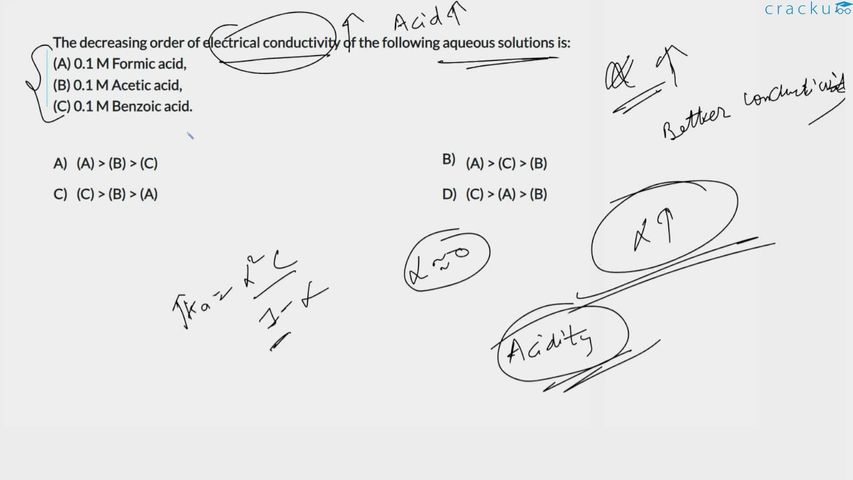
The decreasing order of electrical conductivity of the following aqueous solutions is:
(A) 0.1 M Formic acid,
(B) 0.1 M Acetic acid,
(C) 0.1 M Benzoic acid.
Electrical conductivity in aqueous solutions of weak acids depends entirely on the concentration of mobile ions produced. At identical concentrations ($$0.1 \text{ M}$$), a stronger acid dissociates more completely, releasing more ions into the solution and exhibiting a higher electrical conductivity. Therefore, the conductivity order perfectly follows the acid dissociation constant ($$K_a$$) order.
Formic Acid (A): $$\text{HCOOH}$$
Formic acid has no electron-donating alkyl groups attached to the carboxyl group. It has the highest dissociation constant ($$K_a \approx 1.8 \times 10^{-4}$$) among the three, making it the strongest electrolyte and the most conductive solution.
Benzoic Acid (C): $$\text{C}_6\text{H}_5\text{COOH}$$
The phenyl ring behaves as a weaker electron-donating group via resonance/inductive pathways compared to a normal aliphatic chain when considering overall carboxylic acid strength ($$K_a \approx 6.3 \times 10^{-5}$$). It is weaker than formic acid but significantly stronger than acetic acid.
Acetic Acid (B): $$\text{CH}_3\text{COOH}$$
The methyl group ($$\text{--CH}_3$$) exerts a strong electron-donating inductive effect (+I), which destabilizes the carboxylate anion conjugate base. It has the lowest dissociation constant ($$K_a \approx 1.75 \times 10^{-5}$$), making it the weakest acid and the least conductive solution.
Comparing the ion concentrations produced at equilibrium gives the decreasing order of electrical conductivity as:
$$\mathbf{(A) > (C) > (B)}$$
Answer: Option B — (A) > (C) > (B)
Was this solution helpful?
Click on the Email ☝️ to Watch the Video Solution
Create a FREE account and get:
_1.webp)

Educational materials for JEE preparation

Ask our AI anything

AI can make mistakes. Please verify important information.
AI can make mistakes. Please verify important information.


