
Join Our JEE Preparation Group
Prep with like-minded aspirants; Get access to free daily tests and study material.
Sign in
Please select an account to continue using cracku.in
↓ →
Join Our JEE Preparation Group
Prep with like-minded aspirants; Get access to free daily tests and study material.
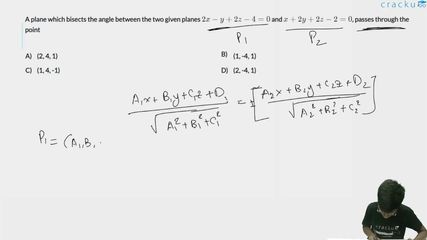
A plane which bisects the angle between the two given planes $$2x - y + 2z - 4 = 0$$ and $$x + 2y + 2z - 2 = 0$$, passes through the point
We have two given planes
$$\Pi_1:\;2x-y+2z-4=0$$
$$\Pi_2:\;x+2y+2z-2=0$$
To find the planes which bisect the angle between them, we use the standard formula:
For planes $$A_1x+B_1y+C_1z+D_1=0$$ and $$A_2x+B_2y+C_2z+D_2=0$$, every angle-bisector plane is given by
$$\frac{A_1x+B_1y+C_1z+D_1}{\sqrt{A_1^{2}+B_1^{2}+C_1^{2}}}= \pm\frac{A_2x+B_2y+C_2z+D_2}{\sqrt{A_2^{2}+B_2^{2}+C_2^{2}}}.$$
First we calculate the magnitudes of the normals of the two planes.
For $$\Pi_1$$ the normal vector is $$(2,-1,2)$$, whose length is
$$\sqrt{2^{2}+(-1)^{2}+2^{2}}=\sqrt{4+1+4}= \sqrt 9 = 3.$$
For $$\Pi_2$$ the normal vector is $$(1,2,2)$$, whose length is
$$\sqrt{1^{2}+2^{2}+2^{2}}=\sqrt{1+4+4}= \sqrt 9 = 3.$$
Because both magnitudes are the same, the factor $$\sqrt{A_1^{2}+B_1^{2}+C_1^{2}}$$ equals the factor $$\sqrt{A_2^{2}+B_2^{2}+C_2^{2}}$$, so the common denominator 3 cancels out. Hence the bisector condition simplifies to a direct equality (with the two possible signs):
$$2x-y+2z-4=\;\pm\;(x+2y+2z-2).$$
We consider the two choices of the sign separately.
Taking the positive sign
$$2x-y+2z-4 = x+2y+2z-2.$$
Subtract the right‐hand side from the left‐hand side term by term:
$$2x-y+2z-4 -x-2y-2z+2 = 0.$$
Combine like terms:
$$x -3y +0z -2 = 0,$$
so one bisector plane is
$$x-3y-2=0\qquad\text{or}\qquad x-3y=2. \quad -(1)$$
Taking the negative sign
$$2x-y+2z-4 = -(x+2y+2z-2).$$
This gives
$$2x-y+2z-4 = -x-2y-2z+2.$$
Bring all terms to the left side:
$$2x-y+2z-4 +x+2y+2z-2 = 0.$$
Combine like terms:
$$(2x+x) + (-y+2y) + (2z+2z) + (-4-2) = 0,$$
$$3x + y + 4z - 6 = 0,$$
so the other bisector plane is
$$3x+y+4z-6=0. \quad -(2)$$
Thus the two angle-bisecting planes are (1) and (2).
Now we test each option to see which point satisfies at least one of these equations.
Option A: $$(2,4,1)$$
Substitute into (1): $$2-3(4)-2 = 2-12-2 = -12 \neq 0.$$
Substitute into (2): $$3(2)+4+4(1)-6 = 6+4+4-6 = 8 \neq 0.$$
So (2,4,1) is on neither bisector.
Option B: $$(1,-4,1)$$
(1): $$1-3(-4)-2 = 1+12-2 = 11 \neq 0.$$
(2): $$3(1)+(-4)+4(1)-6 = 3-4+4-6 = -3 \neq 0.$$
So (1,-4,1) is on neither bisector.
Option C: $$(1,4,-1)$$
(1): $$1-3(4)-2 = 1-12-2 = -13 \neq 0.$$
(2): $$3(1)+4+4(-1)-6 = 3+4-4-6 = -3 \neq 0.$$
So (1,4,-1) is on neither bisector.
Option D: $$(2,-4,1)$$
(1): $$2-3(-4)-2 = 2+12-2 = 12 \neq 0.$$
(2): $$3(2)+(-4)+4(1)-6 = 6-4+4-6 = 0.$$
This point satisfies equation (2) exactly, so it lies on one of the angle-bisector planes.
Therefore the only point through which a plane bisecting the angle between the two given planes passes is $$(2,-4,1).$$
Hence, the correct answer is Option 4.
Was this solution helpful?
Click on the Email ☝️ to Watch the Video Solution
Create a FREE account and get:
_1.webp)

Educational materials for JEE preparation

Ask our AI anything

AI can make mistakes. Please verify important information.
AI can make mistakes. Please verify important information.


